Overview
| Field | Details |
|---|---|
| Ride Dates | April 2–11, 2026 |
| Duration | 10 days / 9 nights |
| Start / End Point | Kathmandu (full loop) |
| Total Distance | ~1,100 km |
| Daily Riding Time | Approx. 5–7 hours/day on riding days |
| Riding Style | Adventure / Extreme Off-road |
| Difficulty | ★★★★★ — Very Challenging |
| Max Altitude | Lo Manthang: 3,840m | Mui La Pass: ~4,170m |
| Overall Rating | ★★★★★ |
Upper Mustang was closed to the outside world until 1992. The Kingdom of Lo — with its walled capital of Lo Manthang founded in 1380 AD, its living king, its 15th-century monasteries and its landscape of red cliffs, ancient sky caves and high-desert plateau — remained sealed from foreign eyes while the rest of Nepal opened to trekkers and riders. What emerged when the doors opened was a place that had preserved Tibetan Buddhist culture with an integrity that even Tibet itself no longer possessed. The Ride to Lo Manthang is the longest and most demanding tour in the Nepal Moto Tours programme. It is also the most culturally extraordinary motorcycle journey in Asia.
The Route
Day-by-Day Breakdown
| Day | Date | Segment | Accommodation |
|---|---|---|---|
| Day 1 | Apr 2 | Kathmandu → Pokhara (Prithvi Highway) | Hotel City Inn, Pokhara |
| Day 2 | Apr 3 | Pokhara → Tatopani (via Beni, Kali Gandaki gorge) | Local Guesthouse, Tatopani |
| Day 3 | Apr 4 | Tatopani → Kagbeni (via Marpha, Jomsom) | Hotel Jomsom Pride (or Kagbeni guesthouse) |
| Day 4 | Apr 5 | Kagbeni → Ghami (restricted zone entry, Chele, Samar) | Guesthouse, Ghami |
| Day 5 | Apr 6 | Ghami → Lo Manthang (Dhakmar, Mui La, Tsarang) | Mandala Hotel, Lo Manthang |
| Day 6 | Apr 7 | Exploration Day — Lo Manthang & Chhoser cave excursion | Mandala Hotel, Lo Manthang |
| Day 7 | Apr 8 | Exploration Day — Lo Manthang & surrounding villages | Mandala Hotel, Lo Manthang |
| Day 8 | Apr 9 | Lo Manthang → Marpha (return via Tsarang, Ghami, Kagbeni) | Marpha Palace |
| Day 9 | Apr 10 | Marpha → Pokhara (via Jomsom, Tatopani, Beni) | Hotel City Inn, Pokhara |
| Day 10 | Apr 11 | Pokhara → Kathmandu (Prithvi Highway) | Kathmandu Suite Homes |
Day 1 — Kathmandu to Pokhara (~200 km | ~6 hrs)
Departure from Kathmandu on the Prithvi Highway. Leave early to clear Kathmandu and Naubise before the trucks wake up. The highway follows the Trisuli River for much of its length — green hills, terraced fields, the river jade-green below. Mugling junction for dal bhat; Pokhara by early afternoon. Rest well. The serious riding starts tomorrow and it does not relent for several days.
Day 2 — Pokhara to Tatopani via Beni (~120 km | ~5 hrs)
The day the ride changes character. Pokhara to Beni is comfortable tarmac via the Modi Khola valley. At Beni the pavement ends and the Kali Gandaki gorge takes over. Fill the fuel tank at Beni without exception — it is the last reliable station before Jomsom. From Beni, the road becomes the geological event you came for: a rocky, cliff-hugging track carved along the gorge wall above one of the world’s great rivers. Waterfalls cross the road directly. The canyon walls close to vertical in the narrow sections between Ghasa and Tatopani. Arrive at Tatopani’s hot springs by late afternoon and spend the evening in the sulphur pools watching the gorge go dark. It is one of Nepal’s great simple pleasures.
Day 3 — Tatopani to Kagbeni via Marpha and Jomsom (~90 km | ~5 hrs)
The day the Mustang plateau begins to reveal itself. The road climbs from Tatopani’s 1,200m through Ghasa, past Rupse Waterfall near Lete, through Kalopani where Dhaulagiri and Nilgiri fill the sky, and into the increasingly arid upper valley. Marpha — the apple capital of Nepal — is a mandatory stop: the white-walled stone alleys, the April blossom on the orchards, the Samteling Monastery above the village and the apple pie at the bakeries. Allow forty minutes. Jomsom is another 7 km: fill the fuel tank completely here and draw cash from the ATM. This is the last fuel and the last cash machine before Lo Manthang.
Kagbeni is 12 km north of Jomsom — and it is the gateway to everything that follows. The ochre-walled monastery on the bluff, the Kali Gandaki running fast and cold below, the medieval flagstone alleys and the checkpoint north of town where the Restricted Area Permit system begins. Walk the village in the afternoon. Stand at the edge of town and look north: the valley narrows, the rock formations begin, and the Tibetan plateau is visible ahead. Check in. Tomorrow you enter the forbidden kingdom.
Day 4 — Kagbeni to Ghami via Chele and Samar (~55 km | ~5–6 hrs)
Carry all permits. Present them at the Kagbeni checkpoint north of town. The restricted zone begins here.
From Kagbeni the road crosses the Kali Gandaki and heads north through Tangbe — a village of white-washed stone walls and flat roofs that announces the Tibetan character of everything ahead. The track enters the canyon system above Chhusang and begins to climb. This is where Upper Mustang reveals its geological personality: the Kali Gandaki has cut through the Himalayan uplift to expose 40,000 years of desert stratigraphy in the cliff faces. Red, ochre, brown, grey and white bands of compressed sediment tower above the track. Every corner opens a different canyon. Every descent reveals another village that looks untouched by any century after the 15th.
The road climbs to the Taklam La pass (3,600m) and then Dajori La (3,650m) with views of the Annapurna massif building behind you as you gain altitude. Between Samar and Syangboche, a short detour leads to Chungsi Cave — an ancient Buddhist meditation cave carved into the cliff face above the valley. The caretaker monk may be present; enter quietly and respectfully. Below Syangboche, the valley of Ghami opens into a wide agricultural basin — barley fields and buckwheat in April, the long mani wall visible from the track above. Overnight in Ghami.
Day 5 — Ghami to Lo Manthang via Dhakmar, Mui La Pass and Tsarang (~55 km | ~5–6 hrs)
The day you arrive.
Depart Ghami early. Cross the Ghami Khola river and pass the longest mani wall in Upper Mustang — a massive stone prayer wall stretching hundreds of metres across the valley, covered in carved mani stones and prayer flags. The road climbs toward Dhakmar: the village that sits beneath the most dramatic geological formation of the entire route. The blood-red ochre cliffs of Dhakmar rise 200 metres above the track, riddled with ancient sky cave openings. Locals say the red comes from the blood of a demon slain by Guru Rinpoche; the colour is actually iron oxide in the Tethys Sea sediment, but the explanation feels less true. Stop and look up.
From Dhakmar the track climbs steeply to Mui La Pass at approximately 4,170m — the highest point of the entire tour. The air is thin, the engine feels it, and the views in every direction are extraordinary: the high plateau stretching north toward Tibet, the Annapurna–Dhaulagiri corridor behind you, and ahead — the first sight of the open valley below Lo Manthang. A short detour from the pass leads to Ghar Gompa (Lo Gekar Monastery), the oldest Mahayana Buddhist monastery in Nepal, built by Guru Rinpoche in the 8th century. If time allows, stop here. The monastery’s antiquity is palpable.
Descend to Tsarang — Upper Mustang’s second town, with its ancient dzong (fortress), whitewashed houses, and Thubten Shedrup Dhargyeling Monastery containing murals of exceptional quality. From Tsarang the track drops to the Tsarang Khola river then climbs again to Chogo La. And then, on the descent from the pass, Lo Manthang appears below: a rectangular enclosure of ochre mud walls on a flat plateau at 3,840m, surrounded by barley fields and prayer flags, with the Annapurna and Nilgiri ranges visible on the southern horizon. It is one of the most striking first sights in all of Nepal.
Ride in through the eastern gate. The walled city of Lo Manthang has approximately 150 stone and mud-brick houses within a 6-metre-high clay wall that is 856 metres long and one metre thick. The wall was built by King Ame Pal in 1380 AD and much of it still stands. Beyond the gate, the narrow cobblestone alleys open onto a small public square where the Royal Palace faces you: five storeys of mud, stone and carved timber, 45 metres wide, the home of the Mustang king’s family. Check in at the Mandala Hotel. Rest. You have arrived.
Day 6 — Exploration: Lo Manthang & Chhoser Cave Excursion (optional ride, ~50 km return)
Rise early. The morning light on Lo Manthang’s walls and the surrounding mountains is its best light; no other time of day has the same quality. Walk the alleys before the town wakes fully. Visit Thubchen Gompa — the great red assembly hall of the late 15th century, its interior walls covered in 500-year-old Buddhist murals that an international conservation team has been restoring since the early 2000s. The restoration work has revealed colours and detail that had been obscured for decades; the murals are among the most significant examples of Himalayan Buddhist art anywhere in the world. Arrive before the monks’ morning puja if possible — the chanting in the dim hall, with butter lamps illuminating the ancient paintings, is one of the most powerful experiences available anywhere on this programme.
In the afternoon: the Chhoser cave excursion. This is the roughest track of the entire tour — ~50 km return on a rocky, high-exposure road to the Chhoser valley where ancient multi-storey cave complexes are carved into the cliffs. The Jhong Cave system is a network of rooms, passages and chambers used variously as meditation cells, burial sites and grain stores over more than a thousand years. Nyphu and Garphu monasteries are nearby. This excursion is for confident off-road riders only; the track deteriorates significantly beyond Lo Manthang. The experience is extraordinary.
Day 7 — Exploration: Lo Manthang (full rest and cultural day)
A day with no planned riding. This is the town at the end of the world — allow it to be itself. Visit Jampa Lhakhang, the oldest monastery in Lo Manthang (early 15th century), with a vast standing Maitreya Buddha dominating the interior. Visit Chode Monastery, the main active monastic community, where monks conduct daily rituals that continue unchanged from medieval practice. Visit the Amchi Museum, which documents the traditional Tibetan medicine practiced in Lo Manthang for centuries. Walk outside the city walls to the Namgyal Gompa on the hilltop above and look down on the walled city from above — the best perspective available. In April, the surrounding fields are being prepared for planting; yaks work the barley terraces outside the city walls. The sound of prayer wheels, the smell of juniper incense, the cold clear light and the vast plateau silence are the atmosphere of this place. Stay in it.
Day 8 — Lo Manthang to Marpha (return begins) (~80 km | ~5 hrs)
Depart Lo Manthang in the morning, before the wind builds. The return route retraces the outbound track but everything is different in the return direction: the light falls differently, the views reverse, and the riding is faster on familiar terrain. Pass Tsarang again — stop for one more look at the dzong. Cross Mui La in the early morning when the air is still and cold. Descend through Dhakmar with the red cliffs catching the morning sun at a different angle than before. South through Ghami, past the mani wall. Reach Kagbeni by early afternoon and present permits at the exit checkpoint.
Continue south to Marpha for the night. This is the reward stop: apple pie, local brandy and one of Nepal’s most beautiful Newari-influenced villages. The orchards are in full spring blossom in early April — white flowers on every tree. Overnight at Marpha Palace.
Day 9 — Marpha to Pokhara (~100 km | ~5 hrs)
The return descent through the Kali Gandaki to Tatopani and Beni is faster going south. Familiar terrain, lighter mental load. The gorge is just as dramatic in the return direction. Stop at Tatopani for a final hot spring soak if time permits. Beni for fuel and the tarmac begins again. Pokhara by evening. Walk Lakeside, eat well, sleep in a proper bed. It has been earned.
Day 10 — Pokhara to Kathmandu (~200 km | ~6 hrs)
The Prithvi Highway home. The rhythm of the river valley and the familiar road. Stop at Mugling for dal bhat. Kathmandu by evening. Tour complete.
The Bike
| Field | Details |
|---|---|
| Motorcycle | Royal Enfield Himalayan 450 |
| Engine | 450cc |
| Loaded Weight | ~200 kg |
| Tyre Setup | Stock (with bash plate fitted) |
| Modifications | Bash plate, luggage rack, hand guards |
Bike Performance Notes
The Royal Enfield Himalayan 450 is the right machine for this route. No other motorcycle in its class combines the low-end torque required for sustained off-road climbing, the highway composure needed for the Prithvi Highway legs, and the durability to absorb 10 days of rocks, dust, river crossings and high-altitude off-road without complaint. The bash plate absorbed multiple significant rock strikes on the Kagbeni–Lo Manthang section. Hand guards proved their value in the gorge sections. The engine performed cleanly at Mui La Pass (4,170m) with noticeably reduced power delivery but no mechanical issues.
One important note: the bike was transported with a mechanical support vehicle for this tour — a jeep carrying spare parts, tools, extra fuel and gear. This is strongly recommended for the Upper Mustang section. Beyond Kagbeni, the nearest workshop capable of serious repairs is Jomsom. A broken chain, snapped cable or puncture on the Dhakmar–Lo Manthang section without support tools is a situation to avoid.
Road & Trail Conditions
| Section | Surface | Notes |
|---|---|---|
| Kathmandu → Pokhara (Prithvi Hwy) | Paved — good | ~200 km. River-valley highway via Trisuli. The warm-up day. Leave early to clear Kathmandu traffic |
| Pokhara → Beni | Mostly paved | Easy riding through the Modi Khola foothills to the Kali Gandaki junction |
| Beni → Tatopani | Rocky track / gravel | True off-road begins at Beni. ~45 km of cliff-edge track, waterfalls, and narrow gorge road above the Kali Gandaki |
| Tatopani → Jomsom (via Marpha) | Mixed: rock, gravel, improved sections | The gorge section to Kalopani is demanding; above Tukuche the valley opens and the track improves. Dust increases significantly |
| Jomsom → Kagbeni | Gravel / compact track | 12 km, relatively flat but exposed to the famous Kali Gandaki afternoon headwind. Ride before noon |
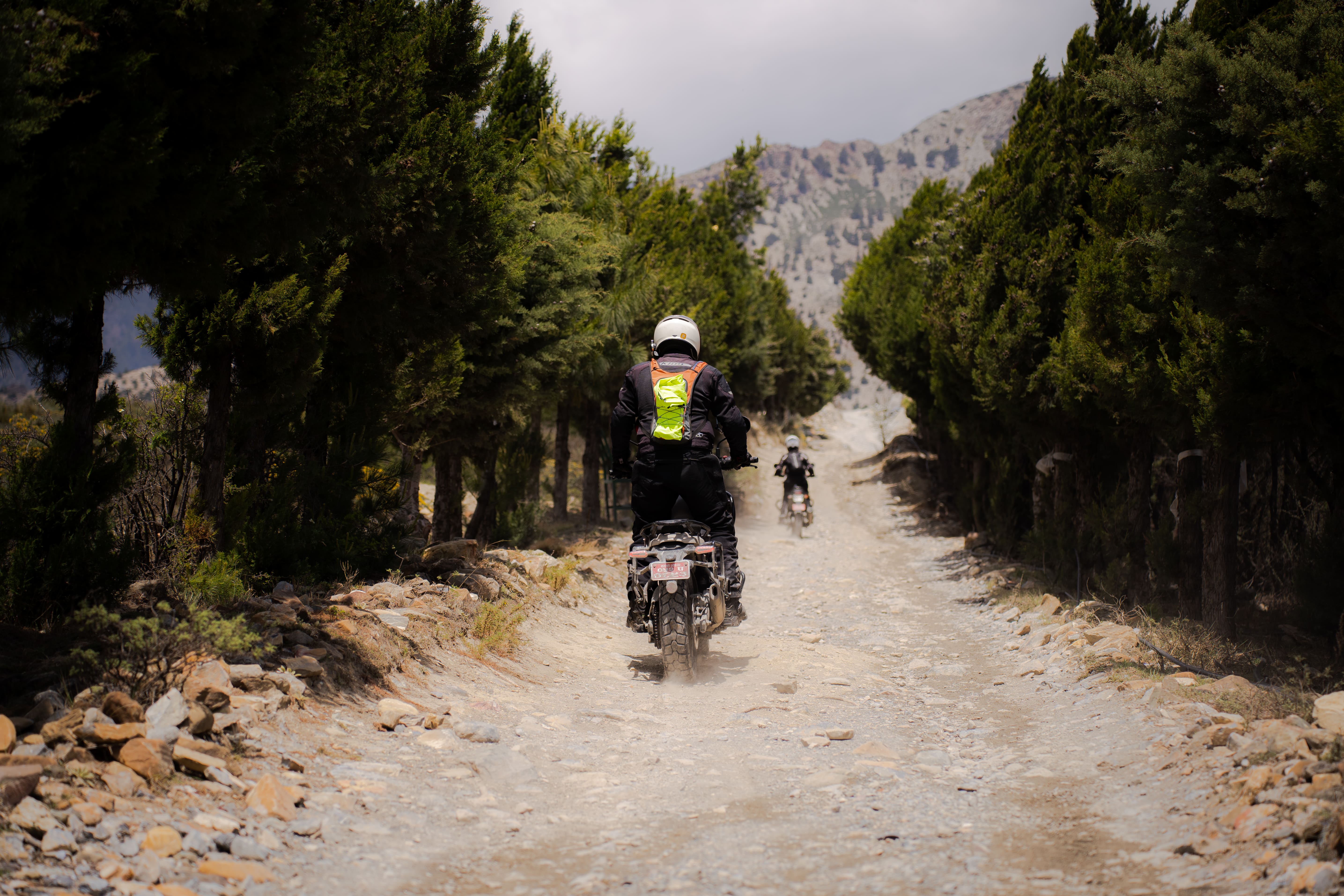
| Kagbeni → Chele (restricted zone entry) | Rocky track / riverbed | The road crosses the Kali Gandaki multiple times. River crossing depth varies by season — April spring melt can raise levels. Rocky and slow |
| Chele → Ghami (via Samar, passes) | Rocky off-road, passes | Crosses Taklam La (3,600m) and Dajori La (3,650m). Loose rock on descents. Stunning arid canyon country |
| Ghami → Lo Manthang (via Dhakmar, Mui La, Tsarang) | Rocky track, some sandy | Mui La Pass at ~4,170m is the highest point of the route. Steep ascent on loose rock; descent to Tsarang is exposed. Final approach to Lo Manthang across open plateau |
| Lo Manthang → Chhoser (Day 6 excursion) | Very rough / rocky | 50 km round trip. The roughest track of the entire tour. High clearance and off-road skill essential. Worth every metre |
Weather & Conditions
| Factor | Details |
|---|---|
| Season Ridden | Spring (April) — one of the two optimal months for Upper Mustang |
| Kathmandu / Pokhara | Warm and pleasant; 22–28°C. April mornings are clear |
| Kali Gandaki gorge | Warm in valley; 15–22°C. Afternoon wind intensifies — notorious force above Jomsom. Start each day before 8am |
| Kagbeni / Jomsom | Cool; 10–18°C daytime. Kali Gandaki wind strongest here — can reach 40 km/h in the afternoon |
| Lo Manthang (3,840m) | Cool days 10–18°C; cold nights −6 to −2°C. Dry, bright, clear spring skies. April is peak clarity for mountain views |
| Wind | The defining weather challenge. The Kali Gandaki afternoon wind is relentless above Jomsom. Between Lo Manthang and Muktinath on return — start before 9am to stay ahead |
| Dust | Significant above Kagbeni; the high desert is arid and wind-driven dust is a constant. Sealed goggles and buff are non-negotiable |
| Visibility | April is excellent — Annapurna, Dhaulagiri, Nilgiri all in sharp definition. One of the best photography windows of the year |
| Rain Shadow | Upper Mustang lies in the Annapurna–Dhaulagiri rain shadow. Virtually no precipitation in spring — the route remains accessible throughout April and May |
April is one of the two optimal months for Upper Mustang — spring brings clear skies, mild daytime temperatures, the Annapurna range in exceptional definition, and the blossom season in Marpha and Kagbeni. The one constant hazard is the Kali Gandaki afternoon wind: a katabatic system that builds from around 11am and can reach 40 km/h or more in the valley above Jomsom. Start every Upper Mustang riding day before 8am without exception. Between Kagbeni and Lo Manthang on both outbound and return legs, be at your destination before the afternoon wind arrives. This is the single most important operational rule of the entire tour.
Permits Required
⚠️ CRITICAL: Upper Mustang is a Restricted Area. All permits must be arranged before departure — they cannot be obtained at Kagbeni checkpoint.
| Permit | Cost (2026) | Validity / Notes |
|---|---|---|
| Upper Mustang RAP (Restricted Area Permit) | USD 50 per person per day | Applies from Kagbeni northward. NEW 2026 pricing (previously USD 500 flat for 10 days). Issued only through registered Nepali trekking agencies at Department of Immigration, Kathmandu or Pokhara. Min. 2 foreign trekkers required; solo foreign travel prohibited. Licensed guide mandatory |
| ACAP (Annapurna Conservation Area Permit) | NPR 3,000 (foreigners) / NPR 1,000 (SAARC) | Required for all riders. TIMS office, Pokhara |
| TIMS Card | USD 20 (foreigners) | TIMS office, Pokhara |
- 2026 UPDATE: The RAP fee was changed from USD 500 flat (10 days) to USD 50 per person per day in late 2025. A 10-day permit now costs USD 500 total — the same cost, but the daily structure means shorter trips are now proportionally cheaper
- Permits issued ONLY through registered Nepali trekking agencies at the Department of Immigration in Kathmandu or Pokhara. Individual foreign nationals cannot apply directly
- Minimum 2 foreign trekkers required per permit. Solo foreign riding is strictly prohibited in Upper Mustang
- A licensed Nepali guide registered with a TAAN-approved agency is legally mandatory throughout the restricted zone — this is checked at Kagbeni entry and Lo Manthang checkpoints
- Carry original permit documents at all checkpoints. Fines up to USD 5,000 apply for violations; deportation is possible
- Nepal citizens do not require a RAP and ride freely north of Kagbeni
Fuel & Logistics
| Location | Fuel Available | Notes |
|---|---|---|
| Pokhara | Yes | Fill completely before departing Day 2 |
| Beni | Yes | Last reliable fuel before mountains — top up here |
| Tatopani | Limited | Occasionally available; do not rely on it |
| Jomsom | Yes | Fill completely here. Last fuel before Lo Manthang and back. Critical |
| Kagbeni | No | No fuel beyond this point |
| Lo Manthang | No | No fuel. Calculate from Jomsom: ~130 km return to Lo Manthang. Plan accordingly |
The Himalayan 450 has a 17-litre tank and consumes approximately 3–3.5L/100km off-road. From Jomsom to Lo Manthang (via Kagbeni) is approximately 65 km. The return is the same distance: 130 km round trip. A full tank from Jomsom is sufficient for the complete Kagbeni–Lo Manthang–Kagbeni section with reserve, assuming no major detours. If undertaking the Chhoser excursion from Lo Manthang (an additional ~50 km of rough track), calculate fuel from the Lo Manthang level. Carry 3 litres of spare fuel beyond Jomsom for peace of mind.
Highlights
This tour contains more concentrated quality per day than any other route in the Nepal Moto Tours programme. The highlights are not moments — they are sustained landscapes, living cultures and historic sites that accumulate over ten days into an experience that changes one’s sense of what motorcycle travel can be.
| Stop | Why It Matters |
|---|---|
| Tatopani hot springs | Natural sulphur pools at the Kali Gandaki — essential recovery after Day 2’s gorge riding. One of Nepal’s finest simple pleasures |
| Marpha (apple capital) | White-walled stone village with apple orchards in spring blossom, the finest apple pie in Nepal, local cider and brandy. A mandatory lunch stop both outbound and return |
| Jomsom viewpoint tower | Panoramic views over the Kali Gandaki valley framed by Nilgiri and Dhaulagiri — the last major town before the restricted zone |
| Kagbeni checkpoint | The medieval gateway to Upper Mustang. Flagstone alleys, ochre monastery on a bluff, the Kali Gandaki running below and the restricted zone beginning north. Allow time to walk the village |
| Chungsi Cave (between Chele and Samar) | An ancient Buddhist cave monastery carved into a cliff face above the Kali Gandaki. One of the most atmospheric stops in all of Upper Mustang |
| Samar village (poplar grove) | A beautiful Tibetan-style village sheltered by a rare grove of ancient poplar trees — an unexpected moment of green in the high desert |
| Ghami Mani Wall | The longest mani wall in Upper Mustang — a massive stone prayer wall stretching across the valley. Ride slowly past it; the scale is extraordinary |
| Dhakmar red cliffs | The village of Dhakmar sits beneath enormous blood-red ochre cliffs containing sky cave dwellings. The red cliff face is one of the most photographed landscapes in all of Nepal |
| Ghar Gompa (Lo Gekar Monastery) | The oldest Mahayana Buddhist monastery in Nepal and Tibet, built by Guru Rinpoche in the 8th century. A short detour from the main track; unmissable for those with historical interest |
| Tsarang village and fort | Upper Mustang’s second town, with an ancient dzong (fortress), whitewashed houses and Thubten Shedrup Dhargyeling Monastery with extraordinary murals |
| Lo Manthang walled city | The destination. Founded 1380 AD by King Ame Pal. The 856m clay wall is still standing; within it: the 5-storey Royal Palace, Thubchen Gompa (late 15th century murals), Jampa Lhakhang (14th century), Chode Monastery, narrow cobblestone alleys and the living king’s family residence |
| Chhoser cave complex | A 50 km round trip from Lo Manthang on the roughest track of the tour. Ancient multi-storey cave dwellings carved into the cliffs above the Chhoser valley, with Nyphu and Garphu monasteries nearby. Extraordinary |
- Entering Lo Manthang through the eastern gate for the first time: the ochre wall, the cobblestone street, the five-storey Royal Palace facing you across the square, and the knowledge that this city has stood in this form since 1380. Nothing in Nepal — or perhaps Asia — prepares you for it
- Thubchen Gompa at morning puja: 500-year-old murals, butter lamps, monks’ chanting in the dim assembly hall. This is the reason the restricted area exists — this culture, this art, this unbroken continuity
- The Dhakmar red cliffs in morning light: the sky cave openings in the cliff face, the blood-red ochre against blue sky, the small white village below. One of the most photographed landscapes in all of Nepal and it is still more impressive in person than in any photograph
- The Kali Gandaki gorge from Beni to Tatopani on Day 2: rock walls, waterfalls, the river below, the technical riding — everything that makes Mustang access an earned experience rather than a purchased one
- Marpha in April blossom: the apple orchards white with flowers, the stone alleys cool and quiet, the brandy warm. Both outbound and return stops deserve full attention
- Standing at Mui La Pass (4,170m) with the Annapurna massif behind you and the Lo Manthang plateau visible ahead: the highest point of the tour and the moment the scale of what you have ridden becomes clear
Lowlights & Challenges
- The Kali Gandaki afternoon wind above Jomsom is not a guidebook exaggeration. At full force it is physically exhausting and makes riding genuinely difficult. The rule is simple and non-negotiable: start every Upper Mustang day before 8am
- The dust in Upper Mustang above Kagbeni is relentless and fine. It penetrates camera bags, luggage, jacket collars and ears. A buff and sealed goggles are minimum protection; plan for everything else to be dusty by Day 7
- The Kagbeni–Lo Manthang section is technically demanding riding across multiple days. River crossings, loose rock, steep off-camber sections and narrow cliff-edge passages all require concentration. This is not a route for riders who do not have genuine off-road experience
- Altitude at Lo Manthang (3,840m) and Mui La Pass (4,170m) is real. Acclimatise properly by staying at Jomsom or Kagbeni the night before pushing to Ghami. AMS symptoms at 4,000m+ can develop rapidly
- Permit logistics require advance planning: 10–14 days minimum to process through a registered agency in Kathmandu or Pokhara. This tour cannot be done spontaneously by foreign nationals
- Above Kagbeni, mobile signal is absent or unusable. For 5 days of the tour, you are effectively unreachable. Carry a satellite communicator (Garmin inReach or similar) for emergency communication
- The Chhoser excursion (Day 6) is the roughest track of the tour. Several riders have suffered tyre punctures and minor falls on this section. It is optional for good reason; assess honestly before committing
Notable Stops Along the Way
|
Stop |
Why It Matters |
|
Tatopani hot springs |
Natural sulphur pools at the Kali Gandaki — essential recovery after Day 2’s gorge riding. One of Nepal’s finest simple pleasures |
|
Marpha (apple capital) |
White-walled stone village with apple orchards in spring blossom, the finest apple pie in Nepal, local cider and brandy. A mandatory lunch stop both outbound and return |
|
Jomsom viewpoint tower |
Panoramic views over the Kali Gandaki valley framed by Nilgiri and Dhaulagiri — the last major town before the restricted zone |
|
Kagbeni checkpoint |
The medieval gateway to Upper Mustang. Flagstone alleys, ochre monastery on a bluff, the Kali Gandaki running below and the restricted zone beginning north. Allow time to walk the village |
|
Chungsi Cave (between Chele and Samar) |
An ancient Buddhist cave monastery carved into a cliff face above the Kali Gandaki. One of the most atmospheric stops in all of Upper Mustang |
|
Samar village (poplar grove) |
A beautiful Tibetan-style village sheltered by a rare grove of ancient poplar trees — an unexpected moment of green in the high desert |
|
Ghami Mani Wall |
The longest mani wall in Upper Mustang — a massive stone prayer wall stretching across the valley. Ride slowly past it; the scale is extraordinary |
|
Dhakmar red cliffs |
The village of Dhakmar sits beneath enormous blood-red ochre cliffs containing sky cave dwellings. The red cliff face is one of the most photographed landscapes in all of Nepal |
|
Ghar Gompa (Lo Gekar Monastery) |
The oldest Mahayana Buddhist monastery in Nepal and Tibet, built by Guru Rinpoche in the 8th century. A short detour from the main track; unmissable for those with historical interest |
|
Tsarang village and fort |
Upper Mustang’s second town, with an ancient dzong (fortress), whitewashed houses and Thubten Shedrup Dhargyeling Monastery with extraordinary murals |
|
Lo Manthang walled city |
The destination. Founded 1380 AD by King Ame Pal. The 856m clay wall is still standing; within it: the 5-storey Royal Palace, Thubchen Gompa (late 15th century murals), Jampa Lhakhang (14th century), Chode Monastery, narrow cobblestone alleys and the living king’s family residence |
|
Chhoser cave complex |
A 50 km round trip from Lo Manthang on the roughest track of the tour. Ancient multi-storey cave dwellings carved into the cliffs above the Chhoser valley, with Nyphu and Garphu monasteries nearby. Extraordinary |
Food & Tea Houses
The food of Upper Mustang is the food of the high-altitude Himalayan trade route: sustaining, simple, made from what grows at 3,500–3,800 metres. Tsampa (roasted barley flour), dried meat, buckwheat, yak dairy products and the occasional dried vegetable are the staples. The guesthouses above Kagbeni all have kitchens capable of dal bhat and basic western options. The Mandala Hotel in Lo Manthang is the best kitchen in the restricted zone and reliably produces good meals at altitude.
| Location | What to Eat / Experience |
|---|---|
| Mugling / Prithvi Hwy | Thakali dal bhat at a roadside canteen — the mandatory highway lunch ritual. Non-negotiable |
| Tatopani guesthouses | Trekker-facing menus: dal bhat, thukpa, momos, eggs. Sit on a terrace above the gorge. The food is simple and welcome after Day 2’s riding |
| Marpha bakeries | Exceptional apple pie, apple crumble, fresh cider and apple brandy from the Marpha distillery established in the 1960s. Also the Samteling Monastery is worth the short walk up. Do not rush through Marpha |
| Jomsom cafes | Surprisingly good espresso and proper meals. The best-provisioned stop before the restricted zone. Buy supplies here |
| Kagbeni tea houses | Tibetan-inflected menu: yak cheese omelette, butter tea, tsampa porridge, Tibetan bread. The butter tea here is the real version — try it |
| Upper Mustang guesthouses | Above Kagbeni, simplify expectations. Dal bhat, rice soup, instant noodles, tsampa, dried meat. All excellent after a long riding day at altitude. The lo-tang (local grain spirit) is worth trying in the evening |
| Lo Manthang — Mandala Hotel | The best kitchen in Lo Manthang. Proper meals, hot drinks, and the warmth of a heated dining room at 3,840m. The views from the terrace over the walled city at sunset are extraordinary |
| Marpha on return (Day 8–9) | Second chance at the apple pie and brandy. Buy enough to bring back to Kathmandu; it survives the journey |
One specific recommendation: the butter tea at Kagbeni tea houses. Made from brick tea, yak butter and salt in a bamboo churn, it tastes nothing like any tea you have had before. It is salty, rich and warming in a way that is perfectly calibrated for cold high-altitude conditions. Most non-Tibetans need a few cups before they appreciate it; by Lo Manthang, most riders are requesting it unprompted.
Accommodation
| Location | Where We Stayed |
|---|---|
| Pokhara (Days 1 & 9) | Hotel City Inn, Pokhara |
| Tatopani (Days 2 & —) | Local Guesthouse, Tatopani |
| Jomsom / Kagbeni (Day 3) | Hotel Jomsom Pride (or Kagbeni guesthouse if arriving late) |
| Ghami (Day 4) | Local Guesthouse, Ghami |
| Lo Manthang (Days 5, 6 & 7) | Mandala Hotel, Lo Manthang (2 or 3 nights) |
| Marpha (Day 8) | Marpha Palace |
| Kathmandu (final night) | Kathmandu Suite Homes |
The Mandala Hotel in Lo Manthang is the best guesthouse in the restricted zone: reliable kitchen, adequate heating, clean rooms and an extraordinary terrace view over the walled city. Book well in advance for April — Lo Manthang accommodation is limited and fills quickly as the season builds toward the Tiji Festival (typically late April or May). If the Mandala Hotel is full, the Snow Leopard Guest House is a solid alternative. Above Kagbeni, all accommodation is basic by Pokhara standards and genuinely comfortable by high-altitude adventure standards.
Tips for Riders Planning This Route
- Book permits through a registered trekking agency a minimum of 14 days before departure. The RAP requires agency sponsorship and cannot be obtained last-minute or at the checkpoint
- Start every day in the Upper Mustang section before 8am. The Kali Gandaki afternoon wind is the tour’s single biggest operational constraint and the one most riders regret ignoring
- Carry a mechanical support vehicle or at minimum a full toolkit, tyre repair kit, spare levers, cable ties, duct tape and 3 litres of spare fuel. Above Kagbeni, help is far away
- Download OsmAnd or Maps.me offline maps for the entire Mustang region before leaving Kathmandu. Mobile signal above Jomsom is absent
- Withdraw all cash needed for Days 4–8 from the Jomsom ATM. Budget NPR 10,000–15,000 per person per day for accommodation, meals and contingencies in the restricted zone
- Fit a bash plate and hand guards before departure. The Kagbeni–Lo Manthang track will find any unprotected components
- Acclimatise at Jomsom or Kagbeni before the Ghami push. Do not ride from Pokhara to Lo Manthang in two days — the altitude gain is too fast for safe acclimatisation
- Carry diamox and know how to use it. The HRA clinic in Jomsom can advise. AMS at 3,840m+ can develop rapidly and incapacitate a rider without warning
- Bring a windproof outer layer for the Upper Mustang plateau. Even in April, the Kali Gandaki wind at altitude is a physical force. A shell layer over riding gear is essential for the afternoon riding windows
- Carry a satellite communicator. Five days with no mobile signal and permit-enforced restricted access means that communication with the outside world requires dedicated hardware. This is not optional for responsible expedition riding
- Respect the restricted zone culture absolutely: request permission before photographing monastery interiors, remove riding boots before entering any religious site, offer a small donation at gompas you enter, and never enter the inner sanctums of the Lo Manthang monasteries without invitation
- If timing allows, plan to arrive in Lo Manthang around the Tiji Festival (late April/May). This three-day Buddhist celebration held in the Chode Monastery courtyard is one of the most spectacular cultural events in Asia — but it requires advance booking of accommodation weeks ahead
Emergency & Practical Information
| Item | Details |
|---|---|
| Mobile Signal | Good in Kathmandu, Pokhara. NTC and Ncell in Jomsom. Very patchy or absent above Kagbeni. Carry satellite communication or GPS for the Lo Manthang section. Inform contacts of full itinerary before crossing Kagbeni |
| ATM | Last ATM in Jomsom — carry sufficient cash for the entire Upper Mustang section (Days 4–8). Budget generously: permit fees, accommodation, guides, meals and contingencies all in cash above Kagbeni |
| Medical | Basic health posts in Jomsom and Lo Manthang. Nearest hospital is Pokhara (~8 hrs). Carry Diamox, a full first-aid kit, and personal medications. Know AMS (altitude sickness) symptoms: headache, nausea, loss of coordination |
| Altitude | Lo Manthang: 3,840m | Mui La Pass: ~4,170m | Chhoser: up to ~4,660m. Acclimatise properly at Jomsom/Kagbeni before the push to Lo Manthang. Do not ascend too fast |
| Permit checkpoints | RAP, ACAP and TIMS checked at Kagbeni entry, Lo Manthang checkpoint and Kagbeni exit. Original documents required at all points. Fines up to USD 5,000 for violations; potential deportation |
| Rescue | Helicopter evacuation from Lo Manthang or Jomsom airstrip in emergency. Adequate travel insurance with helicopter evacuation cover is mandatory for all riders entering the restricted zone |
| Guide requirement | A licensed Nepali guide registered with a TAAN-approved agency is legally mandatory for all foreign riders in Upper Mustang. This is non-negotiable and strictly enforced at Kagbeni checkpoint |
Final Verdict
Would we recommend this ride? Without reservation, and with the clear statement that it is the most demanding and most rewarding motorcycle journey in the Nepal Moto Tours programme.
The Ride to Lo Manthang is not a tour that can be summarised in a paragraph. It is ten days in which the landscape moves from subtropical river valleys to high-altitude Tibetan desert; in which the roads move from a Japanese-engineered highway to a rocky track crossing ancient trade routes; in which the culture moves from Pokhara’s tourist lakeside to a 14th-century walled city whose king’s family still lives in the palace that faces the only public square. Nothing in the first four days fully prepares you for Lo Manthang. And nothing after the tour adequately substitutes for the memory of it.
April 2026 was an exceptional window: clear skies over Lo Manthang, the Annapurna massif visible in both directions, the Marpha orchards in full blossom, and the restricted zone operating at a quieter pre-Tiji pace before the May crowds. The 2026 permit reform — a shift from USD 500 flat to USD 50/day — makes shorter, more focused Upper Mustang trips proportionally more accessible. For riders prepared to commit ten days and the considerable physical and logistical demands this route places on both machine and rider, no other motorcycle journey in Asia offers this combination of extreme adventure and living cultural immersion.
The dust will get into everything. The wind will test your patience and your balance. The altitude will remind you of its authority. And entering Lo Manthang through the eastern gate at the end of Day 5, with the Royal Palace directly ahead and 645 years of history in the walls around you, you will understand immediately why this ride is at the top of the programme. Some places justify everything required to reach them. Lo Manthang is one of those places.
★★★★★
Ride Report by Prabhash Thakur | Nepal Moto Tours | Published April 2026