Ride Report — Kathmandu to Manang
Ride Report
Kathmandu to Manang
Motorcycle Ride Report
Nepal Moto Tours • March 8–13, 2026
Ride Report by Prabhash Thakur
Overview
| Field | Details |
|---|---|
| Ride Dates | March 8–13, 2026 |
| Duration | 6 days |
| Start / End Point | Kathmandu (full loop) |
| Total Distance | ~820 km |
| Daily Riding Time | Approx. 5–8 hours / day |
| Riding Style | Adventure / Extreme Off-road |
| Difficulty | ★★★★☆ — Challenging |
| Overall Rating | ★★★★★ |
The road to Manang has a reputation that precedes it. Riders call it 'the deadliest road to paradise' — 99 kilometres of raw off-road ascent from Besisahar to a 3,519-metre Tibetan valley encircled by some of the highest mountains on earth. March brings the opening of the riding season: snow retreating, gorge waterfalls full and thundering, rhododendrons burning red on the lower hillsides, and the Annapurna massif in its most photogenic pre-monsoon clarity. This is one of the most demanding and most rewarding motorcycle tours in Nepal.
The Route
Day-by-Day Breakdown
| Day | Date | Segment | Accommodation |
|---|---|---|---|
| Day 1 | Mar 8 | Kathmandu → Besisahar (via Prithvi Hwy, Dumre) | Hotel in Besisahar |
| Day 2 | Mar 9 | Besisahar → Tal (Syange, Jagat, Chamje) | Guesthouse, Tal |
| Day 3 | Mar 10 | Tal → Chame (Dharapani, Timang, Thonje) | Hotel / Lodge, Chame |
| Day 4 | Mar 11 | Chame → Manang (Bhratang, Pisang, Braga) | Hotel Manang / Yak Hotel |
| Day 5 | Mar 12 | Exploration Day — Manang, Braga, Gangapurna Lake | Hotel Manang / Yak Hotel |
| Day 6 | Mar 13 | Manang → Besisahar → Kathmandu | Kathmandu Suite Homes |
Day 1 — Kathmandu to Besisahar (~220 km | ~6–7 hrs)
Depart Kathmandu early — the Prithvi Highway out of the valley is manageable before 7am and a slow-moving trial of patience after it. Once past Naubise and the switchback descent towards the Trisuli, the road opens and the rhythm of a long highway day sets in. The river runs alongside for most of the first half, jade-green in the March morning light, the valley walls steepening as you go. Mugling junction is the halfway point and the mandatory dal bhat stop — Thakali roadside canteens here have been feeding travellers since the highway opened and they have perfected the format. The turnoff at Dumre is 22 km beyond Mugling: a right-hand junction onto the road that heads north to Besisahar.
From Dumre, the character of the ride changes completely. The Marsyangdi valley begins to reveal itself through the windscreen: terraced fields on steep hillsides, smaller villages, less traffic, the first glimpses of Himalayan snow on the ridges above. Besisahar arrives after 55 km of winding but manageable road. Fill the fuel tank here — this is the last fuel station before Manang, 170 km of rough mountain track away. Check in, rest, and review the route with locals in the evening. The road condition update from guesthouse staff is invaluable in March — they will know exactly what lies ahead.
Day 2 — Besisahar to Tal via Syange, Jagat, Chamje (~55 km | ~6–7 hrs)
This is where the route earns its reputation. From Besisahar, the pavement disappears within a few kilometres of heading north, and the Marsyangdi gorge takes over. The first section to Jagat (34 km) is the most technically demanding of the entire route: a single-lane rocky track carved along the cliff face above the river, interspersed with waterfalls that cross the road directly, narrow sections where two vehicles cannot pass, and sheer drops to the turquoise Marsyangdi below. In March the river runs cold and fast from snowmelt; it is spectacular.
Syange sits at the true entrance to the gorge, where the valley narrows to a slot and the rock walls close in overhead. The suspension bridges here are a recurring feature — some wide enough for the bike, some requiring the bike to be walked across. Jagat was an ancient customs post on the Tibet salt trade route; Bhotiya (Tibetan) traders still inhabit the stone houses that line its narrow lanes. A brief chai stop here is a chance to absorb the atmosphere before continuing.
Chamje is a small village where a waterfall thunders directly opposite the road — one of the most memorable visual moments of the lower gorge. From Chamje, a final push brings you to Tal: a sudden, beautiful widening of the valley onto a flat river plain surrounded on three sides by cliff walls, with a major waterfall visible across the valley. Tal is one of the finest tea house stops on the route and a perfectly-placed overnight stop after an exhausting Day 2. Arriving here as the afternoon light hits the waterfall is the reward.
Day 3 — Tal to Chame via Dharapani, Timang, Thonje (~65 km | ~5–6 hrs)
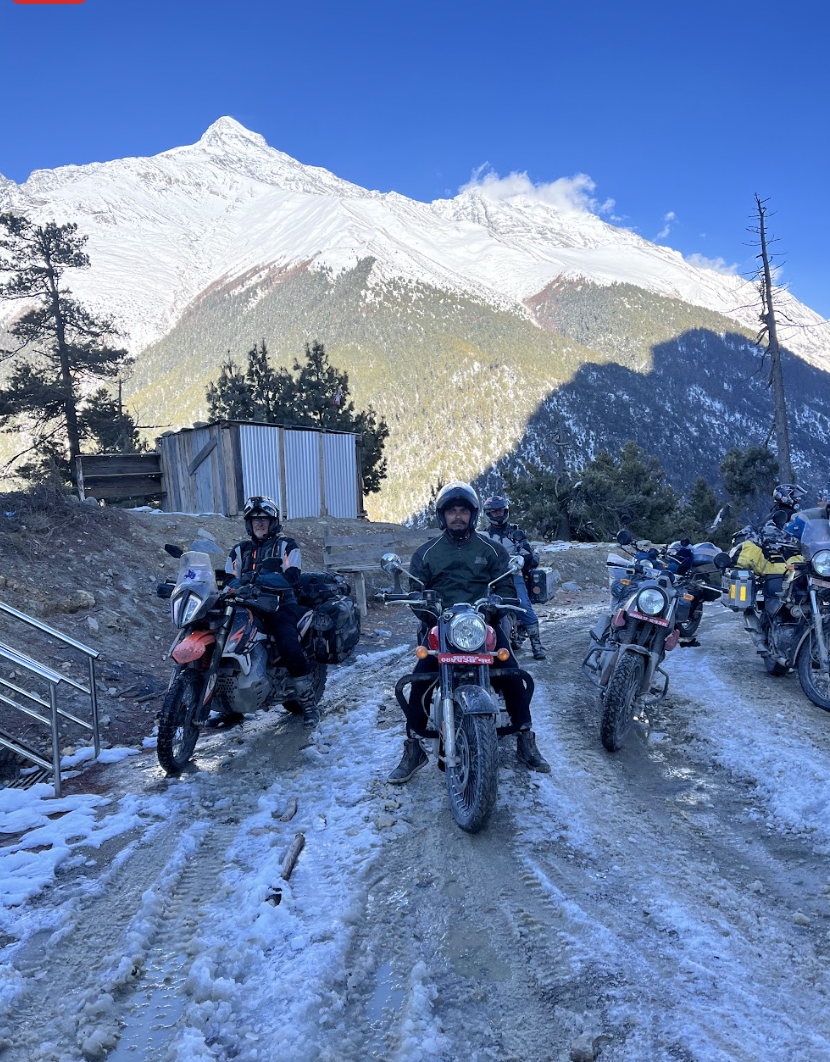
From Tal the road climbs consistently. The gorge slowly relaxes its grip above Dharapani as the valley widens into the lower Manang district, and the scale of the surrounding peaks begins to register properly. Timang at around 2,200m offers a first clear view of the Annapurna massif to the south — a moment that stops most riders in their tracks. The road through Thonje is rough but not technical; the main hazard in early March is shaded bends where overnight frost has left a thin glaze on the stone track. Progress carefully on north-facing sections.
Chame (2,670m) is the administrative headquarters of Manang district: a small but functional town with proper guesthouses, a police post, ACAP checkpoint, and — remarkably for this altitude — some decent food options. The views of Lamjung Himal from Chame are extraordinary, the 6,983m peak rising directly above the village. This is the designated acclimatisation stop before the final push to Manang. Spend the evening at Chame rather than pushing on — the altitude gain from Besisahar to Chame in a single day is significant, and the body needs time.
Day 4 — Chame to Manang via Bhratang, Pisang, Braga (~31 km | ~4 hrs)
The short distance is deceptive — this day packs in more visual spectacle per kilometre than anywhere else on the route. Leaving Chame the road curves through a dramatic granite wall section where the Marsyangdi cuts a narrow canyon and the track is blasted directly into the rock face. Then the Bhratang apple forest appears: a dense grove of wild apple trees through which the road winds for several kilometres. In March the trees are still bare-branched and atmospheric, their twisted forms silhouetted against the pale blue sky and snow peaks above. By April they will be in full blossom.
Above Bhratang, the valley opens into the extraordinary Annapurna plateau. The riding changes character entirely: wide gravel track, open desert-like terrain, massive peaks dominating every sightline. Pisang at 3,200m is a two-tiered village; the upper village (accessed via a short steep climb) offers arguably the finest panoramic view of the full Annapurna massif on the entire circuit — Annapurna II, III, IV, Gangapurna and Pisang Peak all visible simultaneously. Allow thirty minutes here.
Braga is 2 km before Manang: a cluster of traditional flat-roofed stone houses climbing a rock slope, with a 500-year-old monastery (Braga Gompa) perched above them. Inside the gompa, hundreds of clay statues of Buddhist deities line the walls from floor to ceiling, thangka paintings hang in the half-dark, and butter lamps flicker. The caretaker monk will usually open for visitors; a small donation and respectful behaviour is the appropriate response. Braga is one of the most atmospheric stops on the entire Nepal motorbike circuit.
Manang itself arrives like a scene from a different planet. Flat-roofed stone houses, yaks wandering the main street, prayer flags stretched between every rooftop, and four of the world's highest peaks filling the southern horizon: Gangapurna (7,455m), Annapurna III (7,555m), Annapurna IV (7,525m), and Tilicho Peak (7,134m). At 3,519m the thin air is immediately noticeable. Settle in, hydrate, eat, and do not push further on Day 4.
Day 5 — Exploration Day: Manang, Braga, Gangapurna Lake
An acclimatisation rest day is not optional at this altitude — it is the reason the route works. Manang's surroundings offer extraordinary day excursion options that gain altitude without overexertion.
Gangapurna Lake is 20 minutes on foot from the centre of Manang — a glacial lake at the base of the Gangapurna Icefall, its water shifting between milky turquoise and deep grey-blue depending on the light and time of day. In March the lake edge may still carry ice from the winter; Gangapurna's glacier calves directly into it and the backdrop is extraordinary. This is the easiest and most rewarding short walk from Manang — do it in the morning when the light is best.
In the afternoon, walk back to Braga for a second, slower visit to the monastery. The HRA (Himalayan Rescue Association) clinic in Manang holds altitude briefings in the late afternoon during season — highly recommended for any rider planning to explore higher. The clinic staff have seen every altitude-related condition possible and their practical guidance is genuinely useful.
For those with energy and no altitude symptoms: the hike to Ice Lake (4,620m) is a full-day commitment and the finest acclimatisation hike in the area, offering a 360-degree panorama of the Annapurna range that is simply not accessible from any road in Nepal. This is optional and only for riders in strong physical condition with no AMS symptoms whatsoever.
Day 6 — Manang to Besisahar to Kathmandu (~370 km | 9–10 hrs)
A long final day that starts early. The descent from Manang through Pisang, Bhratang and Chame is faster going down — the terrain is familiar, the altitude is dropping, and the body feels the relief of returning oxygen. The gorge section from Tal back through Jagat and Syange to Besisahar requires full concentration in both directions; it does not become less technical on the return.
Besisahar for a late lunch and fuel — then the Dumre junction and the Prithvi Highway for the long run home. Mugling for a final dal bhat stop if time and appetite allow. Kathmandu by evening. The Trisuli valley in the fading light on the return leg has a particular quality — the day's riding still in the legs, the altitude still faintly in the head, and the city beginning to reassert itself. Tour complete.
The Bike
| Field | Details |
|---|---|
| Motorcycle | Royal Enfield Himalayan 450 |
| Engine | 450cc |
| Loaded Weight | ~195 kg |
| Tyre Setup | Stock |
| Modifications | Bash plate, luggage rack, hand guards |
Bike Performance Notes
The Manang route is the hardest test this bike will face in Nepal short of the Upper Mustang off-road sections. The 99 km from Besisahar to Manang is 80% unpaved, with sustained rocky sections, multiple water crossings, steep inclines on loose stone and narrow cliff-edge passages that demand both machine reliability and rider confidence. The Royal Enfield Himalayan 450 handled all of it without mechanical complaint. The bash plate is not optional on this route — it absorbed several significant rock strikes on the Besisahar–Jagat section. Hand guards proved their value in the tight gorge sections where overhanging rock is a constant hazard. No mechanical failures on this trip; the bike reached 3,519m and returned without issue.
One note: the altitude above 3,000m does affect carburetion and engine response even in a fuel-injected machine. Power delivery above Pisang felt noticeably reduced compared to the lower valley. Ride accordingly — smooth throttle, no aggressive power applications on loose surfaces.
Road & Trail Conditions
| Section | Surface | Notes |
|---|---|---|
| Kathmandu → Dumre (Prithvi Hwy) | Paved — excellent | 200 km of fast highway; follow the Trisuli river from Naubise. Heavy lorry traffic on the first stretch from Kathmandu |
| Dumre → Besisahar | Mostly paved | 55 km from the Prithvi Hwy turnoff; winding but manageable. Traffic thins considerably |
| Besisahar → Jagat | Rocky single-lane track | The true off-road begins. 34 km of stone track, occasional waterfalls, sheer drops to the Marsyangdi. The toughest section in pure technical terms |
| Jagat → Tal → Dharapani | Rock, gravel, mud | Narrow gorge track with multiple river crossings and waterfalls. The road is carved directly into cliff faces in several places |
| Dharapani → Chame | Gravel / rocky track | 65 km total (Besisahar to Chame). Gradual altitude gain. Forested mountain corridor; occasional snow patches on shaded bends in early March |
| Chame → Pisang → Manang | Gravel / compact dirt | 31 km. Better maintained than lower section. Bhratang apple forest, open plateau views. Snow likely on upper exposed sections in March |
As of 2024, approximately 80% of the Besisahar–Manang route remains unpaved. Road construction is ongoing in sections but the mountain terrain means meaningful tarmac coverage is years away. Early March can bring residual ice on shaded bends above 2,500m and occasional snow on the Chame–Pisang section. Check conditions with locals in Besisahar and Chame before proceeding. The gorge between Syange and Chamje is the most technically demanding section regardless of season and should be treated with maximum caution.
Weather & Conditions
| Factor | Details |
|---|---|
| Season Ridden | Early Spring (March) — opening of the riding season |
| Kathmandu / Besisahar | Warm and pleasant; 18–25°C daytime. Rhododendrons beginning to bloom on south-facing hillsides |
| Marsyangdi Gorge | Cool valley air; 10–18°C. Waterfalls full and dramatic in early spring |
| Chame (2,670m) | Cool to cold; 5–12°C daytime, near 0°C at night. Light frost possible |
| Manang (3,519m) | Cold; daytime 2–6°C, nights −5 to −9°C. 25% chance of snow/precipitation on any given day in March |
| Snow Risk | Possible on shaded bends above Chame and on the Manang plateau. Confirm conditions with locals before the Chame–Manang push |
| Visibility | Excellent — pre-monsoon spring clarity with sharp mountain definition. Annapurna II, III, IV and Gangapurna in extraordinary focus from Manang |
| Best Time to Ride | March–May and October–November |
March is the opening of the Manang riding season and sits at the cusp of winter and spring. The lower valley (Besisahar to Jagat) is already warm and green; the upper plateau around Manang is emerging from its coldest months and carries residual snow on the higher terrain. The compensation is extraordinary: March in Manang brings some of the clearest mountain visibility of the year, with Gangapurna and the Annapurna peaks in razor-sharp definition against deep blue pre-monsoon skies. Night temperatures in Manang will be genuinely cold (−5 to −9°C) — proper sleeping gear and layering are essential.
Permits Required
Talking about permits for Manang, No restricted area permit is required for Manang. The ACAP permit covers the entire Annapurna Conservation Area including the Marsyangdi corridor from Besisahar to Manang.
| Permit | Cost (approx.) | Where to Obtain |
|---|---|---|
| ACAP (Annapurna Conservation Area Permit) | NPR 3,000 | TIMS office, Kathmandu (Bhrikuti Mandap) or Pokhara |
| TIMS Card | NPR 2,000 | TIMS office, Kathmandu or Pokhara |
- There are 4–5 active ACAP checkpoints between Besisahar and Manang; all require passport and permit presentation. Fines are levied for missed checkpoints — this is enforced seriously
- Arrange permits at the TIMS/ACAP office in Kathmandu (Bhrikuti Mandap) or Pokhara Lakeside before departure. Allow one morning
- Motorcycle registration papers must be carried at all times
Fuel & Logistics
| Location | Fuel Available | Notes |
|---|---|---|
| Kathmandu | ✅ Yes | Fill tank completely at departure |
| Dumre | ✅ Yes | Highway junction; top up if needed |
| Besisahar | ✅ Yes | LAST fuel station before Manang. Fill completely without exception |
| Jagat / Tal | ⚠️ Rare | Occasionally available in bottles from local homes. Never rely on it |
| Chame | ❌ No | No fuel station. Plan from Besisahar |
| Manang | ❌ No | No fuel. Himalayan 450 has good range; plan accordingly from Besisahar (~170 km return to Besisahar) |
The Himalayan 450 has a 17-litre tank and consumes approximately 3–3.5L/100km on rough terrain. The return trip from Besisahar to Manang is approximately 170 km. A full tank from Besisahar covers the ascent comfortably with reserve. Carry 2 litres of spare fuel for peace of mind regardless of calculation. Do not risk running short in the gorge section.
Highlights
This route is defined by constant, layered revelation. Every 10 km brings a different world: subtropical gorge, thundering waterfalls, forested mountain corridor, open Tibetan plateau, ancient monastery, glacial lake. The highlights are not moments — they are sustained experiences.
| Stop | Why It Matters |
|---|---|
| Manakamana Temple (Mugling area, Day 1) | Cable car access from the highway. Hindu temple on the ridgeline — an atmospheric optional detour before the mountains begin |
| Khudi / Bhulbhule (Besisahar vicinity) | First proper Annapurna Circuit villages. Gentle green foothills and warm welcomes mark the gateway to the valley |
| Syange Gorge entry | The Marsyangdi narrows to a slot gorge and the real riding begins. The colour of the river changes to glacial turquoise in early spring |
| Jagat (1,300m) | Ancient customs post on the old Tibet salt trade route; Bhotiya (Tibetan) traders still live here. A fascinating cultural waypoint |
| Tal (1,700m) | Beautiful flat valley opening surrounded by a dramatic waterfall and the widening Marsyangdi. The visual arrival in the valley is a genuine reward |
| Chame (2,670m) | District HQ of Manang; good guesthouses, the first views of Lamjung Himal, and a final checkpoint before the serious altitude begins |
| Bhratang apple forest | The road cuts through a dense wild apple forest between Chame and Pisang. Bare-branched in March but atmospheric and completely unexpected |
| Pisang Village (3,200m) | Two-tiered Tibetan village; upper Pisang offers dramatic views of the entire Annapurna massif and Pisang Peak. Worth the short detour up |
| Braga (3,470m) | 30 minutes from Manang; 500-year-old monastery clinging to a rock slope with hundreds of clay deity statues, ancient thangkas, and butter lamps |
| Gangapurna Lake | 20-minute walk from Manang; glacial lake in milky-turquoise against the Gangapurna Icefall. One of the most photogenic spots on the entire Annapurna Circuit |
| Manang Village (3,519m) | The destination. Flat-roofed stone houses, prayer flag forests, yaks in the streets and four 7,000m+ peaks visible from the main square |
- The first sight of Manang village from the approach road — flat roofs, prayer flags, yaks and four 7,000m peaks simultaneously visible. This is the image that stays with you
- Riding the Marsyangdi gorge on Day 2 — the combination of technical challenge, raw geology and turquoise river is unmatched on any Nepal motorcycle route
- Braga Gompa interior: hundreds of ancient clay statues in the dim butter-lamp light, centuries of Buddhist devotion concentrated in a single room. One of the finest monastery experiences in Nepal
- Gangapurna Lake at dawn on Day 5 — the glacier calving quietly into milky-blue water, complete silence, the icefall glowing in the first light
- Pisang upper village panorama: the full Annapurna massif visible in a single sweep. There is no better mountain view accessible by motorcycle anywhere in Nepal
Lowlights & Challenges
- The Besisahar–Jagat section is the hardest riding on the route and should not be underestimated. Single-lane cliff track, waterfalls crossing the road, and zero margin for error. Take it seriously and take it slowly
- March snow is a real possibility above Chame. The Chame–Pisang section can carry ice on shaded north-facing bends. Check conditions with locals before proceeding; do not dismiss their advice
- Altitude at Manang (3,519m) will affect most riders to some degree. Headaches, disrupted sleep and reduced appetite are normal. A proper acclimatisation day (Day 5) is not negotiable
- The return descent (Day 6) at ~370 km is genuinely tiring. Start by 6am to arrive in Kathmandu before dark
- Cold nights in Manang (−5 to −9°C in March) are brutal without proper sleeping gear. Thin guesthouse blankets are not enough — bring a sleeping bag liner or a proper 0°C-rated sleeping bag
- Mobile signal in the gorge is essentially absent. For multi-day riding, this is fine — but inform someone of your itinerary before leaving Besisahar
- The Day 6 descent is fast and familiar but equally unforgiving. Gorge fatigue is real; the rocks do not get softer on the return
Notable Stops Along the Way
| Stop | Why It Matters |
|---|---|
| Manakamana Temple (Mugling area, Day 1) | Cable car access from the highway. Hindu temple on the ridgeline — an atmospheric optional detour before the mountains begin |
| Khudi / Bhulbhule (Besisahar vicinity) | First proper Annapurna Circuit villages. Gentle green foothills and warm welcomes mark the gateway to the valley |
| Syange Gorge entry | The Marsyangdi narrows to a slot gorge and the real riding begins. The colour of the river changes to glacial turquoise in early spring |
| Jagat (1,300m) | Ancient customs post on the old Tibet salt trade route; Bhotiya (Tibetan) traders still live here. A fascinating cultural waypoint |
| Tal (1,700m) | Beautiful flat valley opening surrounded by a dramatic waterfall and the widening Marsyangdi. The visual arrival in the valley is a genuine reward |
| Chame (2,670m) | District HQ of Manang; good guesthouses, the first views of Lamjung Himal, and a final checkpoint before the serious altitude begins |
| Bhratang apple forest | The road cuts through a dense wild apple forest between Chame and Pisang. Bare-branched in March but atmospheric and completely unexpected |
| Pisang Village (3,200m) | Two-tiered Tibetan village; upper Pisang offers dramatic views of the entire Annapurna massif and Pisang Peak. Worth the short detour up |
| Braga (3,470m) | 30 minutes from Manang; 500-year-old monastery clinging to a rock slope with hundreds of clay deity statues, ancient thangkas, and butter lamps |
| Gangapurna Lake | 20-minute walk from Manang; glacial lake in milky-turquoise against the Gangapurna Icefall. One of the most photogenic spots on the entire Annapurna Circuit |
| Manang Village (3,519m) | The destination. Flat-roofed stone houses, prayer flag forests, yaks in the streets and four 7,000m+ peaks visible from the main square |
Food & Tea Houses
The tea houses of the Marsyangdi valley and Manang district are among the most atmospheric in Nepal. This is the classic Annapurna Circuit corridor and the lodge culture is deeply embedded — the Gurung and Bhotiya communities running these guesthouses have been hosting travellers for decades and the warmth is genuine. March brings the beginning of the trekking season: tea houses are open and staffed, but not yet crowded. You are likely to have the dining room largely to yourself on any given evening.
| Location | What to Eat / Experience |
|---|---|
| Mugling (highway Day 1) | The legendary Mugling dal bhat stop. Thakali canteen cooking at its roadside best. Non-negotiable lunch ritual |
| Besisahar guesthouses | Clean, simple guesthouses well-used to early-season motorcycle groups. Good dal bhat, egg dishes and noodle soup. Ask about road conditions above before departing |
| Jagat tea houses | Small Bhotiya-run lodges; warm, simple and authentic. Try the Tibetan butter tea here for the first time if you have never had it |
| Tal guesthouses | Beautiful setting above the river. Order the vegetable thukpa (noodle soup) and sit on the terrace watching the waterfall across the valley |
| Chame lodges | Chame has the best lodges between Besisahar and Manang — actual heated rooms in March are available at some places. Good kitchen facilities; try the lentil soup with tsampa bread |
| Pisang tea houses | Small, simple stops; dal bhat and basic western options. Sit in the upper village for views while you eat |
| Manang village lodges | Yak Hotel and Hotel Manang are the best-regarded options; reliable kitchen, hot meals, and staff experienced with altitude-affected guests. Try the apple cider (local Manang variety), yak cheese omelette, and tsampa porridge in the morning |
| Braga tea houses | A handful of small options near the monastery. Worth a tea stop after the monastery visit; the gompa caretaker sometimes shares butter tea with visitors |
The HRA clinic in Manang occasionally holds community dinners or informal cultural evenings during the shoulder season. If one is happening during your rest day, attend. The interaction with the Manangi community — people who spend their winters trading in Asia and return to live in a 3,500m valley — is one of the most interesting conversations you will have in Nepal.
Accommodation
| Location | Where We Stayed |
|---|---|
| Besisahar (Day 1) | Hotel at Besisahar (standard guesthouse; several options in the main bazaar) |
| Tal (Day 2) | Local Guesthouse, Tal |
| Chame (Day 3) | Hotel / Lodge, Chame |
| Manang (Days 4 & 5) | Yak Hotel or Hotel Manang, Manang |
| Kathmandu (final night) | Kathmandu Suite Homes |
Yak Hotel in Manang is consistently recommended by experienced riders and trekkers — reliable kitchen, reasonably warm rooms and staff who understand altitude-affected guests. Hotel Manang is a solid alternative. Book ahead if arriving after March 10, when the early spring trekking season begins to build. In Tal and Chame, options are more basic but clean and well-heated. Besisahar has several decent mid-range guesthouses in the main bazaar that cater well to motorcycle groups.
Tips for Riders Planning This Route
- Get ACAP permit and TIMS card in Kathmandu before Day 1. Do not rely on obtaining them en route — they are not available beyond Besisahar
- Besisahar fuel is the most critical logistics point on the entire tour. Fill completely, carry 2 litres spare, and do the maths before leaving town
- Bash plate is mandatory. Hand guards are strongly recommended. The gorge section will find any unprotected component
- Do not rush Day 2. Besisahar to Tal covers only 55 km but takes 6–7 hours in normal conditions. Plan time, not distance
- Overnight at Chame (Day 3) before pushing to Manang. The acclimatisation stop is what makes Day 4 enjoyable rather than miserable
- Carry Diamox and know how to use it. Consult a doctor before the trip; the HRA clinic in Manang can advise on-site during your rest day
- Check ACAP checkpoints carefully. There are 4–5 between Besisahar and Manang and fines for missed check-ins are real and enforced
- Download OsmAnd or Maps.me offline maps for the full Marsyangdi valley before departing Kathmandu. Signal disappears in the gorge
- Bring a 0°C sleeping bag or liner for Manang in March. Guesthouse blankets alone will not be warm enough at −9°C nights
- Ice Lake (Day 5 optional hike) is only for those with no AMS symptoms, good fitness, and full acclimatisation. If in any doubt, skip it and walk to Gangapurna Lake instead
- Respect checkpoint officers and monastery customs. This is a deeply Buddhist region and the communities are warm but proud. Remove helmets and riding gloves before entering monasteries
- Carry mule awareness: the gorge track is shared with supply mules. When mules approach on narrow cliff sections, always press yourself to the uphill rock wall — never wait on the downhill side
Emergency & Practical Information
| Item | Details |
|---|---|
| Mobile Signal | Good on Prithvi Highway and in Besisahar. Sporadic in the gorge (Jagat, Tal). NTC signal available in Chame and Manang but unreliable |
| ATM | Besisahar has ATMs — last reliable cash access before Manang. Carry enough for the entire Chame–Manang segment |
| Medical | Health post in Chame; Himalayan Rescue Association (HRA) clinic in Manang (staffed March–November). Nearest hospital: Kathmandu. Carry Diamox and a basic first-aid kit |
| Altitude | Tal: 1,700m | Chame: 2,670m | Pisang: 3,200m | Manang: 3,519m | Ice Lake (day hike): 4,620m |
| Checkpoints | 4–5 active ACAP checkpoints between Besisahar and Manang. Carry ACAP permit and passport at all times; fines apply for missed checkpoints |
| Rescue | Helicopter evacuation is possible from Humde airstrip (3km east of Manang) in emergency. Adequate travel insurance with helicopter cover is essential |
Final Verdict
Would we recommend this ride? Yes — and without reservation for experienced off-road riders who are prepared for what the route demands.
The Kathmandu to Manang motorbike tour is categorically different from the Mustang routes. This is not a dusty desert plateau with wide gravel roads — this is a deep gorge assault up one of the steepest and most spectacular river valleys in the Himalayas, through ancient trade-route villages, past thundering waterfalls, through a forest, across a plateau, and into a Tibetan high-mountain valley that most of the world will never see. The route demands genuine off-road competence, altitude awareness and physical fitness. It returns an experience so varied and so visually overwhelming that six days barely feels sufficient.
March riding adds a specific quality: the gorge waterfalls are at full force from snowmelt, rhododendrons are beginning on the lower hillsides, and Manang at pre-season quietude has an intimacy that October's trekking crowds never allow. The cold at altitude is real and the snow risk is real — but the mountain clarity is extraordinary and the tea houses are warm. You are among the first riders of the season to reach Manang. That means something.
Standing in Manang's main square at sunrise on Day 5, with Gangapurna glowing pink to the south-east and the valley completely silent except for prayer flags snapping in the morning wind, is one of those rare moments that recalibrate your sense of what is possible on a motorcycle. The road back is just as hard as the road in. Both are worth every metre.
★★★★★
Ride Report by Prabhash Thakur | Nepal Moto Tours | Published March 2026
Tags: Manang • Marsyangdi Gorge • Annapurna Circuit • Besisahar • Braga • Pisang • Nepal Motorcycle Tour • Himalayan Off-road