.png)
Manang sits at 3,519 metres above sea level in the heart of the Annapurna Conservation Area, and the road that climbs to it is widely regarded as one of the most dramatic and demanding motorcycle routes in Asia. Frozen waterfalls, sheer gorge walls, river crossings, and a sky that seems close enough to touch: it is the kind of road that earns a place on a rider's lifetime list.
But before the wheels leave Kathmandu or Pokhara, there is paperwork. Nepal's permit system for the Annapurna region is well-organised, not especially expensive, and — for motorcycle travellers in particular, frequently misunderstood. This guide cuts through the confusion. It covers every document you will need in 2026, exactly what each one costs, where to get it, and what happens at the checkpoints between Besisahar and Manang village. There are no shortcuts, but the process is genuinely straightforward once you understand the logic behind it.
Table of Contents
- Why Permits Are Required for the Manang Route
- Is Manang a Restricted Area?
- The ACAP Permit Explained
- TIMS Card: Requirements and Current Rules (2026)
- Required Documents for Foreign Motorcycle Riders
- Complete Permit Costs in 2026
- Where to Get Your Permits (Kathmandu & Pokhara)
- How to Apply: Step-by-Step Process
- Checkpoints on the Besisahar–Manang Route
- Vehicle-Specific Rules for Motorcycles
- Nar Phu Valley: The Restricted Area Near Manang
- Common Mistakes Riders Make
- Practical Tips for Permit Day
- Frequently Asked Questions
Why Permits Are Required for the Manang Route
Nepal introduced structured permit requirements for the Annapurna region for three interconnected reasons: environmental conservation, trekker and rider safety, and community revenue sharing.
Conservation: The Annapurna Conservation Area Project (ACAP), launched in 1986, manages 7,629 km² of some of the most biodiverse and ecologically fragile terrain in the Himalaya. The region is home to snow leopards, red pandas, Himalayan tahr, and over 450 bird species. Permit revenue is directly reinvested into wildlife habitat restoration, anti-poaching patrols, and reforestation programmes across 55 Village Development Committees.
Safety: The road to Manang passes through narrow gorges, active landslide zones, and high-altitude terrain where conditions change rapidly. The permit system ensures authorities know who is in the area, their planned route, and their emergency contacts. This data is critical for search-and-rescue coordination after landslides, earthquakes, or weather events — all genuine risks on this road.
Community development: Entry fees fund schools, water supply infrastructure, and heritage conservation in villages like Chame, Pisang, Braga, and Manang itself. When you pay for your ACAP permit, a measurable percentage flows directly to communities whose livelihoods depend on responsible tourism.
There is a fourth, practical reason: the checkpoints are staffed, active, and they will turn you around without the correct documents. This is not bureaucratic theatre — it is enforced.
Is Manang a Restricted Area?
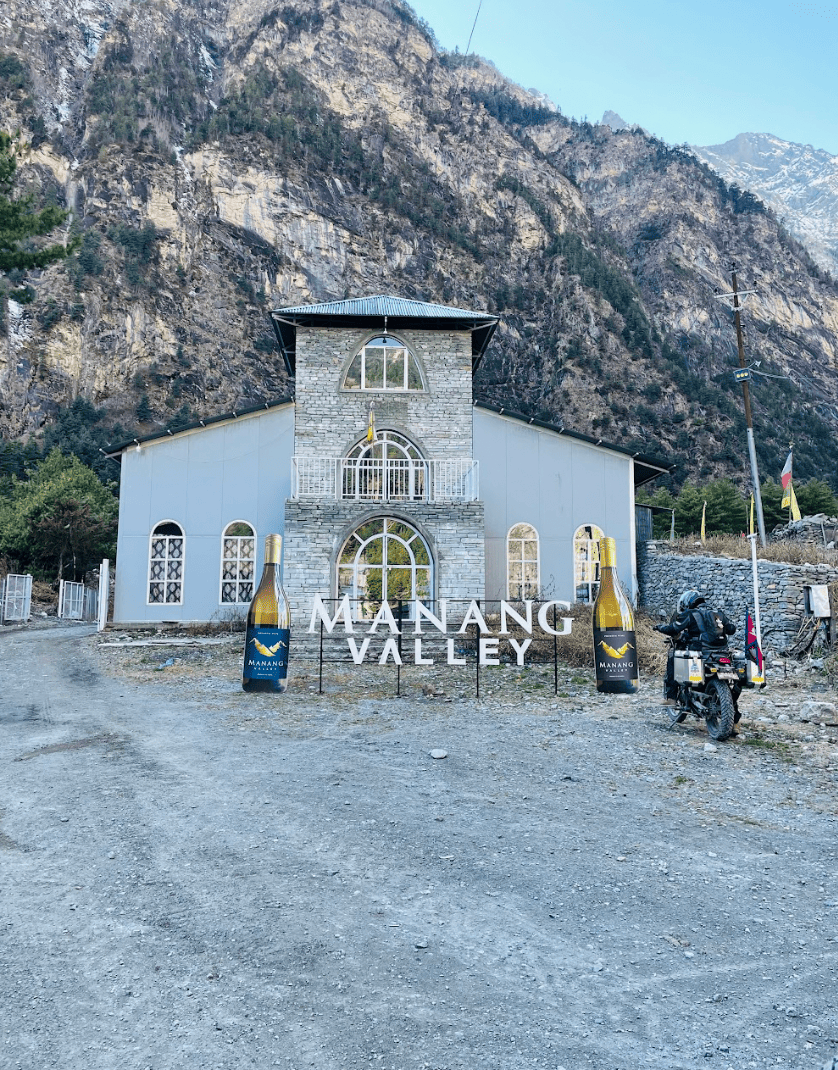
Manang village itself is not a restricted area. It sits within the Annapurna Conservation Area, which requires an ACAP permit (and, in some circumstances, a TIMS card), but it does not require a special Restricted Area Permit (RAP) from the Department of Immigration.
However, two important nuances apply:
The Nar Phu Valley is a restricted area. Nar and Phu are two remote villages accessible via a side route branching off the main Manang road near Koto. This valley does require a separate Restricted Area Permit issued by the Department of Immigration, Kathmandu. If your ride includes Nar Phu, the permit requirements and costs are significantly different.
Beyond Manang toward Thorong La and Mustang: If you plan to continue over Thorong La Pass and into Lower or Upper Mustang, additional permits apply. Upper Mustang in particular requires a Restricted Area Permit currently priced at USD 50 per person per day, mandatory trekking guide, and must be arranged through a registered trekking agency.
For a standard motorcycle tour with Manang as the destination or turnaround point, the permit picture is straightforward: ACAP permit + TIMS card. That is it.
The ACAP Permit Explained
The Annapurna Conservation Area Permit (ACAP) is the single most important document for the Manang route. It is issued by the National Trust for Nature Conservation (NTNC), the government-affiliated body that manages the Annapurna Conservation Area.
What the ACAP Covers
The ACAP is a single-entry permit that covers the entirety of the Annapurna Conservation Area — one permit, one trek or ride, no time limit on the duration of your stay once you are inside. It does not differentiate between trekkers on foot and visitors arriving by motorcycle; if you enter the conservation area boundary, you need one.
The permit covers major routes including:
- Annapurna Circuit (Besisahar → Manang → Thorong La → Mustang)
- Annapurna Base Camp trek
- Ghorepani Poon Hill
- Mardi Himal
- Tilicho Lake approach
- The Besisahar–Manang road (the primary motorcycle route)
How ACAP Revenue Is Used
According to the NTNC, revenue from over 100,000 annual visitors funds three core programme areas:
- Wildlife habitat restoration and anti-poaching
- Community development in 55 Village Development Committees
- Trail maintenance, infrastructure, and conservation education
ACAP Validity
The ACAP permit has no fixed expiry date once issued for a specific trip. It is valid for the duration of a single entry into the conservation area. If you exit and wish to re-enter, you need a new permit.
TIMS Card: Requirements and Current Rules (2026)
The Trekkers' Information Management System (TIMS) card is a registration document introduced in 2008 jointly by the Nepal Tourism Board (NTB) and the Trekking Agencies' Association of Nepal (TAAN). It records your identity, nationality, trekking or riding route, entry and exit dates, guide details, and emergency contact information in a centralized database.
TIMS and Motorcyclists: The Current Position
The TIMS system was designed with foot trekkers in mind, and its application to motorcycle travellers has always been slightly ambiguous. In 2026, the practical situation is as follows:
- On the Annapurna Circuit / Besisahar–Manang road: TIMS is officially required for all non-Nepali visitors entering designated trekking zones, including motorcycle riders. In practice, some checkpoints verify it for riders and others do not — but the official regulation mandates it, and checkpoint behaviour can change without notice.
- TIMS is not optional for safety reasons: If you are involved in an accident or go missing on the road to Manang, TIMS is how search-and-rescue teams reconstruct your planned route and timeline. Carry it.
As of early 2026, the TIMS requirement in the Annapurna region is confirmed mandatory by NTB regulation, though enforcement specifically for motorcycle riders is inconsistent. The official position from TAAN is that TIMS registration applies to all visitors on designated routes, regardless of mode of transport.
Since 2023, Nepal has been transitioning to an electronic e-TIMS system that replaces the physical laminated card with a digital QR code linked to your passport number and route details. Some checkpoints scan the QR code; others still inspect physical permits. Bring both a digital and printed copy.
For fines and enforcement: travellers found without a TIMS card face fines of NPR 12,000 (approximately USD 93) per the current enforcement guidelines.
Official TIMS registration and information can be checked at the Nepal Tourism Board website.
Two Types of TIMS
|
Card Type |
Who It's For |
2026 Cost (Foreign Nationals) |
|
Green Card (Group/Organised) |
Riders booking through a registered agency |
NPR 1,000 (~USD 8) |
|
Blue Card (Individual/Independent) |
Independent riders without an agency |
NPR 2,000 (~USD 15) |
Most motorcycle travellers riding independently will require the Blue Card (Individual TIMS) unless they have pre-booked through a registered Nepali tour operator.
Required Documents for Foreign Motorcycle Riders
Compile all of these before you visit the permit office. Missing even one item means a second trip.
Documents for Permit Applications
|
Document |
Copies Required |
Notes |
|
Original passport |
1 |
Must be valid for at least 6 months |
|
Passport photocopies |
2–3 |
Bio-data page plus Nepal visa page |
|
Passport-size photographs |
4 (minimum) |
White background; 35mm × 45mm |
|
Nepal tourist visa |
1 |
Must be valid for your entire itinerary |
|
Completed ACAP application form |
1 |
Available at permit offices |
|
Completed TIMS application form |
1 |
Available at NTB/TAAN offices |
Documents to Carry on the Ride (for Checkpoints)
|
Document |
Purpose |
|
Original ACAP permit (printed) |
Checked at every conservation area checkpoint |
|
TIMS card (physical + QR code) |
Identity and route registration |
|
Original passport |
Identity verification |
|
Nepal tourist visa |
Confirmed legal status |
|
International Driving Permit (IDP) |
Motorcycle licence recognised in Nepal |
|
Home country motorcycle licence |
Carry alongside IDP |
|
Vehicle registration documents |
Proof of ownership or rental authorisation |
|
Third-party insurance certificate |
Required for riding in Nepal |
|
Rental agreement (if applicable) |
Written authorisation from the owner |
Critical note on digital copies: Checkpoints in the Annapurna region often have limited or no mobile connectivity. Digital copies on your phone are a useful backup but cannot substitute for physical, printed documents. Print everything.
Complete Permit Costs in 2026
Unlike restricted area permits for upper mustang motorbike tours where you have to pay USD 50/day, It’s less costly in terms of Manang. The following costs apply to the standard Besisahar–Manang route. All fees are in Nepalese Rupees (NPR) with approximate USD equivalents based on a mid-2026 exchange rate of NPR 133/USD 1.
For Foreign Nationals (Non-SAARC)
|
Permit |
Cost (NPR) |
Approx. Cost (USD) |
Where Obtained |
|
ACAP Permit |
NPR 3,000 |
~USD 23 |
NTNC offices (Kathmandu/Pokhara) |
|
TIMS Card (Individual/Blue) |
NPR 2,000 |
~USD 15 |
NTB / TAAN offices |
|
TIMS Card (Group/Green) |
NPR 1,000 |
~USD 8 |
NTB / TAAN offices |
|
Total (independent rider) |
NPR 5,000 |
~USD 38 |
|
|
Total (agency-booked) |
NPR 4,000 |
~USD 30 |
For SAARC Nationals (India, Bangladesh, Sri Lanka, Pakistan, Bhutan, Maldives, Afghanistan)
|
Permit |
Cost (NPR) |
Approx. Cost (USD) |
|
ACAP Permit |
NPR 200 |
~USD 1.50 |
|
TIMS Card (Individual) |
NPR 600 |
~USD 4.50 |
|
TIMS Card (Group) |
NPR 300 |
~USD 2.25 |
Additional Costs for Restricted Areas (If Applicable)
|
Permit |
Cost |
Route |
|
Nar Phu Valley Restricted Area Permit |
USD 100/week (Sep–Nov) / USD 75/week (other) |
Koto → Nar/Phu villages |
|
USD 50/person/day |
Kagbeni → Lo Manthang |
|
|
ACAP (already included above) |
NPR 3,000 |
Required for Mustang too |
Payment: All ACAP permit fees are paid in Nepalese Rupees only, in cash, at official permit offices. No card payments or USD accepted at the permit counter. ATMs are available near both the Kathmandu and Pokhara offices.
Where to Get Your Permits (Kathmandu & Pokhara)
Permits for the Manang motorcycle tour cannot be obtained at the trailhead or road entry points in Besisahar. You must get them before leaving Kathmandu or Pokhara.
In Kathmandu
ACAP Permit:
- NTNC Office, Jawalakhel, Lalitpur — the primary issuing office
- Location: NTNC Headquarters, Khumaltar, Lalitpur
- Hours: Sunday–Friday, 9:00 AM – 5:00 PM
- Closed Saturdays and public holidays
TIMS Card:
- Nepal Tourism Board (NTB), Bhrikutimandap, Kathmandu
- This is the main NTB office near the Tundikhel parade ground
- Hours: Sunday–Friday, 9:00 AM – 5:00 PM
- Nepal Tourism Board Contact & Location
Both permits can also be arranged through any registered trekking agency in Nepal. If you are booking your motorcycle tour in Nepal through a local operator, they will handle both documents as part of the service.
In Pokhara
For riders approaching Manang from Pokhara (the most common starting point, as Besisahar is roughly 3–4 hours from Pokhara by road):
ACAP Permit:
- NTNC Pokhara Office, Damside
- Near the Phewa Lake area; well-signposted
- Hours: Sunday–Friday, 9:00 AM – 5:00 PM
TIMS Card:
- TAAN Pokhara Office, Lakeside
- Located in the main Lakeside tourist district
- Hours: Sunday–Friday, 9:00 AM – 5:00 PM
Online / E-Permit Option
The NTNC operates an online ACAP application portal at epermit.ntnc.org.np. You can apply in advance, pay via international payment methods, and receive a digital permit. However: always print the permit and carry a physical copy. Many checkpoints in the Annapurna region have no mobile data connectivity and cannot scan QR codes or verify digital documents reliably.
How to Apply: Step-by-Step Process
Step 1: Arrive at the Permit Office (or Open the Online Portal)
Go to the relevant office in Kathmandu or Pokhara during office hours. Budget at least half a day, especially in peak season (October–November, March–May) when queues can be significant. Alternatively, start the ACAP application online before arriving in Nepal.
Step 2: Collect and Complete Application Forms
Application forms for both ACAP and TIMS are available free of charge at the respective offices. Fill them in with:
- Full legal name (as in passport)
- Passport number and nationality
- Nepal visa number and validity
- Planned entry point (Besisahar for the Manang road)
- Planned exit point and estimated duration
- Emergency contact name, relationship, and phone number
- Guide/agency details (if applicable)
Step 3: Submit Documents and Photographs
Hand over your completed forms alongside:
- Original passport (for verification; returned immediately)
- Two passport photocopies (bio-data + visa pages)
- Two passport-size photographs (white background)
Step 4: Pay the Fee in Cash
Pay the applicable fee in Nepalese Rupees. Collect your receipt — keep it with your permits throughout the trip.
Step 5: Receive Your Permits
ACAP permits are typically issued on the spot, within minutes during off-peak periods. During the high season, allow 1–2 hours. TIMS cards may take a few hours if the office is busy. If using a registered agency, they can often collect permits on your behalf after submission.
Step 6: Make Copies and Photograph Everything
Before leaving the office:
- Photocopy both permits (2–3 copies each)
- Photograph every document page on your phone
- Store a digital backup in cloud storage (Google Drive, Dropbox)
Keep originals accessible during the ride, not buried in panniers.
9. Checkpoints on the Besisahar–Manang Route
The road from Besisahar to Manang is 99 km of mountain terrain. There are multiple staffed checkpoints along this road at which riders must stop, present documents, and have permits recorded. Each checkpoint maintains a ledger of all visitors.
Primary Permit Checkpoints
|
Checkpoint |
Altitude |
What Gets Checked |
|
Besisahar |
760 m |
Entry registration; ACAP + TIMS verification; passport; start of record |
|
Bhulbhule |
840 m |
Secondary check in some seasons; ACAP noted |
|
Jagat |
1,300 m |
ACAP + TIMS; passport check |
|
Dharapani |
1,860 m |
ACAP + TIMS; important junction checkpoint (Manaslu/Annapurna split) |
|
Chame |
2,670 m |
District headquarters of Manang; full document inspection; ACAP verified against conservation rules |
|
Pisang |
3,200 m |
ACAP check; altitude-related note in some seasons |
|
Manang |
3,519 m |
Comprehensive permit and altitude check; health enquiry may be made |
Important for motorcycle riders: Checkpoint officials are accustomed to both trekkers and vehicles. Present your ACAP permit, TIMS card, passport, IDP, and vehicle registration at each stop without waiting to be asked for specific documents — it speeds up the process considerably.
Permits must be physical printed copies. Do not rely on digital versions at checkpoints beyond Chame, where connectivity is poor to nonexistent.
Vehicle-Specific Rules for Motorcycles
Nepal's permit system was built around foot trekkers, but motorcycles are well-established on the Manang road. Here is what applies specifically to riders:
International Driving Permit
Nepal requires an International Driving Permit (IDP) for foreign-registered or foreign-licensed motorcyclists. Your IDP must be accompanied by your home country motorcycle licence. IDPs are issued by automobile associations in your home country (AA, AAA, RAC, ADAC, etc.) before departure — they cannot be obtained in Nepal.
Vehicle Documents
You must carry:
- Original vehicle registration certificate — or a notarised copy if the bike is rented
- Third-party motor insurance valid in Nepal — standard international policies often exclude Nepal; verify before departure. Some Nepali insurers offer short-term policies for visiting riders.
- Written rental/permission letter — if the motorcycle is not registered in your name, a letter from the registered owner authorising your use of the vehicle is required at checkpoints.
Vehicle-Specific Permits
There is no separate "vehicle permit" for the Manang road in the way that some restricted border areas require. Your ACAP permit covers your presence in the conservation area regardless of whether you arrive on foot or by motorcycle.
Road Conditions and Seasonal Access
The Besisahar–Manang road is open to motorcycles from approximately March to November. During the winter months (December–February), sections above Chame can be closed due to snow and ice. The ideal riding windows are:
- Spring: Late March to late May
- Autumn: Early October to mid-November
The road is not paved throughout. Sections between Dharapani and Chame, and again above Pisang, are rough gravel or dirt track requiring off-road capability and experience. Do not attempt this route on a road-only tyre setup.
Nar Phu Valley: The Restricted Area Near Manang
For riders who want to go beyond the standard Manang route and explore the high, remote valleys of Nar and Phu — two of the least-visited communities in Nepal — different, stricter permit rules apply.
The Nar Phu Valley branches off the main Manang road near Koto village, approximately 20 km before Manang. It is classified as a Restricted Area under Nepal's immigration law, managed by the Department of Immigration, Kathmandu.
Nar Phu Restricted Area Permit Requirements
- Restricted Area Permit (RAP): Issued by the Department of Immigration, Kathmandu. Only available through a registered trekking agency — you cannot obtain it directly as an individual.
- Mandatory licensed guide: A government-licensed guide is compulsory. Solo travel into Nar Phu is not permitted.
- Minimum group size: Historically two trekkers minimum; verify current rules with your agency as these have been subject to revision.
- ACAP permit: Also required (included in the main ACAP for the Annapurna region).
Nar Phu RAP Costs (2026)
|
Season |
Cost |
|
Peak (September–November) |
USD 100 per person per week |
|
Off-peak (other months) |
USD 75 per person per week |
If your motorcycle tour includes Nar Phu, begin the permit process at least 2 weeks before departure through a registered Nepali agency, as processing can take time and the permit cannot be fast-tracked at the border of the restricted zone.
Common Mistakes Riders Make
Based on reported experiences from the Manang motorcycle route, these are the most frequent and costly errors:
Mistake 1: Trying to Get Permits at Besisahar
The problem: Riders arrive at Besisahar, the trailhead, thinking they can buy permits there. They cannot. ACAP and TIMS permits are only issued in Kathmandu or Pokhara. Being turned back from Besisahar to Pokhara for permits costs a full riding day.
The fix: Sort permits before leaving your base city.
Mistake 2: Bringing Only Digital Copies
The problem: Above Chame, mobile connectivity essentially disappears. Checkpoints cannot scan QR codes or access the e-permit database. Riders with only digital copies on their phones are sometimes refused passage.
The fix: Always carry printed physical copies of every permit.
Mistake 3: Not Carrying Enough Photographs
The problem: Permit application forms require passport photos. Riders who have not brought spare photos must find a photo shop — which in Besisahar or Chame may not be possible.
The fix: Bring at least 6–8 passport-size photos from Kathmandu or Pokhara.
Mistake 4: Incorrect IDP for Motorcycle Class
The problem: IDPs issued in some countries specify vehicle categories. An IDP issued only for Category B (car) does not authorise motorcycle riding in Nepal. Officials at checkpoints have been known to flag this discrepancy.
The fix: Verify before departure that your IDP is endorsed for motorcycle use (Category A).
Mistake 5: Assuming the Road Is Seasonal Without Checking
The problem: The Besisahar–Manang road can be blocked by landslides or snow outside the usual season dates. Riders sometimes arrive in early March or late November only to find sections impassable.
The fix: Check road conditions via the Annapurna Conservation Area Project updates or local riding forums within a week of departure.
Mistake 6: Not Registering the Vehicle
The problem: Riders on rented motorcycles sometimes do not carry the rental agreement or a letter from the owner. Checkpoints, particularly at Chame, can detain a rider until proper vehicle authorisation is confirmed.
The fix: Always carry the registration certificate and a signed, dated letter from the bike owner if the registration is not in your name.
Mistake 7: Skipping the TIMS Card
The problem: Some riders, having read that TIMS enforcement for motorcyclists is inconsistent, skip the card entirely. The fine for being caught without TIMS — NPR 12,000 (~USD 93) — exceeds the cost of the card several times over.
The fix: The card takes 30 minutes to obtain in Pokhara or Kathmandu. Get it.
Mistake 8: Arriving at Permit Offices on Saturday
The problem: Both the NTNC and NTB/TAAN offices are closed on Saturdays and public holidays. Nepal's official weekend is Saturday (Sunday is a working day). Riders who plan to ride on Sunday and try to get permits on Saturday morning find offices shut.
The fix: Plan permit day for a Sunday through Friday. Check for public holidays that fall within your planning window.
Practical Tips for Permit Day
- Arrive early: Both Kathmandu and Pokhara permit offices open at 9:00 AM. Arriving by 8:45 AM during peak season (October, November, April) avoids the worst queues.
- Budget NPR in cash: Neither the NTNC nor TAAN offices accept card payments. ATMs near both offices work reliably, but withdraw a buffer — NPR 10,000 is enough for both permits plus change.
- Bring two sets of everything: Two copies of your passport, two copies of your visa, four photos. Having extras means the office can take what they need without you running short.
- Photograph the permit before leaving the office: If a permit is lost or damaged on the road, a clear phone photograph helps at checkpoints and at the issuing office when requesting a replacement.
- Register your details with your embassy: Before a remote mountain road trip, register your itinerary with your country's embassy or consulate in Kathmandu. This is separate from TIMS but important for emergency response.
- Check the e-permit portal in advance: The NTNC e-permit system allows you to begin your ACAP application before arriving in Nepal and pay online. You still pick up or print the permit in-country, but it reduces office time.
Summary: Quick Permit Checklist for Manang Motorcycle Tour
|
Item |
Required? |
Where to Get |
Cost (Foreign National) |
|
ACAP Permit |
✅ Yes |
NTNC Kathmandu / Pokhara / Online |
NPR 3,000 (~USD 23) |
|
TIMS Card |
✅ Yes (official) |
NTB / TAAN offices |
NPR 1,000–2,000 (~USD 8–15) |
|
International Driving Permit |
✅ Yes |
From home country before travel |
Varies by country |
|
Vehicle Registration |
✅ Yes |
Carry original |
Already have |
|
Rental Authorisation Letter |
✅ If rented |
From rental company |
Included in rental |
|
Nepal Tourist Visa |
✅ Yes |
On arrival or e-visa |
USD 30 (15 days) |
|
Nepal Entry Visa |
✅ Yes |
Included above |
— |
|
Nar Phu RAP |
⚠️ Only if visiting Nar/Phu |
Dept. of Immigration via agency |
USD 75–100/week |
|
Upper Mustang RAP |
⚠️ Only if continuing to Mustang |
Dept. of Immigration via agency |
USD 50/person/day |
Frequently Asked Questions
Do motorcyclists need the same permits as trekkers for Manang?
Yes. The ACAP permit and TIMS card apply to all visitors entering the Annapurna Conservation Area, regardless of whether they arrive on foot, by motorcycle, or by jeep. The permit cost does not change based on mode of transport.
Can I get my ACAP permit online before arriving in Nepal?
The NTNC offers an online application via epermit.ntnc.org.np. You can apply and pay online but must still carry a printed copy on the road. Digital-only permits are not accepted at all checkpoints.
Is a guide mandatory for the Manang motorcycle route?
No — a licensed guide is not mandatory for the standard Manang route (unlike restricted areas such as Nar Phu or Upper Mustang). You can ride to Manang village independently. However, since April 2023, Nepal has made licensed guides mandatory for many high-altitude trekking routes on foot; confirm the current rule for your specific itinerary with the permit office.
How long does it take to get permits in Pokhara?
On a quiet day, both ACAP and TIMS can be completed in 1–2 hours across two offices. On a busy day in October or April, allow a full morning (3–4 hours). Using a registered agency saves time but adds a service fee.
Are permits valid for the return journey?
Yes. The ACAP permit covers a single entry into the conservation area and remains valid for the duration of your time inside, including the return journey on the same route. You do not need a new permit to ride back from Manang to Besisahar.
What happens if I lose my permit on the road?
Contact the nearest checkpoint or conservation area office. Present your passport and a photograph of the permit (hence the advice to photograph everything before leaving the office). Replacement permits can be issued at the NTNC office in Pokhara. You cannot obtain a replacement at Chame or Manang.
Is there an ATM in Manang?
There is one ATM in Manang village, but its reliability is inconsistent — connectivity issues and cash shortages are common. Carry sufficient NPR cash from Kathmandu or Pokhara to cover your entire trip beyond Besisahar.
Can I visit Manang with a pillion passenger?
Yes. Each person in your party, including passengers, requires their own ACAP permit and TIMS card. The permits are person-specific, not vehicle-specific.
What is the fine for entering without an ACAP permit?
Fines are assessed at checkpoint level. Officially, entering a conservation area without a permit is a violation under Nepal's National Parks and Wildlife Conservation Act. In practice, riders without permits are most commonly turned back to obtain them, with significant time and logistical cost. Carry permits; do not test the checkpoint system.
Are permits required for Nepali citizens?
Nepali citizens do not require ACAP permits or TIMS cards. SAARC nationals pay significantly reduced fees.
Useful Official Links
- NTNC ACAP e-Permit Portal — online ACAP application and payment
- Nepal Tourism Board (NTB) — TIMS card information and contact
- TAAN (Trekking Agencies' Association of Nepal) — registered agencies list
- Department of Immigration, Nepal — Restricted Area Permits for Nar Phu, Upper Mustang
- NTNC Official Site — ACAP project information
- Nepal Tourism Board Contact — office locations
- Annapurna Circuit Trek Permit Guide – Magical Nepal — route-specific permit breakdown
- How to Motorcycle to Manang – Mad or Nomad — rider's field guide to the route
All permit fees and regulations listed in this guide are current as of May 2026. Nepal's permit system is subject to revision by the government; always verify the latest requirements with the NTNC or NTB before departure. This guide does not constitute legal or regulatory advice.