Two of Nepal's most iconic motorcycle destinations. Two completely different riding experiences. And one question that every adventure rider eventually has to answer - Manang or Mustang?
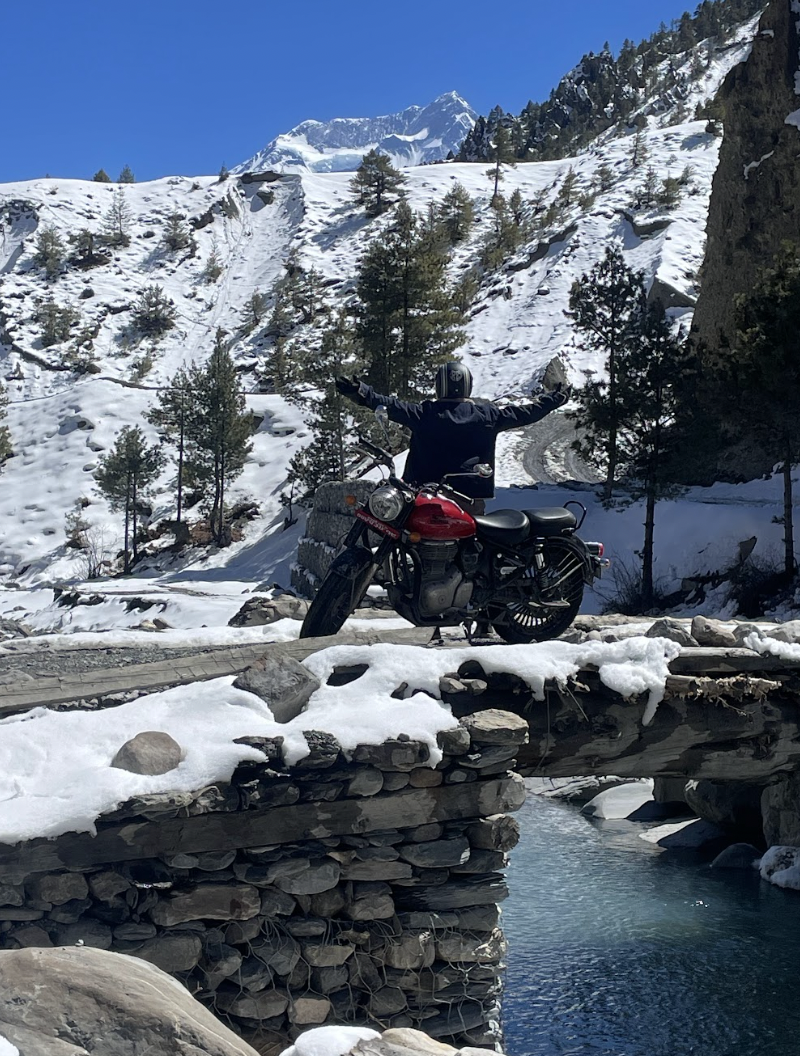
Both routes cut through the Himalayan heartland of Nepal. Both sit at high altitude. Both deliver scenery that makes riders stop their bikes, take off their helmets, and just stare. But beyond those shared qualities, Manang and Mustang are fundamentally different expeditions — in terrain, culture, difficulty, logistics, and the kind of rider each one is built for.
This comparison cuts through the overlap and gives you a direct, honest breakdown of both routes so you can choose the one that actually matches your riding level, your timeline, and what you want to take home from the Himalayas.
The Core Difference in One Paragraph
Manang is a deep-valley Himalayan ride through lush gorges, cascading waterfalls, and dramatic high-altitude glacial terrain, accessible, visually extraordinary, and suited to intermediate riders ready for their first serious Himalayan expedition. Mustang is a high-altitude desert ride into a restricted, culturally preserved ancient kingdom — more remote, more demanding, more logistically complex, and delivering a riding environment unlike anything else in the region. Manang impresses with natural drama. Mustang impresses with otherworldly isolation.
Route Overview: Where You Are Actually Going
The Manang Motorcycle Route
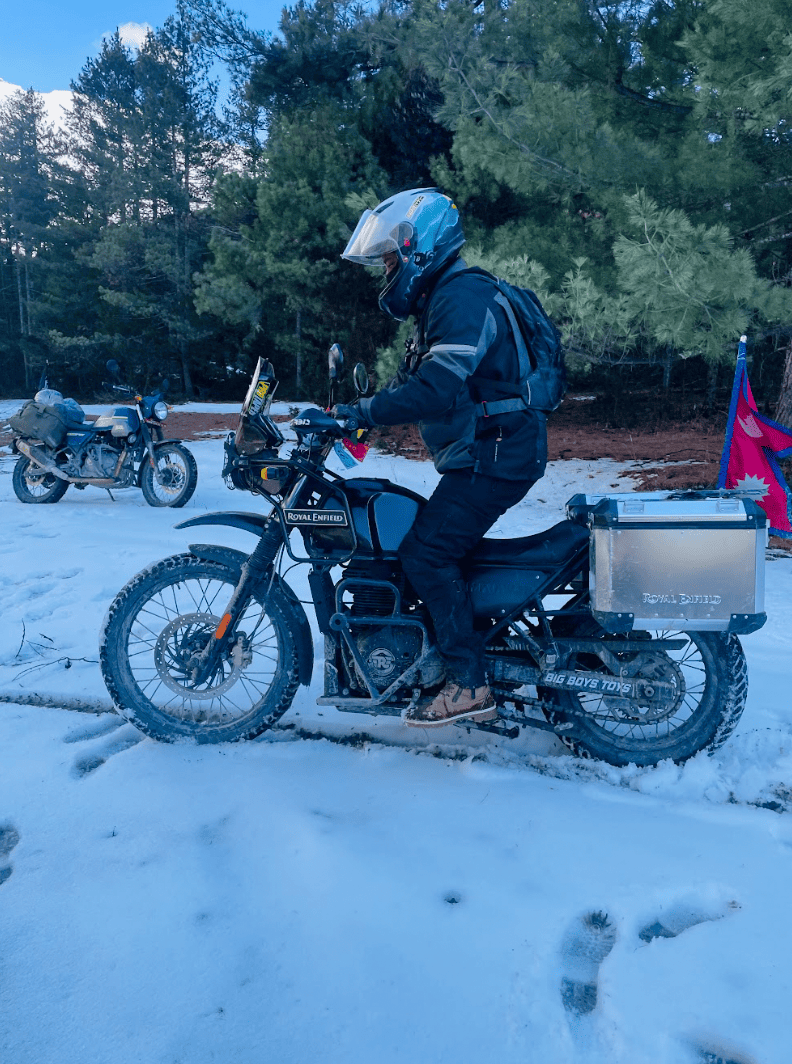
The route for Manang motorbike tour follows the Marsyangdi river valley northward from Besisahar into the Annapurna Conservation Area, climbing steadily through one of Nepal's most dramatic canyon systems before opening into the wide glacial basin surrounding Manang village at 3,519 metres.
Key route sections:
- Kathmandu / Pokhara → Besisahar (paved highway)
- Besisahar → Tal (lower Marsyangdi gorge — technical and scenic)
- Tal → Chame (mixed gravel, valley opens)
- Chame → Pisang (pine forest, high-altitude transition)
- Pisang → Manang (glacial valley, Annapurna panorama)
The landscape shifts dramatically every 20 kilometres. Subtropical vegetation in the lower gorge gives way to rhododendron and pine forests, which give way to barren high-altitude terrain surrounding Manang village, with Gangapurna Glacier and the Annapurna massif filling the skyline.
Total riding distance (Kathmandu to Manang): Approximately 250–280 km Typical riding days: 3–4 days to Manang (one way)
The Mustang Motorcycle Route
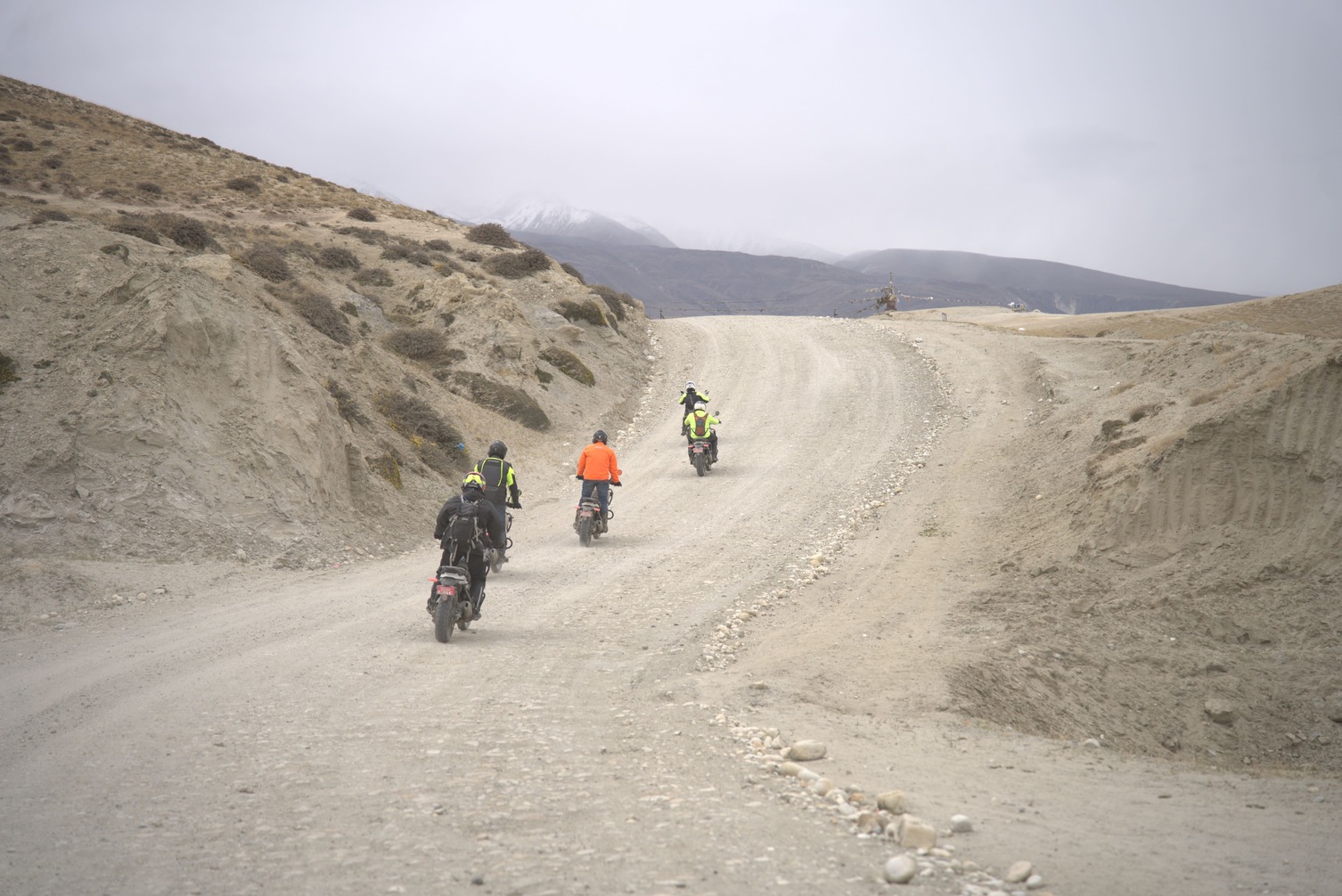
The route for Lower & Upper Mustang motorcycle tour follows the Kali Gandaki river valley northward from Pokhara through Beni, Tatopani, and Jomsom before crossing the restricted area entry checkpoint at Kagbeni and continuing through increasingly remote terrain to the walled city of Lo Manthang at approximately 3,840 metres.
Key route sections:
- Pokhara → Beni (paved highway warm-up)
- Beni → Tatopani (broken asphalt, first technical sections)
- Tatopani → Jomsom (river valley, wind begins)
- Jomsom → Kagbeni (transition, permit checkpoint)
- Kagbeni → Chele → Ghami → Tsarang → Lo Manthang (full off-road expedition)
The landscape in Mustang is defined by the rain-shadow desert effect. There is almost no vegetation above Kagbeni. Wind-carved cliffs, ochre canyon walls, ancient cave monasteries, and open dust plateaus replace any expectation of green Himalayan scenery. It looks more like the high deserts of Tibet than anything most riders associate with Nepal.
Total riding distance (Pokhara to Lo Manthang): Approximately 210–230 km Typical riding days: 8–12 days full expedition (return)
Terrain and Road Conditions Compared
Manang Route Terrain
The lower gorge sections between Besisahar and Tal are the most technically demanding parts of the Manang route — narrow, carved above the river, with loose gravel and occasional river crossings. Above Tal, the road progressively improves in quality as it gains elevation through Chame and Pisang.
Terrain difficulty profile:
- Lower gorge (Besisahar–Tal): Moderate to Hard — narrow, loose, weather-sensitive
- Mid-section (Tal–Chame): Moderate — mixed gravel, manageable
- Upper approach (Chame–Manang): Moderate — rough gravel, firmer surface
The Manang route has genuine technical sections but they are punctuated by better-quality stretches. It is a progressive difficulty route — harder at the start, more manageable as you climb.
Mustang Route Terrain
Mustang's terrain difficulty is inverse to Manang's — it gets progressively harder the further you go. The first two days from Pokhara to Kagbeni are manageable. Everything from Kagbeni to Lo Manthang is a different level of riding.
Terrain difficulty profile:
- Pokhara–Kagbeni: Easy to Moderate — paved to rough mixed surface
- Kagbeni–Chele: Hard — loose gravel, riverbeds, sudden elevation changes
- Chele–Lo Manthang: Hard — cliffside tracks, rocky climbs, desert plateaus, strong wind
Upper Mustang has no predictable surface. Loose gravel, sand, riverbeds, and narrow cliffside paths cycle continuously. The challenge is not any single section — it is the relentlessness of it over multiple days at altitude.
Verdict on terrain: Manang is more accessible and forgiving. Mustang is more sustained and demanding. If you are not yet confident on loose off-road surfaces, Manang is the correct first step.
Difficulty Level Compared
|
Factor |
Manang |
Mustang |
|
Overall difficulty |
🟡 Moderate |
🟠 Moderate to Hard |
|
Terrain type |
Gorge / gravel / glacial valley |
Desert / sand / cliffside / riverbed |
|
Off-road intensity |
Moderate |
High |
|
Daily riding hours |
4–6 hours |
6–9 hours |
|
Expedition length |
3–4 days (one way) |
8–12 days (return) |
|
Altitude peak |
3,519m (Manang village) |
~3,840m (Lo Manthang) |
|
Wind challenge |
Moderate |
High (Kali Gandaki wind tunnel) |
|
Navigation complexity |
Low–Moderate |
Moderate–High |
Manang is the right first Himalayan expedition for riders stepping up from road riding into serious mountain terrain. Mustang is the right next step for riders who have already proven themselves on multi-day off-road Himalayan routes.
Permits and Regulations Compared
Manang Permits
Manang sits within the Annapurna Conservation Area, which requires the ACAP permit (Annapurna Conservation Area Permit). There is no restricted area classification for Manang — it is open to all visitors. No special government permission or mandatory licensed guide is required for motorcycle riders entering Manang.
Permits required:
- ACAP Permit: NPR 3,000 per person (approximately USD 22–25)
- TIMS Card (Trekkers' Information Management System): NPR 2,000
Total permit cost for Manang: Relatively low and straightforward.
Mustang Permits
Upper Mustang is a legally restricted area that requires a specific government-issued permit beyond standard conservation area fees. The Restricted Area Permit (RAP) for Upper Mustang is among the most expensive trekking/riding permits in Nepal.
Permits required:
- Restricted Area Permit (RAP): USD 500 per person for the first 10 days (approximately NPR 67,000+), with additional fees per day beyond 10 days
- ACAP Permit: NPR 3,000
- Licensed guide: Mandatory — independent riding in the restricted zone is not permitted
Verdict on permits: Manang is significantly more affordable and logistically simpler to permit. Mustang involves a substantial permit investment that makes budget planning essential.
Scenery and Landscape Compared
What You See in Manang
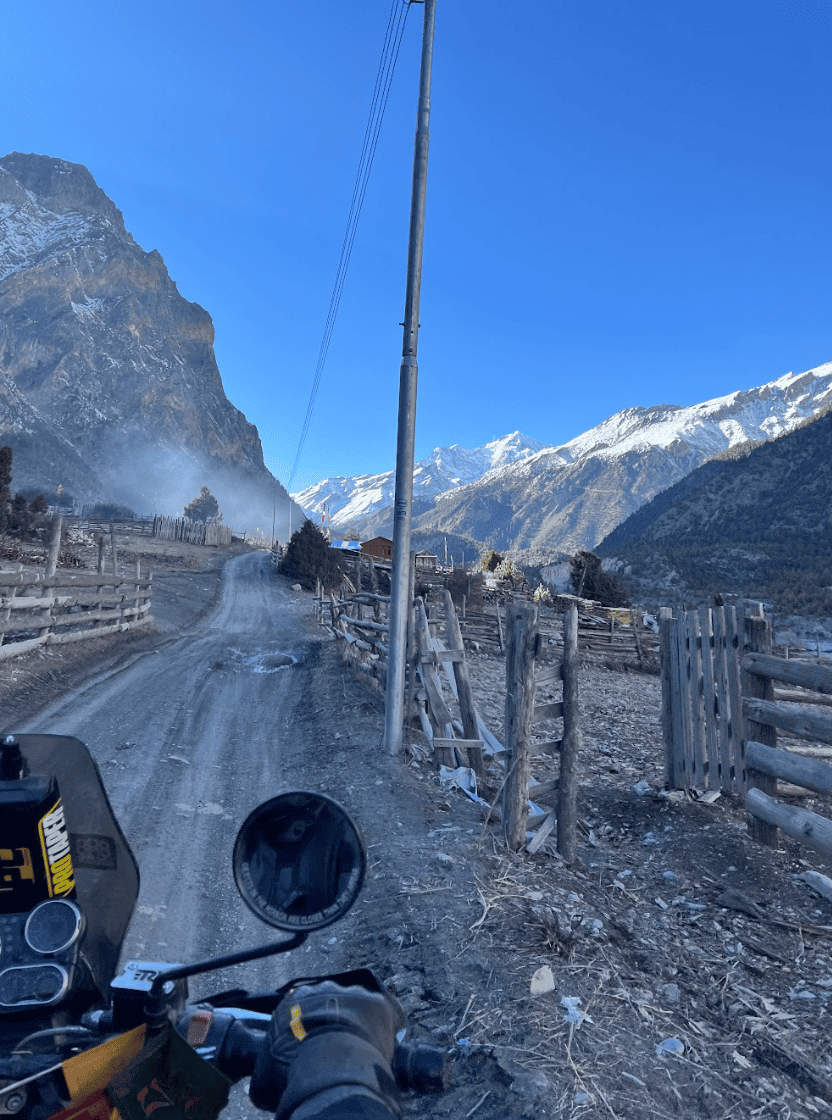
The Manang route delivers layered Himalayan scenery that changes dramatically with every elevation gain. The lower gorge is lush and dramatic — waterfalls cascade from hidden valleys above, the Marsyangdi river churns below, and the canyon walls rise steeply on both sides. By the time you reach Manang village, you are sitting in a glacial amphitheatre with Gangapurna Glacier on one side and the Annapurna III, IV, and II peaks forming the horizon.
Gangapurna Lake, just below the village, reflects the glacier and peaks in conditions that photographers specifically schedule their expeditions around. The scale of the terrain around Manang — massive, vertical, and snow-covered — is quintessential high Himalayan scenery.
What You See in Mustang
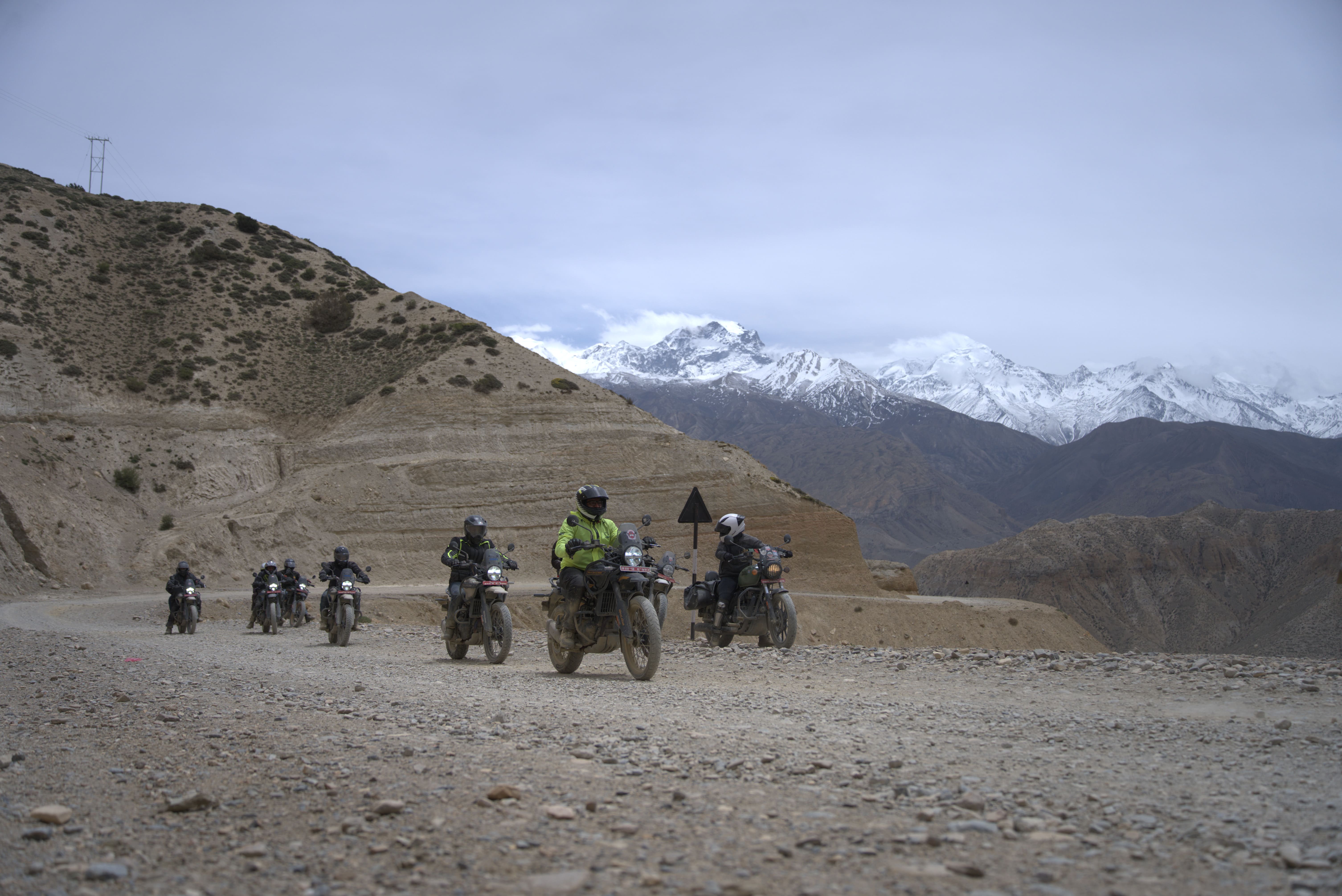
Mustang's landscape is nothing like conventional Himalayan scenery — and that is precisely its power. The rain-shadow desert strips away every expectation. Above Kagbeni, there is no green. What replaces it is a palette of ochre, rust, and deep red canyon walls sculpted by wind and water over millennia. The cave monasteries carved into cliff faces along the route have been occupied for centuries. Lo Manthang's ancient walled city — still inhabited, still functioning as a community — is one of the most extraordinary destinations accessible by motorcycle anywhere in Asia.
The landscape of Upper Mustang looks more like the high Tibetan plateau than Nepal, because culturally and geographically, that is largely what it is. Riders who arrive expecting Himalayan green are surprised. Riders who arrive prepared for desert isolation are transformed.
Verdict on scenery: Manang delivers dramatic natural Himalayan beauty — glaciers, waterfalls, massive peaks. Mustang delivers something rarer — an ancient cultural landscape that feels genuinely untouched by the modern world. Both are exceptional. They are just exceptional in different ways.
Cultural Experience Compared
Culture in Manang
Manang village and the communities along the lower route are predominantly Gurung and Manangi people — a trading culture with deep historical connections to both the Tibetan plateau above and the lowland markets below. The route passes through a progression of ethnic communities, each with distinct architectural styles, farming methods, and local traditions.
The cultural experience in Manang is authentic but accessible — riders interact with communities naturally along the route without needing special context or access.
Culture in Mustang
Upper Mustang's cultural experience is in a different category entirely. The Kingdom of Mustang, historically independent, with its own royal lineage, maintained near-complete isolation from the outside world until 1992. The communities in and around Lo Manthang practice a form of Tibetan Buddhism that has been preserved without interruption for centuries. Ancient monasteries, sky burials, Tiji festival ceremonies, and a way of life organised around traditions that predate modern Nepal by hundreds of years create an immersive cultural experience that very few motorcycle destinations on earth can match.
Verdict on culture: Manang offers a genuine and interesting cultural layer. Mustang offers one of the most intact ancient Himalayan cultures accessible to outsiders anywhere in the world. For riders who travel for cultural depth as much as road quality, Mustang is exceptional.
Cost Comparison
|
Expense |
Manang |
Mustang |
|
Permits |
USD 30–40 |
USD 150–250+ |
|
Guided tour requirement |
Optional |
Mandatory |
|
Typical full tour cost |
USD 400–700 |
USD 1,200–2,000+ |
|
Accommodation |
Budget to mid-range available |
Basic but consistent |
|
Fuel availability |
Available at key points |
Limited — carry extra |
|
Expedition length |
Shorter (3–4 days one way) |
Longer (8–12 days return) |
Manang is a significantly more affordable expedition at every level. Mustang's RAP permit alone adds USD 50/day to the trip cost before any other expenses. For riders with budget constraints, Manang delivers extraordinary value. For riders willing to invest in a once-in-a-lifetime destination, Mustang's cost reflects access to something genuinely irreplaceable.
Which Rider Should Choose Which Route?
Choose Manang If You:
- Are attempting your first serious Himalayan motorcycle expedition
- Have some gravel and off-road experience but are not yet confident on sustained technical terrain
- Have a limited time window of 7–10 days total
- Are riding on a tighter budget
- Want dramatic natural scenery — glaciers, waterfalls, massive peaks
- Plan to eventually do Mustang and want to build skills and altitude experience first
Choose Mustang If You:
- Have previous Himalayan or high-altitude off-road riding experience
- Are comfortable with sustained loose-surface riding for multiple consecutive days
- Have 12–16 days available for a full expedition
- Are prepared to invest in the permit and guided experience
- Want a cultural experience as profound as the riding experience
- Are specifically seeking remoteness, isolation, and the feeling of riding into a world apart
Can You Do Both in One Trip?
Yes, and for riders with three weeks or more available, combining both routes into a single Nepal motorcycle expedition is entirely feasible.
A practical combined itinerary runs: Kathmandu → Manang route (4 days) → Pokhara → Mustang route (8–10 days) → Pokhara → Kathmandu. This gives riders the full spectrum of what Himalayan motorcycle riding in Nepal offers — lush gorge riding, glacial scenery, high-altitude desert, ancient culture, and two completely different terrain challenges.
Riders who do this sequence consistently report that Manang builds both the physical conditioning and the technical confidence that makes the Mustang section significantly more enjoyable than it would have been without that warm-up.
Conclusion: Manang vs Mustang — Which Is Better?
Neither route is objectively better. They are built for different riders at different stages of their expedition riding journey.
Manang is better if you want your first serious Himalayan motorcycle adventure — dramatic, accessible, affordable, and genuinely rewarding for intermediate riders stepping up from standard road touring.
Mustang is better if you are ready for something that pushes further — more remote, more demanding, more culturally extraordinary, and ultimately more expensive. For riders who have already proven themselves in challenging terrain and are looking for an expedition that earns the word, Mustang is the answer.
The honest recommendation for most riders approaching this decision: ride Manang first, then come back for Mustang. The skills you build, the altitude adaptation you develop, and the confidence you gain on the Manang route will make your Mustang expedition safer, more comfortable, and far more enjoyable than arriving cold.
Either way, Nepal's Himalayas will deliver exactly what you came for. The question is only which chapter you are ready to write.
FAQ: Manang vs Mustang Motorcycle Tour
Q1: Which route is better for first-time Himalayan motorcycle riders?
Manang is the better starting point for first-time Himalayan riders. The route is shorter, permits are straightforward and affordable, the terrain is challenging but not as sustained as Mustang, and the lower altitude peak gives riders a more manageable acclimatisation experience. Mustang's difficulty, remoteness, and permit cost make it better suited as a second or third Himalayan expedition.
Q2: Which route has better scenery — Manang or Mustang?
They offer fundamentally different scenery rather than one being better than the other. Manang delivers lush gorge landscapes, waterfalls, rhododendron forests, and dramatic glacial basin scenery surrounding Manang village. Mustang delivers a high-altitude rain-shadow desert with ancient canyon walls, cave monasteries, and the walled city of Lo Manthang. Most riders who have done both describe Mustang's landscape as more unique globally, while Manang's is more classically Himalayan.
Q3: How much more expensive is Mustang compared to Manang?
Mustang is significantly more expensive, primarily due to the Restricted Area Permit which costs USD 500 per person for 10 days. A complete guided Mustang motorbike expedition typically costs USD 1,200–2,000 or more. A comparable Manang expedition runs USD 400–700. The permit cost difference alone is USD 460–470 per person.
Q4: Do you need a guide for both Manang and Mustang?
A guide is legally mandatory for Mustang — the Restricted Area Permit requires a licensed guide and independent riding in the upper zone is not permitted. For Manang, a guide is not legally required but is strongly recommended for first-time riders unfamiliar with the route, particularly for navigating the lower gorge sections and managing altitude.
Q5: Can you combine the Manang and Mustang routes in one Nepal trip?
Yes. A combined Manang and Mustang motorcycle expedition is feasible in approximately 18–22 days. The typical sequence is Kathmandu to Manang via the Marsyangdi valley, then Pokhara as the base for the Mustang expedition via the Kali Gandaki valley. This combination gives riders the full range of Nepal's Himalayan riding environments and is considered one of the great motorcycle journeys in Asia.