

.jpg)
There is a moment on the track between Kagbeni and Chusang in Upper Mustang where the road, if you can still call it that, narrows to a shelf of loose rock above the Kali Gandaki river, the wind picks up without warning from the south, and every variable that matters about your motorcycle becomes immediately, viscerally clear. Ground clearance. Weight. Handlebar width. The predictability of your throttle response on gravel. How well you know the bike's limits because the bike is simple enough to have readable limits.
At that moment, on that specific shelf of rock, above that specific river, the Royal Enfield Himalayan is not the most powerful machine available. It is not the most technologically sophisticated. It is not the fastest, the lightest, or the most expensive. It is, by a distance that matters in exactly the way distances matter on Himalayan roads, the most appropriate. And appropriateness, not specification, is what Nepal's mountain roads select for.
This article is a full technical and practical account of why, not the version that asserts dominance through marketing language, but the version that explains the specific mechanical, ecological, and economic reasons that make the Royal Enfield Himalayan the default machine of Nepal's high-altitude riding culture, and why that position is likely to persist regardless of what competitors bring to market.
Nepal's Roads as a Selection Environment
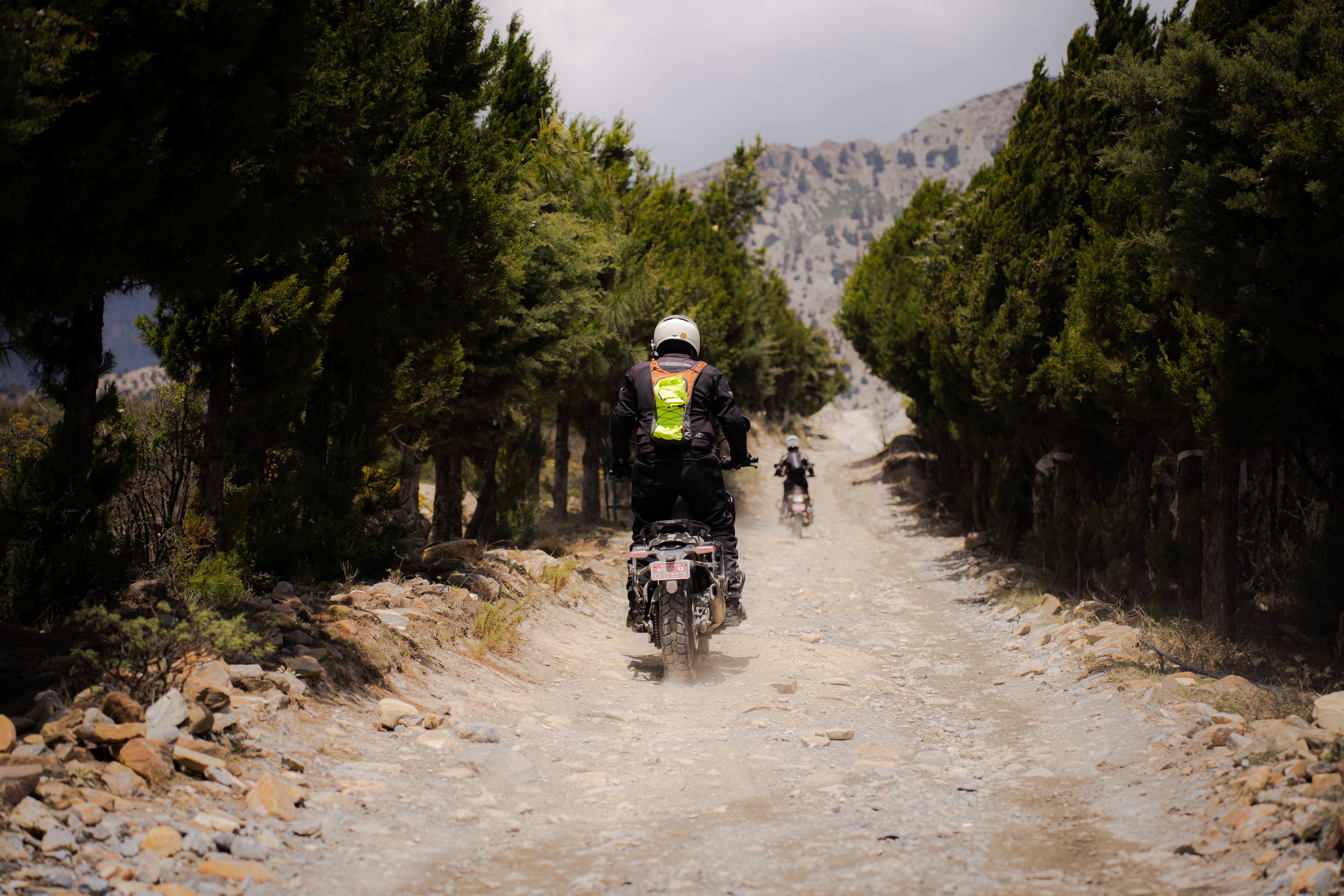
To understand why any motorcycle dominates Nepal's mountain roads, you first need to understand what those roads actually are, because the image in most people's minds when they picture Himalayan riding is significantly more romantic and significantly less accurate than the reality.
Nepal's mountain road network is not a single type of road. It is a spectrum. At one end, the Prithvi Highway between Kathmandu and Pokhara and the Siddhartha Highway south carry real tarmac, real traffic, and real road discipline of the kind recognizable to riders from any country. At the other end, the tracks into Upper Mustang above Kagbeni, the approaches to Tsum Valley, and the high-altitude roads of the Dolpo region are less roads than they are agreements between the landscape and the vehicles willing to cross it — loose river gravel, exposed limestone shelves, sections where the track is defined less by surface preparation than by the line previous vehicles happened to take.
Between these extremes lies the majority of Nepal's motorcycle touring terrain: paved sections interrupted by unpaved river crossings, maintained gravel tracks that deteriorate sharply after Monsoon and improve slowly after repair, road widths that accommodate one vehicle in each direction when conditions are favourable and require complex negotiation when they are not. Altitude ranges from under 1,000 metres in the Terai lowlands to over 5,400 metres at Thorong La on the Annapurna Circuit.
Any motorcycle claiming genuine suitability for Nepal's mountain roads must perform credibly across this entire spectrum, not excel at one end of it while becoming a liability at the other. That requirement immediately eliminates categories and specific models that would perform well on parts of Nepal's network while failing seriously on others. The Royal Enfield Himalayan does not fail seriously on any of it. That single fact is the root of its dominance, and every specific advantage below is either a direct expression of it or a consequence of the market position it produces.
Ground Clearance: The Number That Matters Most
The Royal Enfield Himalayan's 220mm of ground clearance is not a headline specification chosen for marketing purposes. It is a functional requirement for Nepal's specific road surface conditions, and the gap between it and most competitors in its price class is consequential rather than marginal.
Ground clearance determines whether a bike clears embedded rocks in a track surface, crosses a boulder-strewn river bed without contact damage to the engine or exhaust, and handles the sudden surface transitions, from compacted gravel to exposed rock shelf — that Nepal's mountain tracks produce regularly and without warning. At 220mm, the Himalayan clears the majority of these obstacles routinely. At the 150–170mm that characterises many road-biased adventure bikes in a similar price bracket, those same obstacles become a series of risks requiring conscious avoidance rather than obstacles that pass beneath the bike unremarkably.
The companion specification is suspension travel. The Himalayan's 200mm front fork travel and 180mm rear monoshock absorption are not luxury features on Nepal's roads. They are the mechanism by which the Himalayan converts the continuous low-frequency punishment of corrugated mountain tracks, hours of small, irregular impacts at speeds too slow for the vibration to be meaningfully absorbed by forward momentum — into a riding experience that leaves you tired but functional at the day's end rather than physically degraded in ways that affect the next day's riding and decision-making.
Both specifications were designed for the Indian subcontinent's road reality, which shares significant characteristics with Nepal's road environment. This design alignment is not coincidental, Royal Enfield is a subcontinental company, and the Himalayan was built for subcontinental conditions in a way that European and Japanese adventure bikes, designed for their own markets and road cultures, simply were not.
The Altitude Equation: Carburetion in a Thin-Air World
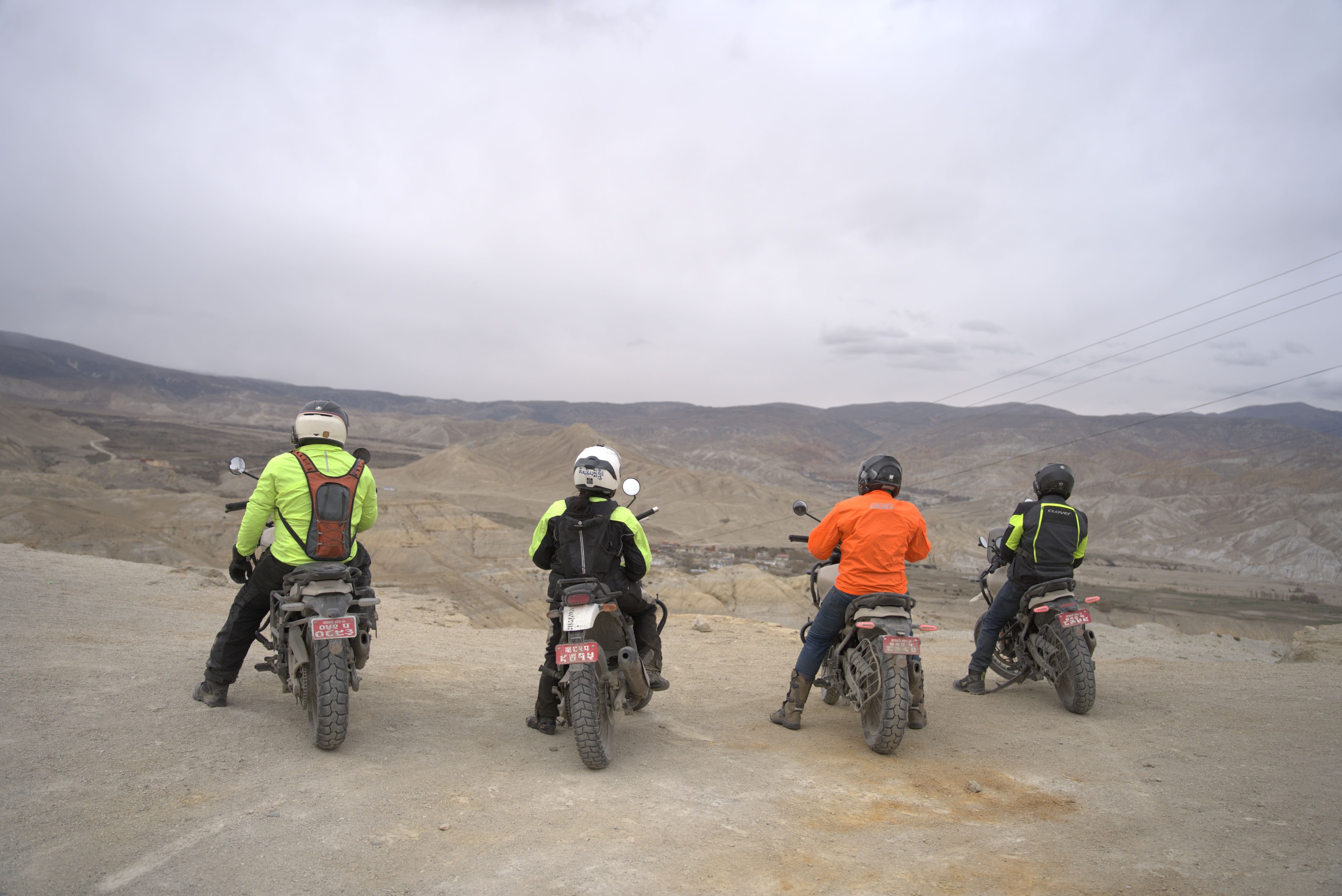
This is the most technically significant reason for the Royal Enfield Himalayan's Nepal dominance, and the least well understood by riders who approach the comparison from a specification-led perspective.
The BS4 Royal Enfield Himalayan, still the predominant model in Nepal's rental and privately owned fleet because it predates the BS6 emissions-standard transition uses a carbureted 411cc single-cylinder engine. Its competitor, the KTM 390 Adventure, uses fuel injection. The Honda CRF300L uses fuel injection. The Hero Xpulse 200 uses fuel injection. At sea level, fuel injection is in almost every measurable respect the superior technology — more precise fuel delivery, better cold-start performance, improved fuel economy, consistent throttle response across operating conditions.
At 4,500 metres above sea level, the calculation changes in one specific and critical way: fuel injection systems compensate for thin air automatically through oxygen sensor feedback and ECU adjustment, until they malfunction. When a fuel-injected engine develops a problem at altitude in a remote section of the Mustang district, the diagnosis requires electronic equipment. The repair requires either the correct replacement component or a diagnostic capability that is not available in most high-altitude settlements. The rider's options, in practice, are limited to waiting for transport to a town with a Royal Enfield or brand-specific dealer, which on the more remote routes means losing at minimum a day and potentially more.
A carbureted engine running rich at altitude, a common consequence of the reduced oxygen density at high elevation can be leaned out by any mechanically literate rider using a screwdriver and twenty minutes at a roadside stop. The adjustment is not complicated. The knowledge required to make it is widely distributed among mechanics across Nepal's mountain towns. The tools required cost less than a meal.
This distinction field-repairable with simple tools versus diagnostic-dependent is not a minor technical footnote in Nepal's high-altitude riding environment. It is the difference between a mechanical event that costs an hour and one that costs a day or more, and on routes where a day's riding represents a significant portion of the total trip, that difference matters enormously to everyone involved: the rider, the rental operator, and the guide responsible for keeping a group on schedule.
The BS6 Himalayan, which uses fuel injection, is gradually entering Nepal's fleet as older BS4 machines age out. The mechanical advantage of carburetion is therefore slowly diminishing at the fleet level. But the enormous installed base of BS4 machines currently operating on Nepal's routes means the mechanic knowledge, tooling, and spare parts infrastructure built around carbureted Himalayans remains deeply embedded in the country's motorcycle support culture and that infrastructure advantage persists long after the technical specification changes.
The Mechanics Network: A Century of Embedded Knowledge
Royal Enfield has operated continuously on the Indian subcontinent for over a century. The mechanical architecture of its single-cylinder engines, relatively uncomplicated, dimensionally stable across generations, tolerant of the kind of maintenance conditions that remote high-altitude riding produces, is understood not just by trained Royal Enfield mechanics but by a broad community of motorcycle technicians across Nepal, India, and the border regions connecting them.
This matters in a way that cannot be replicated simply by a competitor opening more dealerships. Mechanical knowledge of the kind that helps a rider on a remote Mustang track is not the knowledge that lives in a dealership manual. It is the knowledge that lives in a mechanic who has worked on the same basic engine architecture for fifteen years and has encountered, by direct experience, the specific failure modes that high altitude, river crossings, and sustained vibration on loose gravel produce. That mechanic exists in Jomsom. In Manang. In Beni. In Tatopani. In the towns that constitute the support infrastructure for Nepal's serious riding routes.
A KTM 390 Adventure that develops a fuel injection fault or an ABS sensor error in Kagbeni is in serious trouble. Not because KTM makes a bad motorcycle, it does not but because the knowledge required to diagnose and repair that specific fault does not exist in Kagbeni. The nearest KTM-competent mechanic is almost certainly in Kathmandu or Pokhara, a journey that from Kagbeni, with a non-functional motorcycle, is a logistical problem rather than a riding problem.
A Royal Enfield Himalayan with a loose carburettor jet, a worn clutch cable, or a slipping drive chain in Kagbeni is within reach of a mechanic who has fixed exactly those problems on exactly that engine architecture more times than they can readily count. The repair happens locally, quickly, and at a cost that reflects local labour rates rather than dealership service pricing.
Weight and Ergonomics: The Handling Reality of Technical Terrain
The Royal Enfield Himalayan's 182kg kerb weight sits in a range that experienced Nepal riders consistently identify as near-optimal for the specific demands of mountain track riding — heavy enough to maintain stability in crosswinds and on loose surfaces where a lighter bike can be thrown off line, light enough to be recovered from a low-speed fall without mechanical assistance or a second rider.
This matters because low-speed falls on Nepal's technical terrain are not exceptional events confined to inexperienced riders. They are routine occurrences that happen to experienced riders on river crossings, soft gravel approaches, and sections where the road surface conceals a transition that the front wheel finds before the rider's eyes do. A motorcycle that a rider can pick up alone, rebalance, and continue riding is a fundamentally different proposition in this environment from one that requires help to recover.
The ergonomics reinforce this advantage. The Himalayan's upright seating position, 800mm seat height, and wide handlebar sweep accommodate riders across a wide size range and allow the standing-on-pegs technique that technical off-road riding requires standing transfers weight to the footpegs, improves balance, and absorbs surface impacts through the legs rather than transmitting them to the spine. This technique becomes necessary rather than optional on Nepal's more technical sections, and the Himalayan's ergonomics support it without forcing an uncomfortable compromise position.
The seat height of 800mm is particularly significant for Nepal's rider demographics. Nepali riders, and the majority of riders from South and Southeast Asia who make up a significant proportion of Nepal's domestic motorcycle touring market, sit at heights where the 835–890mm seat heights of some competing adventure bikes become a genuine confidence issue at low speeds and at stops. A rider who cannot flatfoot their bike confidently at a stop on a steep, loose surface is not going to push that bike to its limits anywhere that matters. The Himalayan's 800mm seat height is not an accident of design, it reflects the market the bike was built for.
The Fleet Economics That Sustain the Dominance
The Royal Enfield Himalayan's dominance on Nepal's mountain roads is not only a function of its mechanical appropriateness. It is also sustained by an economic logic that governs how Nepal's motorcycle touring industry purchases, maintains, and replaces its fleet — and that economic logic strongly reinforces the Himalayan's position regardless of what competing motorcycles offer at the specification level.
A trekking agency or motorcycle tour operator building a fleet of eight to twelve machines in Nepal faces a specific economic calculation: purchase cost per bike, ongoing maintenance cost, parts availability and cost, mechanical downtime per machine, and resale or replacement value at end of working life. The Royal Enfield Himalayan wins this calculation at every stage.
Purchase cost sits significantly below the KTM 390 Adventure and Honda CRF300L at current Nepal market prices approximately NPR 20,00,000–22,00,000 versus NPR 8,00,000–11,50,000 for the KTM and NPR 500,000 or more for the BMW G 310 GS. Across a fleet of ten bikes, this difference represents a capital saving that buys considerable ongoing maintenance capacity.
Parts costs reinforce this advantage. Genuine Royal Enfield parts are available in Kathmandu with reasonable reliability, and compatible aftermarket components are widely stocked across Nepal's urban and semi-urban parts ecosystem. The same cannot be said for KTM, BMW, or Honda CRF-specific parts at comparable availability and cost outside the capital.
Maintenance intervals and service requirements favour the Himalayan's simpler mechanical architecture. A valve clearance check on the 411cc single is a straightforward task within the capability of any competent general mechanic. The equivalent task on a more complex multi-valve, fuel-injected engine from a European or Japanese competitor requires a higher skill level and typically more specialised tooling.
The combined effect of these economic factors is that operators running Royal Enfield Himalayan fleets maintain lower total cost of ownership than operators who diversify into competing models, even when those models carry genuine technical advantages. For commercial operators making rational fleet decisions, this arithmetic has repeatedly produced the same conclusion: the Himalayan.
Where the Himalayan Legitimately Falls Short
The dominance is real, and the reasons for it are substantial. The limitations are also real, and acknowledging them accurately is part of understanding why the dominance exists where it does and does not extend beyond its appropriate context. When you are on a motorcycle tour in Nepal, you will definitely feel the difference.
The Himalayan is not fast. Its 411cc single produces approximately 24 bhp, adequate for Nepal's mountain speeds, where the road surface sets the pace rather than the engine, and genuinely insufficient for riders who want to cover ground efficiently on Nepal's paved highways. A full day on the Prithvi Highway between Kathmandu and Pokhara on a Himalayan is a longer, more vibration-affected experience than the same day on a faster, smoother machine.
Vibration at sustained speeds above 80 km/h is a consistent criticism from riders who use the Himalayan on paved sections as well as technical terrain. The 411cc single inherits the characteristic vibration of large-displacement single-cylinder engines, and while this is manageable in the mountain context where speeds are lower and the rider is frequently standing on the pegs anyway, it becomes fatigue-inducing on long paved highway sections at cruising speed.
Build quality, while improved across successive generations, still receives criticism from riders comparing it to Japanese or European machines at equivalent price points. Fit and finish is not the Himalayan's strongest characteristic, and owners who delay maintenance in the way that a Honda might tolerate discover that the Royal Enfield punishes inattention more sharply. This is not a problem for well-run operators who maintain their fleets properly. It is a problem for budget rental operations where maintenance discipline is variable.
The BS6 fuel-injected transition addresses the emissions standards required for current production and importation but reduces the carburetor altitude advantage that is a significant reason for the BS4's Nepal dominance. As BS6 machines replace BS4 in the fleet, this specific advantage will diminish — though the parts ecosystem, mechanic knowledge, and economic advantages outlined above will persist considerably longer.
What Would Need to Change for a Competitor to Displace It
The Royal Enfield Himalayan's Nepal dominance is not simply a market position that better marketing could shift. It rests on four structural factors — mechanical appropriateness for the terrain, embedded regional service infrastructure, fleet economics that consistently favour it, and a mechanic knowledge base built over decades — any one of which would take years to replicate, and all four of which would need to shift simultaneously before a competitor could genuinely challenge the Himalayan's position.
A competitor would need to match or exceed the Himalayan's ground clearance and suspension travel at a price point the Nepal market can absorb. It would need to be simple enough mechanically that the knowledge to maintain and repair it could develop organically through Nepal's existing mechanic culture rather than requiring a parallel dealership infrastructure to be built from scratch. Its parts would need to be available in the towns where riders actually encounter mechanical problems, which means the supply chain would need to extend well beyond Kathmandu and Pokhara into the mountain trading towns that serve the serious riding routes. And the economics of fleet ownership would need to be competitive with a machine that has been continuously improving its Nepal-specific value proposition for years.
No current competitor meets more than one or two of these criteria. The Hero Xpulse 200 comes closest on mechanics and price but lacks the displacement and ground clearance for the most demanding routes. The KTM 390 Adventure exceeds the Himalayan on technical specification but fails on repairability, fleet economics, and parts availability outside the cities. The Honda CRF300L is a capable dual-sport but expensive for its engine displacement in Nepal's market and not optimised for long-distance touring loads.
The Himalayan's position on Nepal's mountain roads is not permanent in any absolute sense. Markets change, infrastructure develops, and a manufacturer willing to invest in the kind of long-term regional support infrastructure that Royal Enfield's century in the subcontinent has built could eventually shift the equation. But the timeline for that kind of structural change is measured in decades, not product cycles. For the foreseeable future, the Himalayan will continue to be what it is on Nepal's mountain roads: not the best motorcycle in the world, but the best motorcycle for this specific world, on these specific roads, in this specific environment. That is a considerably more durable kind of dominance than any specification sheet can generate. At Nepal moto tours, Royal Enfield Himalayan is one of the most chosen bikes.