We've seen riders turned away at the last minute because their travel insurance was inadequate. Not absent but inadequate. A policy that looked fine on paper, purchased in good faith, that excluded the two or three specific things that matter most on a high-altitude motorcycle expedition.
This guide exists to prevent that from happening to you.
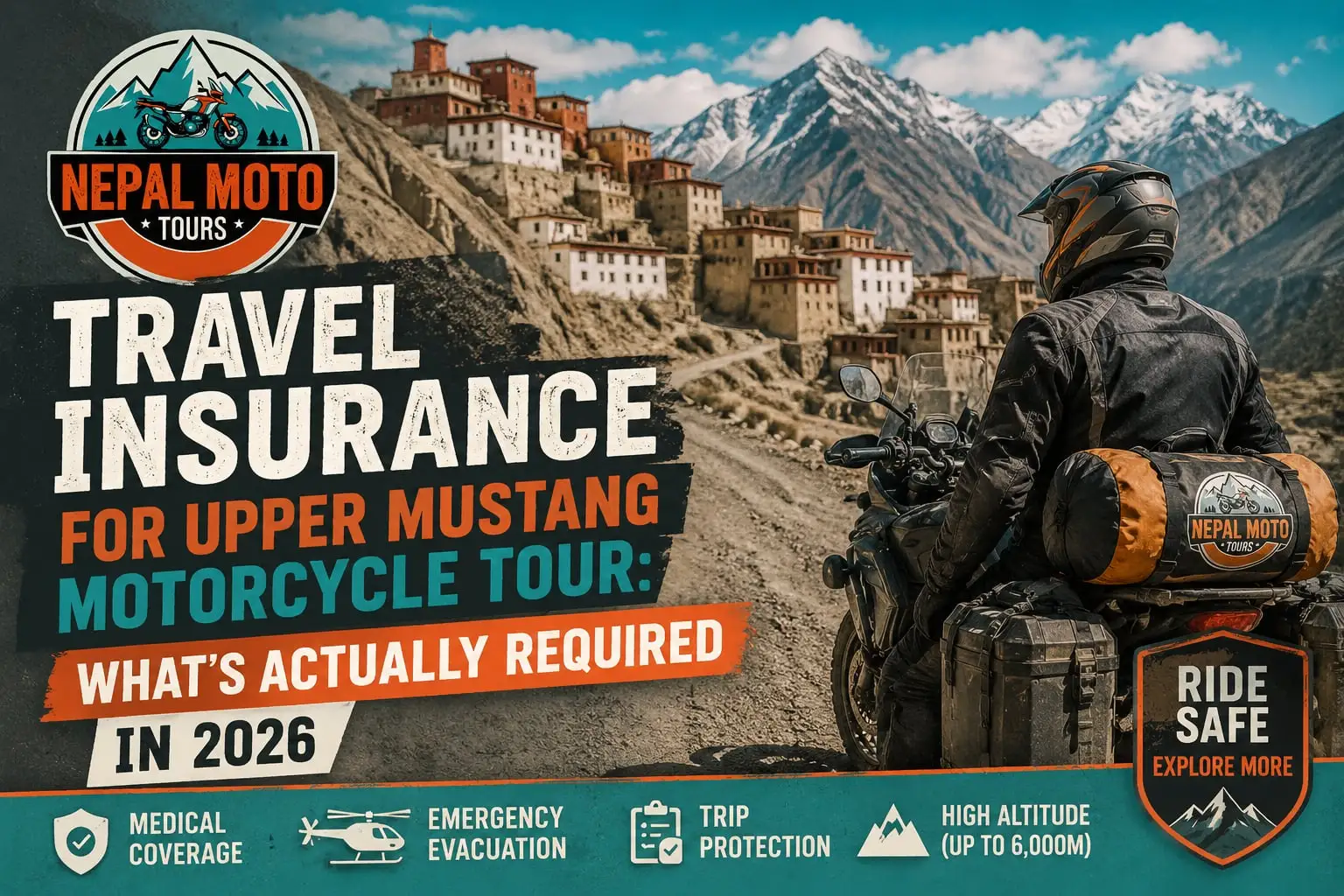
Travel insurance for the Upper Mustang motorcycle tour is not a box-ticking exercise. In a region with no hospitals, limited communication, and helicopter evacuation as the primary emergency response option, your insurance policy is part of your safety infrastructure as essential as your helmet and more consequential than your panniers.
What follows is the honest breakdown: what coverage you actually need, what standard policies routinely miss, what helicopter evacuation really costs without coverage, and the five insurance mistakes that experienced expedition riders have learned the hard way so you don't have to.
Why Upper Mustang Changes the Insurance Equation Entirely
Most travel insurance guides are written for travellers whose worst-case scenario is a cancelled flight or a stolen camera. The Upper Mustang motorcycle expedition operates in a different risk category, and your insurance needs to reflect that.
From Kagbeni northward into the restricted zone, you are riding at altitudes between 2,800 metres (Jomsom) and 3,840 metres (Lo Manthang), on off-road terrain that includes loose gravel, rocky riverbeds, sand trails, and narrow cliffside tracks — far from any meaningful medical facility.
The nearest hospitals with genuine emergency capacity are in Pokhara, roughly a full day's road travel from Lo Manthang under normal conditions. In an emergency — a serious fall, acute mountain sickness escalating to HACE or HAPE, a cardiac event — road transport is not a viable option. The only realistic emergency response is a helicopter evacuation.
A helicopter evacuation from Lo Manthang to Pokhara costs between USD $3,000 and $6,000, depending on conditions, aircraft availability, and weather delays. This is not a theoretical figure — it reflects actual evacuation costs from this region. Without insurance that explicitly covers this, that cost lands entirely on you, payable upfront before the helicopter lifts off in many cases.
That is why insurance is not optional for this expedition. It is a core operational requirement.
Is Travel Insurance Legally Mandatory for Upper Mustang?
This question gets asked constantly, and the honest answer has two parts.
Legally, by Nepal's government: No. The permit requirements for Upper Mustang — the Restricted Area Permit and the ACAP — do not include a mandatory insurance provision enforced by immigration authorities.
Practically, by reputable tour operators: Yes. Every legitimate Upper Mustang expedition operator requires proof of adequate travel insurance before confirming your booking. This is not bureaucratic overcaution. It is risk management based on direct experience of what happens in the restricted zone when things go wrong without coverage.
If you book with an operator who doesn't ask for insurance documentation at all, that absence is itself a warning sign about the quality of the operation. Nepal Moto Tours and other serious Upper Mustang expedition operators treat insurance verification as a non-negotiable pre-departure requirement, not because they're covering liability, but because they've operated these expeditions long enough to know what the consequences of inadequate coverage look like.
The practical position for 2026: treat travel insurance as mandatory. The legal technicality is irrelevant when you're at 3,800 metres with altitude sickness and the question is who's calling the helicopter.
The Four Coverage Categories You Cannot Compromise On
Standard travel insurance will not cover an Upper Mustang motorcycle expedition. This is the single most important sentence in this guide. Read it again.
The reason is structural: most travel insurance policies are designed for conventional tourism and exclude adventure activities, motorbiking, off-road riding, and high-altitude environments either explicitly or through altitude caps that your expedition will exceed.
Here are the four categories where your policy must deliver — and where standard policies most commonly fail.
1. High-Altitude Coverage (Minimum 4,000m)
Lo Manthang sits at approximately 3,840 metres. Several passes and approach tracks exceed 4,000 metres. Your insurance must explicitly cover activities at these elevations.
The most common failure point here: policies that include an altitude cap of 2,500m or 3,000m — a standard threshold that renders the policy useless for the core of your expedition. This cap is often buried in the exclusions section and not visible in the headline coverage summary.
What to verify: Read the full exclusions document, not the marketing summary. Search specifically for altitude caps. If the policy cap is below 4,000m, it is not suitable for Upper Mustang.
2. Motorcycle and Off-Road Riding Coverage
This is where the largest number of riders get caught out, and the reason is straightforward: many insurers classify motorcycle riding — particularly on bikes above 125cc — as a high-risk activity subject to exclusion. Off-road motorcycle riding is excluded even more commonly than road riding.
Upper Mustang is ridden on adventure bikes ranging from 200cc to 450cc, across terrain that is by definition off-road for the majority of the restricted zone section. Both the engine size and the terrain type need to be explicitly covered by your policy.
What to verify: Contact your insurer directly and ask specifically: "Does this policy cover motorcycle riding on bikes above 125cc on unpaved roads in Nepal?" Get the confirmation in writing. Do not rely on a general "adventure sports" inclusion without confirming motorcycle specifics.
3. Emergency Medical Coverage (Minimum USD $100,000)
Medical treatment costs in Nepal are lower than in many countries, but the coverage minimum needs to be high because severe cases require evacuation to Kathmandu and potentially medical repatriation to your home country.
A spinal injury from a serious fall, for example, requires emergency treatment, stabilisation, evacuation, surgery, and potentially air ambulance repatriation — a cost chain that can easily exceed $100,000 before you're home and recovering.
What to verify: Minimum $50,000 medical coverage is the absolute floor. $100,000 or above is the appropriate level for this expedition. Confirm that the coverage applies to injuries sustained during motorcycle riding specifically.
4. Helicopter Evacuation Coverage
This is the most critical single component of your Upper Mustang insurance and the most commonly excluded element in basic adventure policies.
Acute Mountain Sickness (AMS) can escalate to High Altitude Pulmonary Edema (HAPE) or High Altitude Cerebral Edema (HACE) — both life-threatening conditions that require immediate descent and medical treatment. Road descent from Lo Manthang is too slow to be viable in severe cases. Helicopter evacuation is the only appropriate response.
The cost structure for helicopter evacuation in the Upper Mustang region:
|
Evacuation Route |
Approximate Cost (USD) |
|
Lo Manthang to Pokhara |
$3,000 – $5,000 |
|
Ghami / Tsarang to Pokhara |
$2,500 – $4,500 |
|
Jomsom to Pokhara (lower risk) |
$1,500 – $3,000 |
|
Pokhara to Kathmandu hospital transfer |
$500 – $1,500 |
These costs are typically required to be confirmed or paid before evacuation proceeds. Without insurance cover, you or your emergency contact must arrange payment in real time, while you are in a medical emergency, in a remote area with limited communication.
What to verify: Confirm that helicopter rescue and mountain evacuation are explicitly included, not just ground ambulance or hospital transfer. Some policies cover the hospital but not the helicopter that gets you there.
The Real Cost of Getting This Wrong: Scenarios That Have Happened
These are not hypothetical. They are the type of scenarios that guides and operators who run Upper Mustang expeditions regularly encounter.
AMS escalation at Lo Manthang: A rider develops a severe headache on day two at altitude, dismisses it as dehydration, and by morning cannot stand without severe dizziness. Helicopter evacuation to Pokhara is required. Cost without insurance: approximately $4,500. Cost with adequate insurance: the coordination call to the insurer.
Fall on cliffside track between Chele and Ghami: A rider goes down on loose gravel on a narrow section, sustains a fractured collarbone and suspected rib fractures. Road evacuation to Jomsom takes six hours on rough terrain. Air transfer to Kathmandu for surgery is required. Total cost without insurance: $8,000–$15,000 depending on surgery and hospital. Cost with adequate insurance: the documentation process.
Severe weather stranding: An unexpected dust storm grounds helicopter operations for three days while a rider with early-stage HAPE waits in Lo Manthang. The insurance implication is not just evacuation but trip interruption coverage for the extended stay and rescheduled flights.
The common thread: these situations are not unusual in remote high-altitude expedition riding. They are the expected risk profile of this environment. Insurance doesn't prevent them. It determines whether they become manageable incidents or financially catastrophic ones.
Five Insurance Mistakes Upper Mustang Riders Make
Mistake 1: Buying the Cheapest Adventure Policy Available
The cheapest adventure travel insurance typically covers activities up to a certain altitude (usually 2,500–3,000m), excludes motorised vehicles or limits engine size to 125cc, and includes ground transport but not helicopter evacuation. It covers the risks of a moderate trekking holiday. It does not cover the risks of a restricted-zone motorcycle expedition at 3,840 metres.
The cost difference between a basic adventure policy and one with proper altitude, motorcycle, and evacuation coverage is typically $100–$200 for a 14-day trip. That difference is the correct investment.
Mistake 2: Assuming "Adventure Sports" Covers Motorcycling
"Adventure sports" is a marketing term, not a defined coverage category. Policies that advertise adventure sports coverage frequently include activities like white-water rafting, bungee jumping, and trekking at altitude — while specifically excluding motorised vehicles. Do not assume. Verify.
Mistake 3: Not Checking Altitude Caps in the Exclusions
This is the most common practical failure. The headline coverage looks appropriate. The exclusions section, which requires actual reading rather than skim-reading, contains an altitude cap that disqualifies your expedition. Check every policy's full exclusions document before purchasing.
Mistake 4: Assuming the Tour Operator's Insurance Covers You
It doesn't. Reputable Upper Mustang tour operators carry operational insurance that covers their liability in certain circumstances. That coverage is not your personal medical and evacuation insurance. Your personal coverage is always your own responsibility.
Mistake 5: Not Carrying Physical Proof of Insurance in the Field
Your insurance details, emergency contact number, and policy number should be on your person — in your jacket or pack — throughout the expedition, not just stored on a phone that may have no signal. Your guide should also have a copy. In an emergency, the ability to provide your insurer's emergency line immediately is what determines how quickly coordination begins.
What a Proper Upper Mustang Insurance Policy Looks Like
For reference, here is the coverage structure that experienced riders and reputable operators recommend as the minimum appropriate level for a 2026 Upper Mustang motorcycle expedition:
|
Coverage Category |
Recommended Minimum |
|
Emergency medical treatment |
USD $100,000 |
|
Helicopter / mountain evacuation |
Explicitly included, no sub-limit below $10,000 |
|
Medical repatriation |
Included |
|
Altitude coverage |
4,000m minimum, 6,000m preferred |
|
Motorcycle riding |
Explicitly included, 200cc+ and off-road |
|
Trip cancellation / interruption |
Included |
|
Personal liability |
USD $500,000+ |
Estimated premium range for this coverage level: USD $150–$350 for a 14-day expedition, varying by nationality, age, and insurer. This is the correct budget line for insurance — not $50–$80.
How to Verify Your Policy Before Booking
Before confirming any insurance purchase for an Upper Mustang motorcycle tour, run through this verification checklist:
Call or contact the insurer directly and ask the following questions verbatim:
- "Does this policy cover motorcycle riding on bikes above 125cc?"
- "Does the coverage extend to off-road riding on unpaved surfaces?"
- "What is the altitude coverage limit?"
- "Is helicopter evacuation and mountain rescue explicitly covered?"
- "Are there any exclusions for Nepal or Himalayan region travel?"
Get the responses confirmed in writing — by email is sufficient. Save that confirmation with your policy documents.
Submit proof to your operator before departure. Your Nepal Moto Tours guide or expedition coordinator will typically request your policy number and insurer emergency contact number before the tour departs Pokhara. Having this ready confirms to your operator that you're properly covered and removes a potential last-minute complication.
For a clear picture of what's expected from a rider's documentation before an Upper Mustang expedition, the Upper Mustang Motorbike expedition outlines the pre-departure requirements including insurance verification.
A Note on Travel Insurance and the RAP Permit System
The Restricted Area Permit system for Upper Mustang — the $50 per person per day structure in effect for 2026 — does not include any insurance provision. The permit fee covers your legal access to the restricted zone. It does not fund emergency services, evacuation coordination, or medical response.
The Nepalese government has no obligation under the RAP system to fund or coordinate your evacuation. The logistics of helicopter rescue in Upper Mustang depend on private operators, weather windows, and your insurer's coordination — not government infrastructure.
This is not a criticism of Nepal's permit system. It is a clarification that foreign riders sometimes misunderstand: paying for the RAP does not buy any safety net. That safety net is your personal insurance policy.
Seasonal Risk and Insurance Timing
The season you choose for your Upper Mustang motorcycle tour affects the risk profile and, by extension, the importance of certain coverage categories.
Spring (March–May): Stable conditions, lower weather risk. Core coverage requirements are the same — altitude sickness and accident risk don't change with the season.
Monsoon (June–August): Upper Mustang stays relatively dry, but approach roads south of Kagbeni can be affected by flooding and landslides. Trip interruption coverage becomes more relevant.
Autumn (September–November): The optimal season. Lower weather risk, best visibility. Core coverage requirements unchanged.
Winter (December–February): Highest risk season. Hypothermia and cold-weather injury become additional risk factors. Ensure your policy covers cold-weather medical events and route closure trip interruption.
For seasonal timing guidance on the full Upper Mustang route, Nepal Moto Tours' tour listings include seasonal operation schedules that reflect actual riding conditions month by month.
The Bottom Line
Travel insurance for the Upper Mustang motorcycle tour is not paperwork. It is the financial and logistical foundation that makes a safe expedition possible.
The coverage you need is specific: high altitude (4,000m+), explicit motorcycle and off-road riding inclusion, helicopter evacuation, and emergency medical coverage at a minimum of $100,000. The cost of getting this right is $150–$350. The cost of getting it wrong can be measured in thousands of dollars or, in the worst case, in hours lost coordinating payment while someone needs a helicopter.
Prepare your insurance the same way you prepare your bike and your gear — thoroughly, in advance, and with specific attention to what the terrain actually demands.
Planning your Upper Mustang expedition? Nepal Moto Tours runs fully guided Upper Mustang motorbike tours with experienced local guides, full permit coordination, and pre-departure insurance verification built into their booking process. Get in touch to plan your 2026 dates.
Tags: travel insurance Upper Mustang motorcycle tour, Upper Mustang bike tour insurance 2026, helicopter evacuation Nepal motorbike, adventure motorcycle insurance Nepal, Upper Mustang RAP permit insurance, high altitude motorcycle insurance, Nepal motorbike expedition insurance
Frequently Asked Questions
Is travel insurance legally required for the Upper Mustang RAP permit?
No — Nepal's government does not legally require insurance as a condition of the Restricted Area Permit. However, virtually all reputable expedition operators require it as a booking condition, and the practical risk of riding this region without adequate coverage makes it essential regardless of legal status.
What altitude coverage does my insurance actually need?
A minimum of 4,000 metres is recommended. Lo Manthang sits at approximately 3,840m, but some passes and tracks in the region exceed 4,000m. A 6,000m altitude limit provides appropriate headroom and is the standard for serious Himalayan adventure insurance.
Will my existing travel insurance from home cover this trip?
Almost certainly not in full. Most standard and even standard-tier adventure travel policies exclude motorcycle riding, off-road activities, or altitude above 3,000m — often all three. Your existing policy needs to be specifically verified against the coverage requirements listed in this guide.
What happens if I have no insurance and need evacuation?
You are responsible for evacuation costs in full, payable before or immediately after the evacuation. Costs typically range from $3,000 to $6,000+ for helicopter evacuation from the Upper Mustang zone to Pokhara. Your expedition operator and guide can assist with coordination but cannot fund or guarantee evacuation costs on your behalf.
Does my operator's insurance cover me as a rider?
No. Operator insurance covers the company's liability in certain defined circumstances. Your personal medical, evacuation, and trip interruption coverage is always your individual responsibility.