
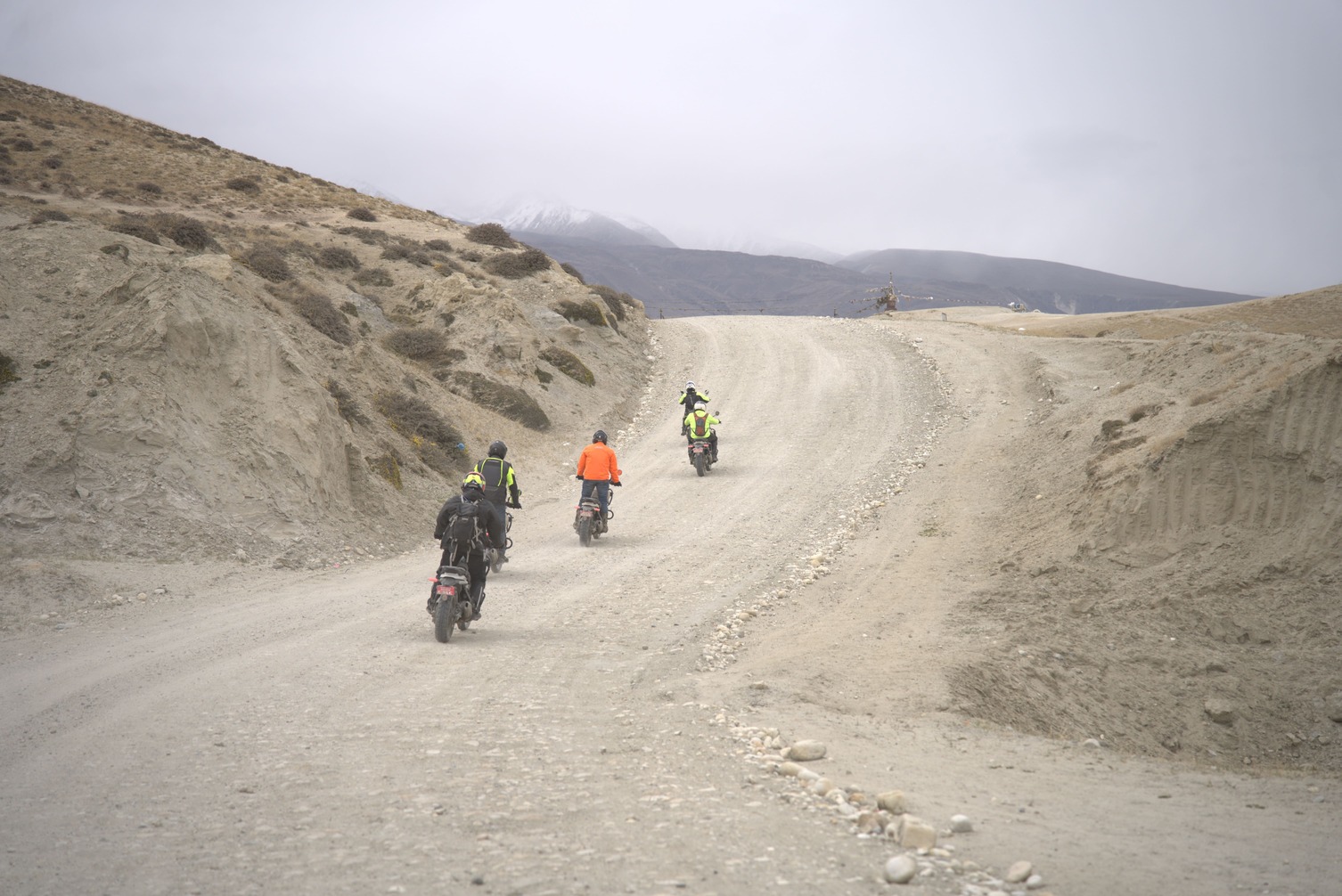
Upper Mustang is not just another Himalayan motorbike destination, it is a high-altitude cold desert where weather is not a background factor, it is a primary riding condition. However, Upper Mustang remains one of the bucket list destinations for tourists coming for motorcycle tours in Nepal
Every seasoned adventure rider knows that terrain is only half the battle. The other half? Understanding the environment you are riding through, and in Upper Mustang, that environment is defined by wind, dust, brutal UV exposure, and temperature swings that can shift 20°C between sunrise and mid-afternoon.
Many experienced off-road riders who are completely comfortable on gravel and rocky Himalayan tracks arrive in Upper Mustang and get blindsided. Not by the road. By the wind pushing them off line on an open plateau. By the dust cloud that drops visibility to 50 metres. By the cold morning that tightens every muscle before they have even started the engine.
This guide breaks down Upper Mustang weather conditions in full detail — seasonal patterns, daily wind cycles, dust zones, temperature impacts, and the riding strategies that experienced expedition riders use to manage it all safely.
Understanding Upper Mustang's Unique Climate
Upper Mustang sits in the trans-Himalayan region of Nepal, positioned just north of the great Annapurna and Dhaulagiri mountain ranges. Geography is the key to understanding everything about its climate.
Most people expect Himalayan weather to mean monsoon rains, fog, and cold temperatures. Upper Mustang defies that expectation entirely. Because the Annapurna and Dhaulagiri massifs act as a massive natural wall, blocking the moisture-laden monsoon clouds that drench the rest of Nepal every summer, Upper Mustang exists in a rain-shadow desert zone — dry, arid, and unlike anything else in the region.
The result is a climate that behaves far more like the high-altitude deserts of Central Asia than the Himalayan foothills below. For motorbike riders, that distinction matters enormously.
What Makes Upper Mustang's Weather Different From Other Himalayan Routes
Riders who have previously done Manali-Leh, the Spiti circuit, or the lower Annapurna region arrive in Upper Mustang with a set of expectations built from those experiences. Most of those expectations need updating.
Five distinct characteristics define Upper Mustang's climate:
- Extremely low rainfall — Even during the monsoon months, the upper zone rarely sees significant precipitation
- Strong valley winds — Particularly powerful in the Kali Gandaki corridor, creating a natural wind tunnel effect
- High UV radiation — Altitude amplifies sun intensity significantly, burning exposed skin faster than most riders expect
- Dry, low-humidity air — Dehydration is faster and less noticeable here than in humid mountain environments
- Large day-to-night temperature swings — Differences of 20–25°C between afternoon and pre-dawn temperatures are common
This combination creates a riding environment that is harsh but largely predictable — and predictability is something expedition riders can work with, provided they understand the patterns.
The Rain Shadow Effect and What It Means for Riders
The Annapurna-Dhaulagiri barrier is one of the most dramatic rain-shadow boundaries on earth. Monsoon systems moving in from the Bay of Bengal lose almost all their moisture when they rise over these 8,000-metre walls. By the time any atmospheric moisture reaches Upper Mustang, there is almost nothing left.
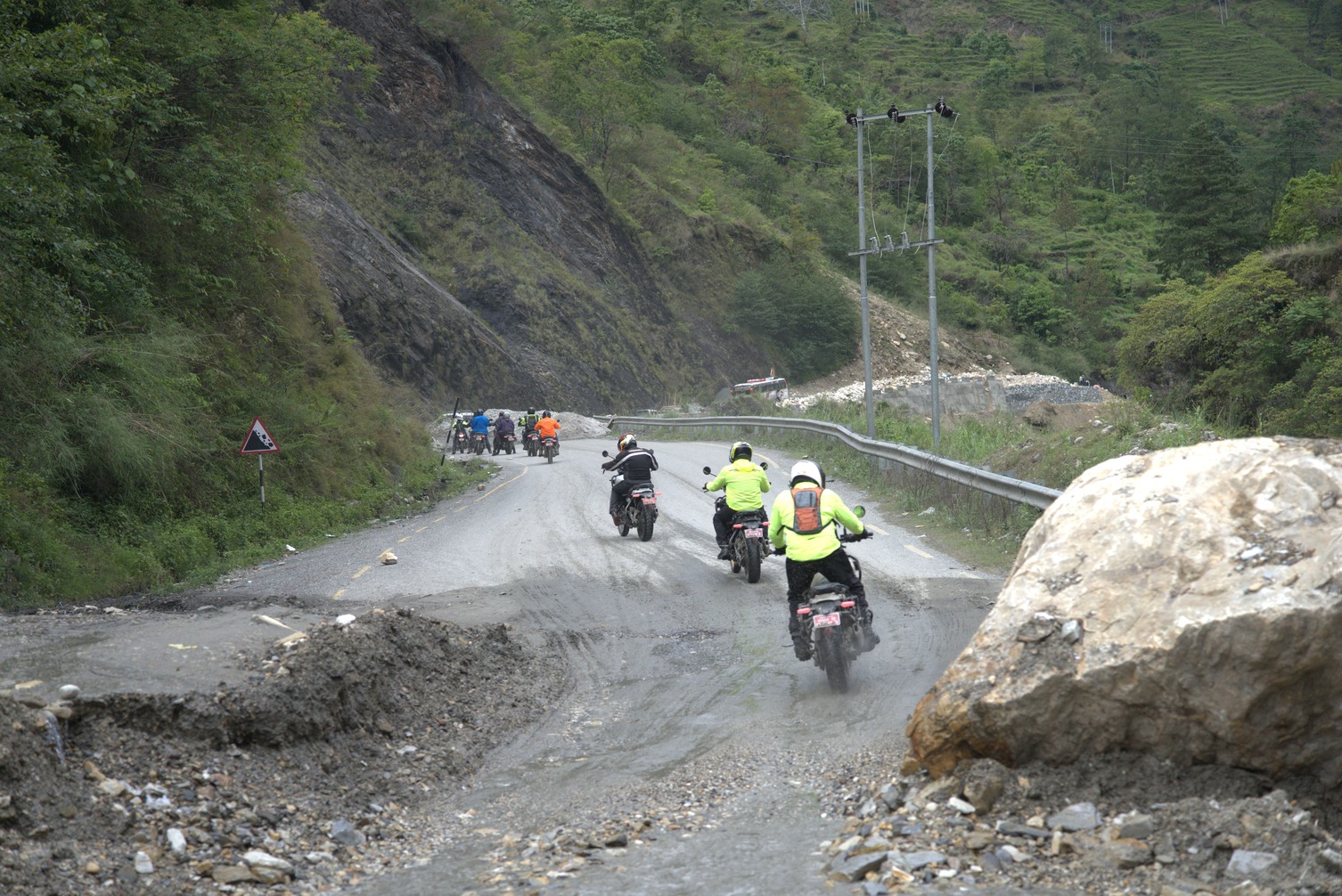
For riders, this has one major practical implication: Upper Mustang roads stay rideable even during Nepal's monsoon season. While routes in lower Nepal and even the lower sections of the Mustang approach road can flood or become dangerously muddy between June and August, the upper zone remains dry. The dust stays loose, the gravel stays loose, and the terrain continues behaving like a desert — because that is exactly what it is.
The trade-off is that without moisture, dust suppression is zero. Every vehicle, every gust of wind, every passing yak caravan kicks dust into the air. In peak season with multiple groups on the trail, dust becomes a near-constant companion.
Seasonal Weather Breakdown for Upper Mustang Motorbike Tours
Understanding the four riding seasons in Upper Mustang is the foundation of any expedition plan. Each season presents a genuinely different riding environment — not just in comfort, but in technical difficulty and safety risk.
Spring Season (March to May) — Best Overall Riding Season
Spring is the first-choice season for Upper Mustang motorbike expeditions, and the conditions make the reason clear.
After winter's deep cold breaks, the landscape opens up with stable weather, manageable winds, and the clearest air quality of the year. Dust levels are lower than in summer because the terrain retains some residual moisture from winter, and the winds have not yet reached their peak intensity.
Temperature range:
- Daytime: 10°C to 20°C
- Nighttime: -2°C to 5°C
What riding feels like in spring:
The mornings are cold but energising. Proper layering gets you through the first couple of hours comfortably, and by mid-morning, the sun has warmed the air to pleasant riding conditions. Winds are present — they are always present in Upper Mustang — but spring sees them at their most moderate, typically not hitting their most disruptive intensity until mid-afternoon.
Visibility is excellent across most of the spring. The combination of low dust and clear skies means you can see the surrounding Himalayan panorama from the trail, which adds to the experience significantly when you are riding through a landscape this dramatic.
Spring advantages for riders:
- Best dust-to-visibility ratio of any season
- Stable daily weather patterns (easier planning)
- Comfortable temperature window through most of the day
- Wildflowers add visual texture to the landscape between Tatopani and Jomsom
- Road surfaces are firmer from residual winter moisture
One consideration: Spring is the most popular riding season, which means more groups on the trail simultaneously and more dust generated by traffic. Plan your daily start times to stay ahead of the convoy.
Summer Season (June to August) — Monsoon Shadow Period
Summer in Upper Mustang is more rideable than it sounds, but riders need to enter with accurate expectations rather than standard Himalayan assumptions.
Because of the rain-shadow effect, the upper zone remains dry while the rest of Nepal is soaked. This makes June-August a viable riding window that many riders overlook. The challenge is that summer brings the most intense wind and the highest dust levels of the entire year.
Temperature range:
- Daytime: 15°C to 25°C
- Nighttime: 5°C to 10°C
What riding feels like in summer:
Mornings are genuinely pleasant — the warmest mornings of the year, with comfortable temperatures from the first hour. The problem is what happens from midday onward. Summer afternoons in Upper Mustang can push wind conditions to their seasonal peak. The same valley geography that makes this landscape spectacular creates a powerful natural wind tunnel, and in summer, that tunnel runs hard.
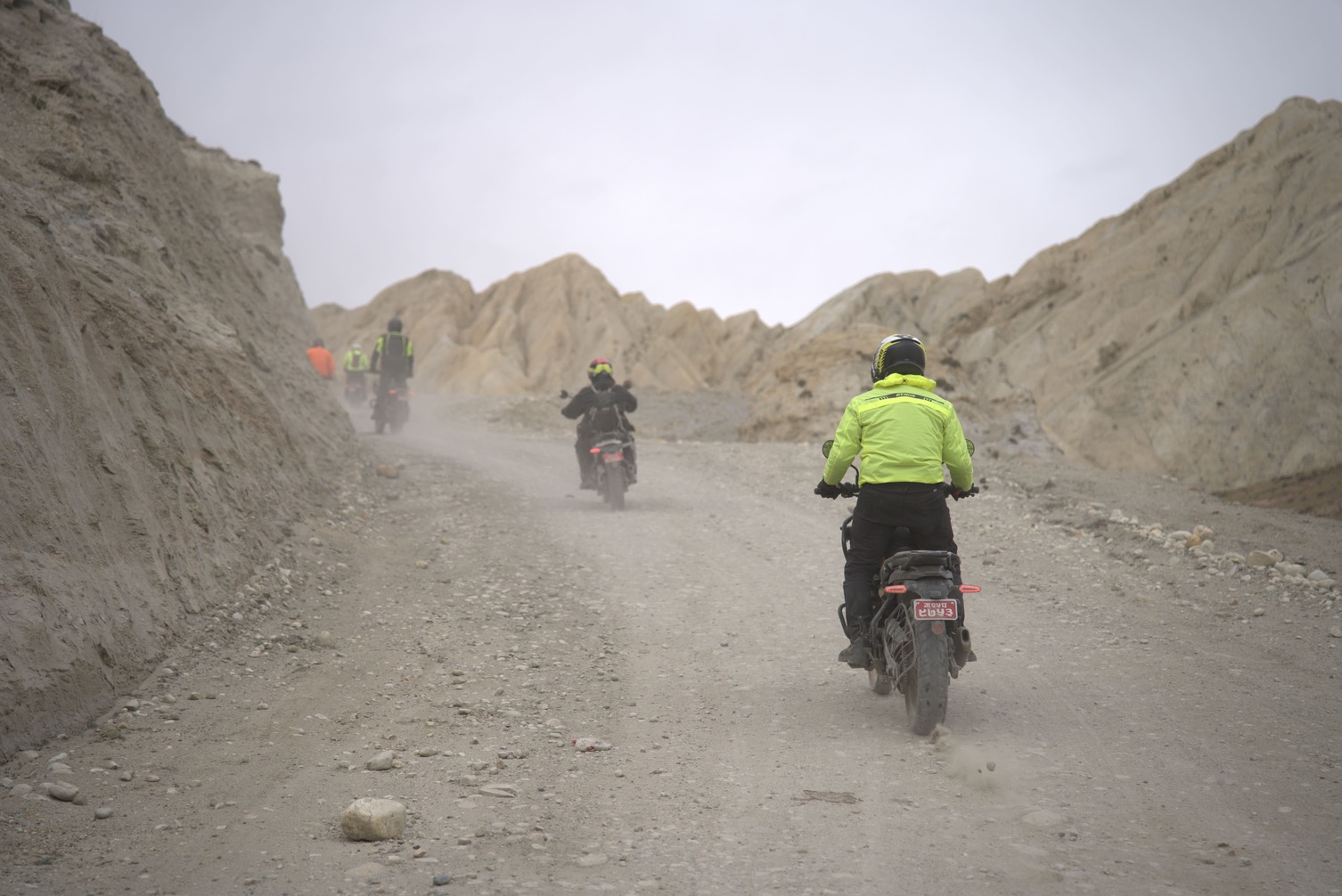
Dust levels in summer are the highest of any season. The combination of dry terrain, strong winds, and increased traffic (from riders taking advantage of the monsoon-free upper zone) means dust is pervasive. Visibility reductions to 50–100 metres are not uncommon in the worst sections during peak afternoon wind.
Summer riding reality check:
The lower approach sections between Beni and Tatopani can be significantly more challenging in summer due to monsoon-affected roads below the Mustang zone. Riders should check the condition of the lower sections before departure, as some years see significant road damage in these areas even while upper Mustang remains dry.
Summer advantages:
- Warmest temperatures of the year (cold mornings are manageable)
- Upper zone is dry when everything else in Nepal is wet
- Fewer tour groups than in the peak spring/autumn seasons
- Unique desert summer atmosphere
Summer challenges:
- Strongest winds of the year
- Highest dust levels
- Lower approach roads are potentially affected by the monsoon
- Dehydration risk increases with a combination of heat and dry air
Autumn Season (September to November) — Second Best Season
Autumn runs close to spring as the best riding season, and for many experienced riders, it edges ahead on a key metric: visibility.
After the monsoon clears in late August and September, Upper Mustang enters what is arguably its most photogenic and technically cleanest riding window. The air is washed clear, the sky is an almost aggressive shade of blue, and the mountains surrounding the trail come into sharp relief.
Temperature range:
- Daytime: 8°C to 18°C
- Nighttime: -5°C to 5°C
What riding feels like in autumn:
Slightly cooler than spring, but the visual clarity is exceptional. Morning starts require full cold-weather layering, but the payoff is riding into conditions that most riders describe as the most consistently beautiful of any season. The terrain is at its most compact and predictable — the summer's loose dust has partially settled, the ground is firmer, and the overall riding quality is excellent.
Wind in autumn is moderate, lower than summer, comparable to spring. The main difference is that temperatures drop faster in the afternoon as the season progresses toward November, compressing the optimal riding window slightly.
Autumn advantages:
- Best mountain visibility of any season
- Stable, predictable weather patterns
- Well-settled road surfaces
- Excellent photography conditions
- Popular season means good group companionship on the trail
Autumn caution for November riders:
Late November marks the beginning of the transition toward winter conditions. Night temperatures can drop significantly below freezing, morning starts become demanding, and high sections may see the first snowfall of the season. Plan to complete the expedition before mid-November for the most comfortable conditions.
Winter Season (December to February) — Not Recommended for Motorbike Tours
Winter in Upper Mustang is not a riding season — it is a survival environment.
Temperatures at altitude drop to -15°C and lower overnight. High passes and plateau sections can receive snowfall that makes off-road riding not just difficult but genuinely dangerous. Many guesthouses in the upper zone reduce services or close entirely, and the logistical support network that makes the route manageable in other seasons is significantly thinner.
Temperature range:
- Daytime: 0°C to 10°C
- Nighttime: -15°C or lower (significantly colder at higher elevations)
For virtually all adventure riders, winter is the right time to plan the expedition — not to do it. The single exception would be highly experienced cold-weather riding specialists with full expedition-level gear and specific preparation for sub-zero mountain conditions. For everyone else, the risk-to-reward ratio in winter is simply unfavourable.
Wind Conditions in Upper Mustang: The Defining Weather Factor
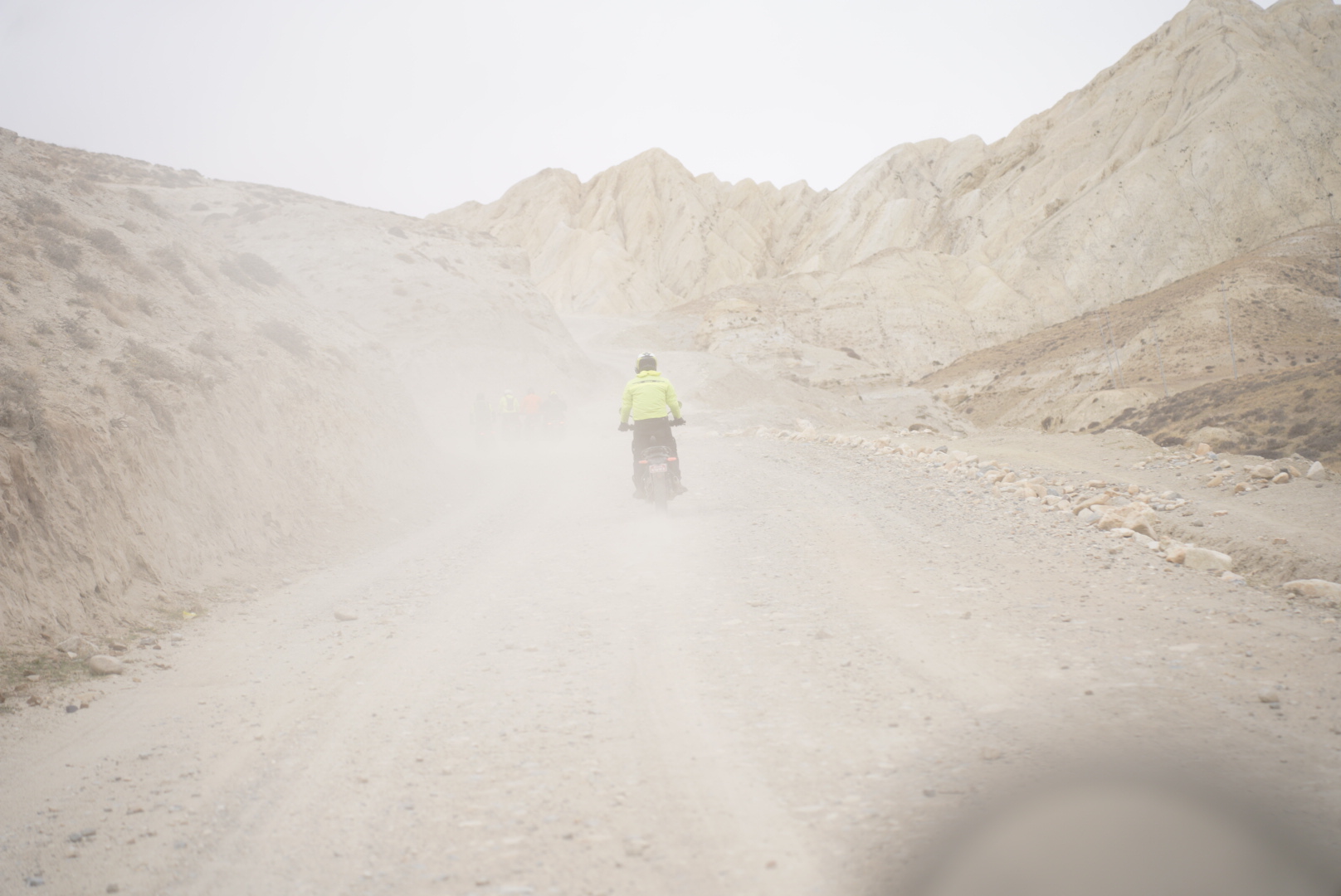
Wind is the single most important weather element to understand before riding in Upper Mustang.
Terrain can be studied, altitude can be acclimatised to, and dust can be managed with the right gear. Wind is different. Wind is dynamic, immediate, and physically intrusive in a way that no amount of reading can fully prepare you for until you experience it on the trail.
Why Upper Mustang Is So Windy
The answer is in the geography. The Kali Gandaki river valley — which forms the main corridor through which the Upper Mustang route travels — is one of the deepest gorges on earth. This narrow channel between towering ridgelines creates a textbook natural wind tunnel.
As the day heats up and thermal activity increases, air is pulled through this corridor with increasing force. The valley acts as a pressure differential engine: cold air from the high plateau moves toward the warmer lowlands, and the narrow valley amplifies the speed and intensity of that movement significantly.
The result is a predictable but powerful daily wind cycle that every rider on this route must understand and plan around.
The Daily Wind Cycle in Upper Mustang
Understanding this cycle is not optional — it is the most important piece of practical weather knowledge for any Upper Mustang motorbike expedition.
Morning (6:00 AM – 10:00 AM) — The Golden Riding Window
This is the best riding period of the day. Wind is calm or very light. Visibility is at its clearest. The air is cold but still, and the trail is as predictable as it will be all day. Every experienced rider on this route prioritises getting maximum distance covered during this window.
Mid-Morning to Midday (10:00 AM – 12:00 PM) — Wind Begins Building
The thermal cycle kicks in as the sun heats the valley floor. Wind begins picking up, incrementally at first. Dust starts lifting from the trail surface. This is the window where riders need to be making pace decisions — either pushing to cover critical exposed sections before conditions deteriorate, or identifying a good midday rest point.
Early Afternoon (12:00 PM – 3:00 PM) — Wind is Active
Wind is now consistently affecting riding. Gravel and loose terrain become significantly more challenging to navigate in a straight line. Dust is airborne and reduced visibility starts requiring more caution in group riding. This period demands active wind-compensation in riding technique — particularly on exposed plateau sections and near cliff edges.
Peak Afternoon (3:00 PM – 6:00 PM) — Strongest Winds of the Day
This is the most challenging weather window of the Upper Mustang riding day. Wind can reach speeds sufficient to push a loaded adventure bike sideways on open terrain. Visibility can drop sharply with wind-lifted dust. Rider fatigue — already accumulated from the day's riding — combines with the physical effort of fighting the wind to create a meaningful safety risk.
Experienced guides and expedition operators typically aim to have riders at their destination or a protected rest point before this window. Riders who are still on exposed sections in the peak afternoon are dealing with conditions that were entirely predictable hours earlier.
Evening (After 6:00 PM) — Wind Drops, Temperature Falls
As thermal activity decreases with the setting sun, wind reduces significantly. The trail becomes calm again — but by this point, riding is finishing and temperatures are dropping fast. The same evening that brings calm air also brings the cold night.
How Wind Directly Impacts Bike Control
Understanding the mechanism matters, not just the timing.
Wind affects motorbike control in Upper Mustang in three specific ways:
- Lateral force on the bike — Strong crosswinds push the loaded bike off its intended line. On open plateaus this is manageable with technique. On narrow cliffside tracks it becomes genuinely dangerous.
- Traction disruption on loose surfaces — Wind-driven movement of loose gravel and sand continuously shifts the surface under tyres. This is not like riding gravel in calm conditions. The surface is actively moving.
- Accelerated rider fatigue — Holding position against consistent wind pressure requires constant muscular effort. This is separate from riding fatigue and adds to the cumulative physical load of a long expedition day in ways many riders do not anticipate.
Dust Conditions Along the Upper Mustang Route
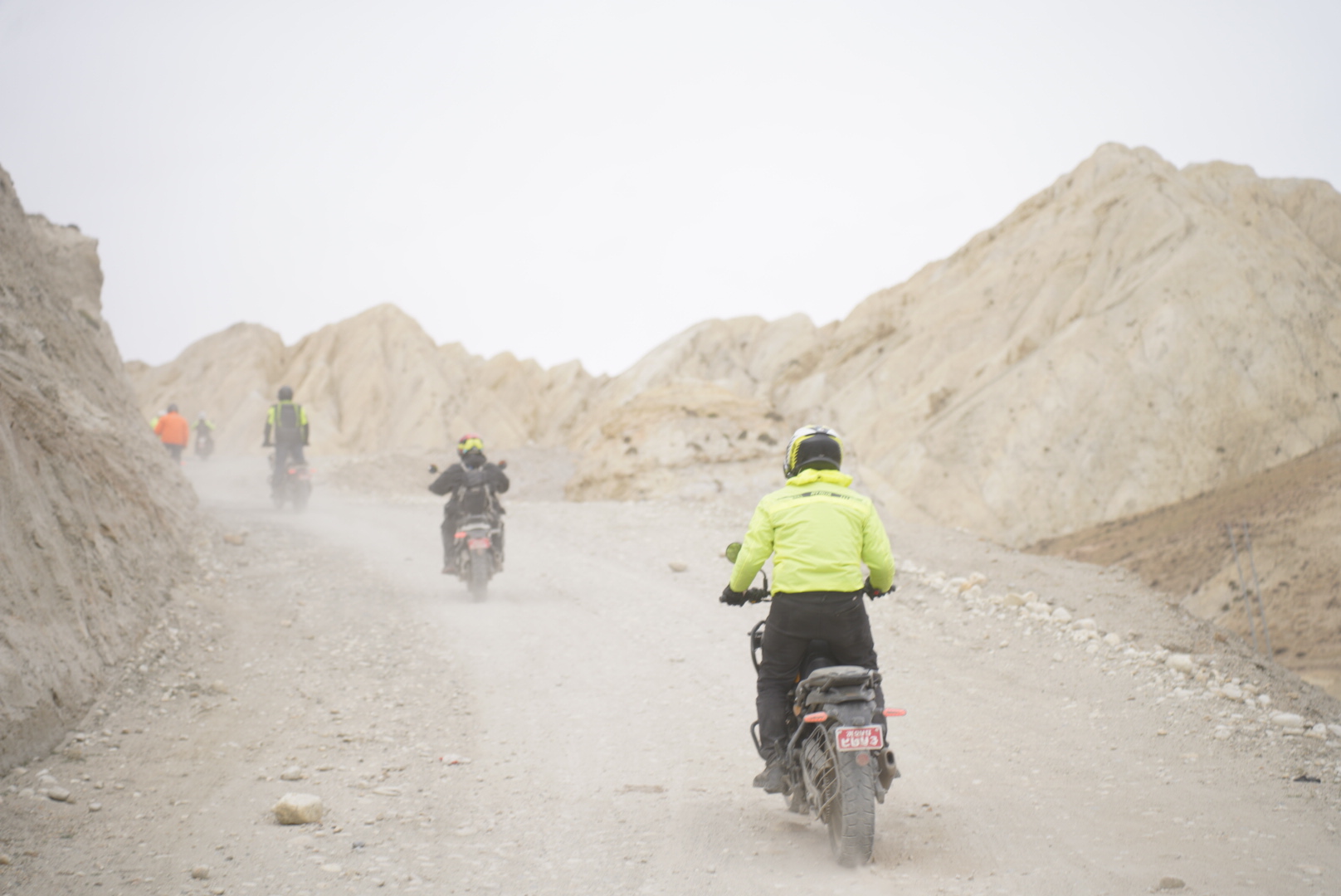
Dust in Upper Mustang is not a minor inconvenience — it is an active riding challenge that requires specific preparation and technique.
Why Dust Is So Intense in Upper Mustang
Three factors combine to make Upper Mustang one of the dustiest riding environments in the Himalayan region:
- Desert terrain — No moisture binds the surface particles
- Loose gravel and sand surfaces — Highly friable material that lifts easily
- Consistent wind — A constant delivery mechanism to keep particles airborne
The result is that on active trail sections — particularly between Kagbeni and Lo Manthang — dust is essentially continuous. Every vehicle, every wind gust, every rider generates a dust trail that takes minutes to settle.
Dust Hotspots on the Route
Certain sections of the Upper Mustang route generate significantly heavier dust conditions than others:
Kagbeni entry roads — The transition point into the upper zone has particularly loose surface material. This is where riders first encounter the full dust environment.
Jomsom valley stretches — The valley width here allows wind to carry dust across a broad front, making the entire section hazy on windy days.
Upper Mustang plateau sections — The open high-altitude plateaus between Ghami and Lo Manthang have no natural windbreaks. Dust generated anywhere in the visible landscape contributes to the ambient haze.
Visibility Risks and Group Riding Safety
In worst-case dust conditions, visibility can drop to 50–100 metres. For group riding, this creates specific hazards:
- Following distance judgment becomes unreliable
- Navigation markers are harder to identify
- Reaction time to obstacles in the road is reduced
- Group cohesion is harder to maintain — riders lose visual contact with each other
Standard group riding discipline breaks down in heavy dust. Experienced expedition operators maintain larger spacing between bikes (typically 30–50 metres minimum in dust conditions) and reduce speed significantly.
Practical Dust Management Techniques for Riders
Use proper goggles, not just a visor — A helmet visor leaves gaps at the edges. Purpose-built riding goggles seal against the face and dramatically reduce dust reaching your eyes. This is not optional equipment in Upper Mustang.
Maintain disciplined group spacing — Riding too close behind another bike in dust means riding through their entire dust cloud at full concentration. The standard spacing used in normal conditions is not sufficient.
Reduce speed in heavy dust sections — This is the non-negotiable rule. Speed determines how quickly you encounter obstacles you cannot see clearly. In dust, slower is not cautious, it is correct.
Protect your air filter — Dust loads the air filter of your motorcycle significantly faster than in normal conditions. Carry a spare and inspect it daily.
Temperature Variations: What Upper Mustang's Climate Does to Your Body and Bike
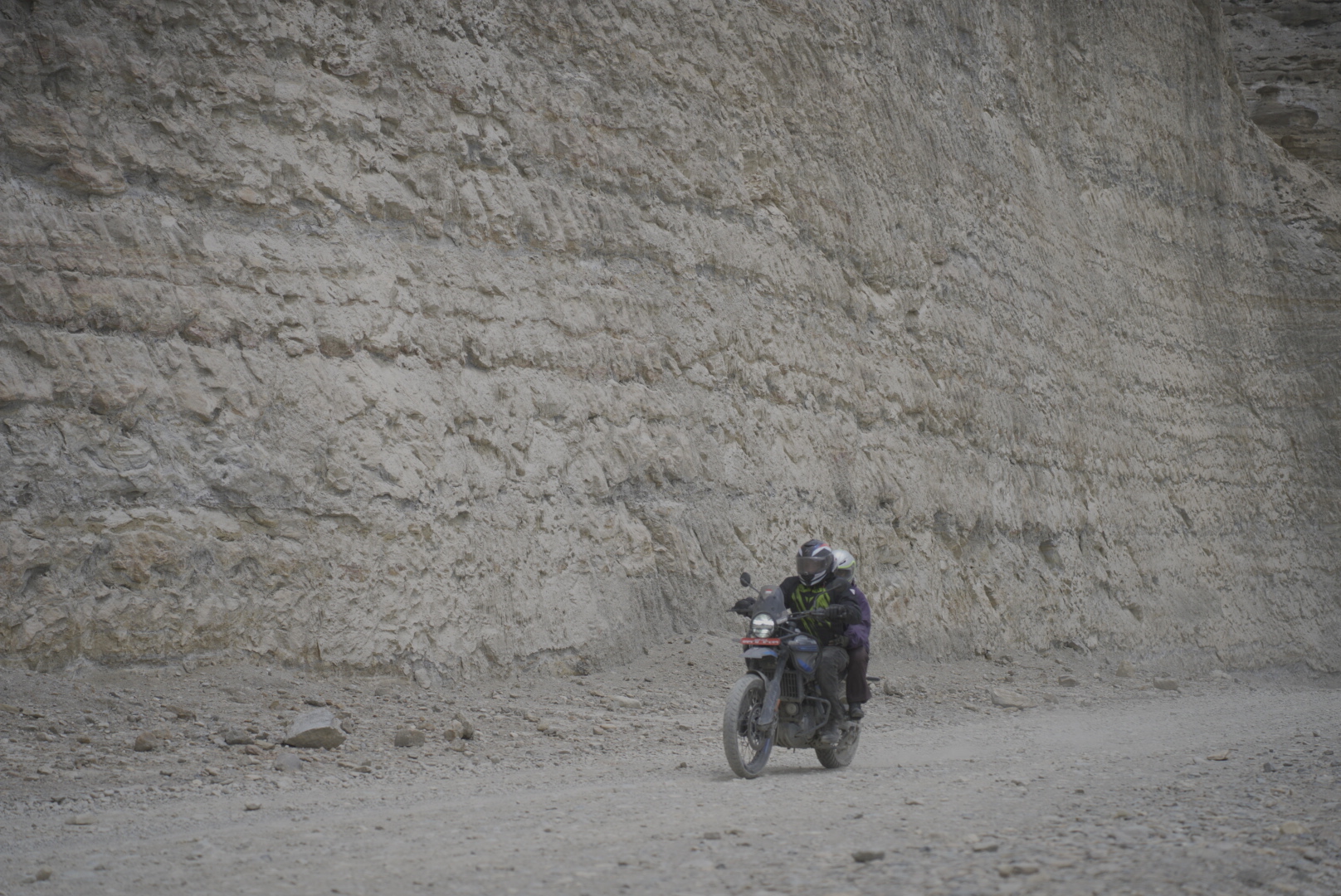
Temperature variation in Upper Mustang is extreme — and the effects are felt by both rider and machine.
Day-to-Night Temperature Swings
A difference of 20–25°C between afternoon warmth and pre-dawn cold is common, particularly in spring and autumn. What this means in practice:
- You start each morning in conditions that require full insulated layers
- By late morning, you are removing layers as temperatures climb
- Afternoon sees the day's warmest conditions
- Early evening requires immediate re-layering as temperatures drop sharply
This constant layering cycle is not just a clothing inconvenience — it is a fatigue contributor. Stopping to manage clothing takes time, disrupts momentum, and adds to the daily expedition management workload.
How Altitude Changes Temperature Along the Route
As you climb toward Lo Manthang at approximately 3,800 metres, temperatures drop noticeably compared to the lower sections near Jomsom. Even on a day when the lower valley feels comfortably warm, the high plateau around Lo Manthang can feel genuinely cold, particularly with wind-chill factored in.
Riders who do not account for this elevation-temperature relationship are frequently underprepared when they reach the highest sections of the route.
How Cold Temperatures Affect Riding Performance
Cold morning conditions create specific rider performance issues:
- Reduced muscle flexibility — Cold muscles respond more slowly and fatigue faster. The first hour of riding in cold conditions places more physical demand on riders than the equivalent distance in comfortable temperatures.
- Slower cognitive response — Cold slows mental processing slightly, which matters when making rapid line-choice decisions on technical terrain.
- Grip reduction — Cold hands lose fine motor control. On technical sections requiring precise throttle and brake inputs, this has direct safety implications.
Cold also affects bike performance. At high altitude with cold morning temperatures, engines take longer to reach optimal operating temperature. Tyre grip is reduced until the rubber reaches working temperature. Brake performance can be marginally affected in the first sections of the morning.
Best Daily Riding Window: Timing Strategy for Upper Mustang
Based on Upper Mustang's weather patterns, the optimal daily riding window is clear.
The Recommended Riding Window
Start: 6:30 AM to 7:00 AM — Finish: 11:00 AM to 12:00 PM
This is the window that captures:
- Calm or light wind conditions
- Best daily visibility
- Temperatures warm enough for comfortable riding after the first hour
- Full morning energy and focus before fatigue accumulates
Riders who consistently operate within this window cover the same distance with significantly less wind exposure, lower dust loading, and better overall safety margins than those who ride into the afternoon.
What Happens If You Ride Late
Afternoon riding in Upper Mustang is not inherently impossible — riders do it, and most do not have accidents. But the margin for error narrows considerably:
- Wind is working against you on exposed sections
- Dust has reduced visibility
- Fatigue has accumulated throughout the day
- The temperature is dropping toward evening
The combination of these factors is what makes afternoon riding the highest-risk period of the day. Most experienced Upper Mustang guides structure itineraries to ensure riders are at the destination by early afternoon, with arrival windows planned before peak wind hours.
Weather Risks Every Rider Must Prepare For
Preparation is not about eliminating weather risk in Upper Mustang — it is about knowing what the risks are and having a response ready.
Sudden Wind Gusts
The most immediately dangerous weather event in Upper Mustang is a sudden strong wind gust on an exposed section. These are not random — they follow the daily cycle — but their exact timing and intensity at any given point on the trail is not perfectly predictable.
Risk is highest: On open high-altitude plateaus and narrow cliffside tracks where lateral force from a gust has nowhere to go except sideways relative to the intended riding line.
Management: Reduce speed on exposed sections. Adopt a wider, lower stance. Be ready to put a foot down if stability is threatened.
Dust Storms
While full dust storm events are relatively rare in Upper Mustang, reduced-visibility dust episodes are common. The distinction matters less than the response: when dust degrades visibility significantly, the correct action is to stop, wait, and allow conditions to improve before continuing.
Rapid Temperature Drops
Particularly relevant in autumn and late spring, the temperature can drop sharply with cloud cover or in the late afternoon. A rider who departed in warm afternoon conditions and is caught by a rapid temperature drop without adequate layers faces a meaningful cold exposure risk at altitude.
Management: Always carry the full layering system in your riding bag, regardless of how warm the day looks when you depart.
High UV Radiation
At 3,500–3,800 metres altitude, UV radiation intensity is significantly higher than at sea level. The dry, clear air provides none of the UV attenuation that humidity and haze offer at lower altitudes.
Sunburn in Upper Mustang happens faster than most riders expect, affecting the exposed face, neck, and wrist areas most commonly. Full-face sun protection, appropriate gloves, and sun-blocking base layers are not optional.
Weather Preparation Strategy for Upper Mustang Riders
Preparation for Upper Mustang's weather breaks down into three practical categories.
Gear Strategy
Windproof outer layer — Your jacket must be capable of blocking sustained wind, not just providing warmth. Many mid-range adventure jackets provide excellent warmth but insufficient windproofing for Upper Mustang's wind conditions.
Layering system — A minimum three-layer system: moisture-wicking base layer, insulating mid-layer, and windproof/waterproof outer shell. The ability to add or remove layers quickly during rest stops is important.
Dust goggles — Not a helmet visor. Sealed riding goggles that fit flush against the face. This is genuinely essential gear, not an optional upgrade.
Sun protection — Factor 50 sunscreen, UV-blocking gloves, a neck gaiter, and a balaclava for exposed sections.
Heated glove liners or winter gloves — For cold morning starts in spring and autumn. Cold hands compromise riding control, and control matters on technical terrain.
Riding Strategy
- Start early every day — Respect the morning window. It is your most valuable daily weather asset.
- Monitor the wind, not just the time — On days when the wind builds earlier than expected, adjust your stopping point accordingly rather than pushing through deteriorating conditions.
- Maintain group spacing in dust — Enforce 30–50 metre minimum following distances when dust is active. Brief your group before each day's ride.
- Plan rest points around wind timing — Structure your lunch break to coincide with peak afternoon wind. Arrive at a sheltered point, rest through the worst of it, and ride again as conditions ease in the early evening if needed.
Hydration Strategy
Dehydration in Upper Mustang is faster than most riders expect and less obvious. The dry air draws moisture from your body continuously. The cold suppresses thirst signals. The altitude increases your respiratory water loss.
Drink consistently throughout the day — not reactively when you feel thirsty. By the time thirst is noticeable at altitude in dry conditions, you are already meaningfully dehydrated. Aim for 3–4 litres of water daily, more on heavy riding days.
Common Weather-Related Mistakes Upper Mustang Riders Make
Even experienced riders fall into predictable weather management errors in Upper Mustang. Knowing them in advance costs nothing.
Underestimating the wind — The most common mistake. Riders arrive having read about wind and still underestimate the physical reality of sustained strong crosswind on loose terrain. Respect it before you experience it, not after.
Riding too late in the day — The daily wind and dust pattern is not a secret. Riders who ignore it and push afternoon sections accept increased risk that was entirely preventable. Adjust the plan, not the risk tolerance.
Ignoring dust protection — Arriving without proper goggles, or using them inconsistently, results in eye fatigue, reduced visibility tolerance, and general comfort degradation that accumulates over a multi-day expedition.
Poor layering system — Carrying a single heavy jacket rather than a versatile layering system means being either too cold in the morning or too hot at midday, with no comfortable middle ground. Upper Mustang's temperature swings are too large for a single-garment approach.
Skipping sun protection — High altitude, dry air, and clear skies make UV exposure intense and fast. Sunburn on day two of a twelve-day expedition creates genuine daily discomfort for the remainder of the trip.
Conclusion
Upper Mustang's weather is demanding — but it is not unpredictable, and it is not unmanageable. That distinction matters enormously for expedition planning.
The wind follows a daily cycle that experienced riders can structure their days around. The dust is intense in certain sections and seasons but controllable with the right gear and technique. The temperature swings are large but follow consistent patterns that a good layering system handles effectively.
What Upper Mustang's weather demands from riders is awareness and respect — not fear, but genuine preparation and the discipline to make decisions based on conditions rather than despite them.
The riders who have the best Upper Mustang experiences are not necessarily the most technically skilled. They are the ones who start early, read the wind honestly, rest during peak afternoon conditions, and arrive at Lo Manthang with both energy and perspective intact.
Best seasons for Upper Mustang motorbike expeditions:
- 🟢 Spring (March–May) — Best dust-visibility balance, moderate winds, comfortable temperatures
- 🟢 Autumn (September–November) — Best mountain visibility, stable conditions, excellent road quality
Seasons to approach with caution or avoid:
- 🟡 Summer (June–August) — Rideable in the upper zone, but high dust and the strongest winds
- 🔴 Winter (December–February) — Not suitable for standard motorbike expeditions
The mountain does not negotiate. But with the right knowledge and the right preparation, the weather in Upper Mustang becomes part of the experience — raw, challenging, and unforgettable — rather than a threat to it.
FAQ: Upper Mustang Weather Conditions for Motorbike Riders
Q1: Is Upper Mustang windy throughout the entire day?
Wind in Upper Mustang follows a consistent daily pattern rather than blowing constantly at peak intensity. Mornings from approximately 6:00 AM to 10:00 AM are typically calm or have light winds — this is the best riding window of the day. Wind builds through midday and reaches its strongest between 3:00 PM and 6:00 PM. Riders who structure their day around this cycle can cover a significant distance in comfortable wind conditions by finishing their main riding before early afternoon.
Q2: Does it rain during the monsoon season in Upper Mustang?
Upper Mustang receives very little rainfall even during Nepal's monsoon season (June–August), thanks to its rain-shadow position behind the Annapurna and Dhaulagiri ranges. The monsoon clouds lose almost all their moisture crossing these 8,000-metre barriers, leaving Upper Mustang dry. The primary summer challenge is not rain but rather increased dust and stronger afternoon winds. Note, however, that the lower approach roads below the Mustang zone can be significantly affected by the monsoon, so check the lower route conditions before departure.
Q3: When is dust the worst on the Upper Mustang motorbike route?
Dust levels are highest during the summer season (June–August) when winds are strongest and terrain is at its driest. Within any single day, dust is worst during peak afternoon wind hours (3:00 PM–6:00 PM). The heaviest dust zones on the route are the Kagbeni entry roads, the Jomsom valley section, and the open plateau sections between Ghami and Lo Manthang. Spring and autumn see lower dust levels overall, making them preferable seasons for riders sensitive to dust exposure.
Q4: How much does temperature vary between morning and afternoon in Upper Mustang?
Temperature swings of 20–25°C within a single day are common in Upper Mustang, particularly in spring and autumn. A morning start at 5–8°C can give way to a pleasant 18–22°C by midday, before temperatures drop again sharply in the late afternoon as the sun loses intensity. At the highest elevations near Lo Manthang, the range is even more pronounced. A versatile three-layer clothing system that can be adjusted during rest stops is essential for managing this variation comfortably.
Q5: What is the single most important piece of weather preparation advice for Upper Mustang riders?
Respect the daily wind cycle and plan every riding day around it. Start between 6:30 AM and 7:00 AM, maximise distance covered before 11:00 AM, and aim to reach your day's destination before 2:00 PM when possible. The wind pattern in Upper Mustang is predictable — riders who work with it have safer, less fatiguing, and more enjoyable expeditions. Riders who ignore it are simply accepting avoidable risk. Everything else — gear, hydration, dust management — supports this fundamental planning discipline.