Most descriptions of the Manang motorbike tour use the word "challenging" and leave it there. Which is about as useful as describing Everest as "tall."
Here's what they don't say: the Manang is not technically the hardest motorbike tour in Nepal but it has a unique ability to surprise riders who've underestimated it. The Marsyangdi River valley corridor from Besisahar to Manang is a road carved into vertical cliffs with drops of 500 metres straight down to the river, with the road itself no wider than two to three metres in places. That's not marketing language — that's the actual geology of the approach.
Add Manang village sitting at approximately 3,519 metres above sea level — where altitude sickness becomes a real concern — and a route structure that offers, as one rider guide memorably put it, "one way in and one way out," and you have a tour that rewards preparation and punishes assumption in equal measure.
Overall difficulty rating: Moderate to Hard. Suitable for intermediate riders with prior off-road experience. Not recommended as a first Himalayan motorcycle trip.
Here's the complete, honest breakdown of what that actually means.
What the Manang Motorbike Tour Actually Is?
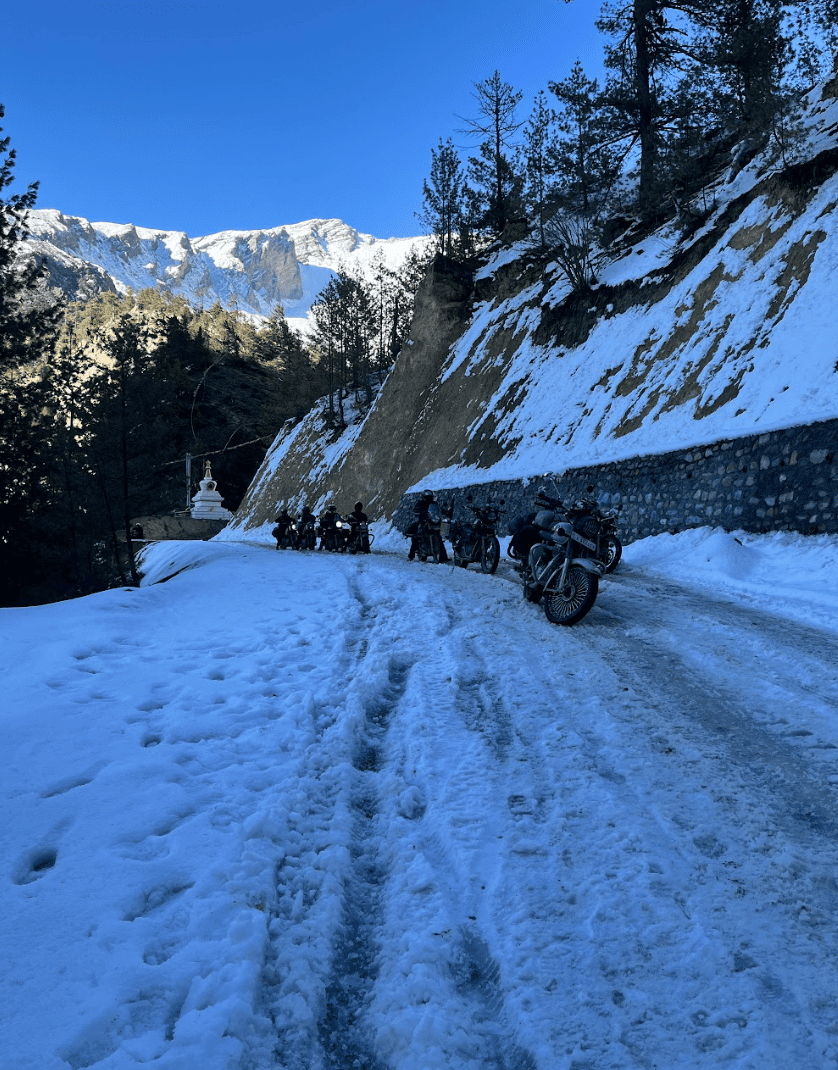
The Manang motorbike tour follows the Annapurna Circuit corridor from Kathmandu through Besisahar — the self-styled "Gateway to the Himalayas" — and up the Marsyangdi River valley to Manang village at 3,519m. This 99km journey from Besisahar to Manang is one way in and one way out, so after you conquer the road you get to do it all again backwards.
The full round-trip from Kathmandu covers approximately 800km over 8–10 riding days, including time in Manang for acclimatisation and side excursions. For decades, trekkers from across the world walked toward this mystical valley — but only recently has the road opened for motorcycles. Today, riding to Manang is considered one of the best off-road motorcycle adventures in Nepal.
The route climbs from Kathmandu at 1,350m through Besisahar (760m) and up through dramatically changing terrain — subtropical forests, river gorges, cliff-carved tracks, and high alpine valleys — to the Tibetan-influenced culture of Manang at 3,519m. Many itineraries extend to Khangsar village at 3,734m, the last rideable point before Tilicho Lake — at 4,919 metres, one of the highest freshwater lakes in the world.
Thorong La Pass — the Annapurna Circuit's high point at 5,416m — is not accessible by motorcycle. You cannot take motorcycles to the top of Thorong La. The Manang motorbike tour terminates at Manang or Khangsar and returns via the same route.
Difficulty Breakdown: What You're Actually Dealing With
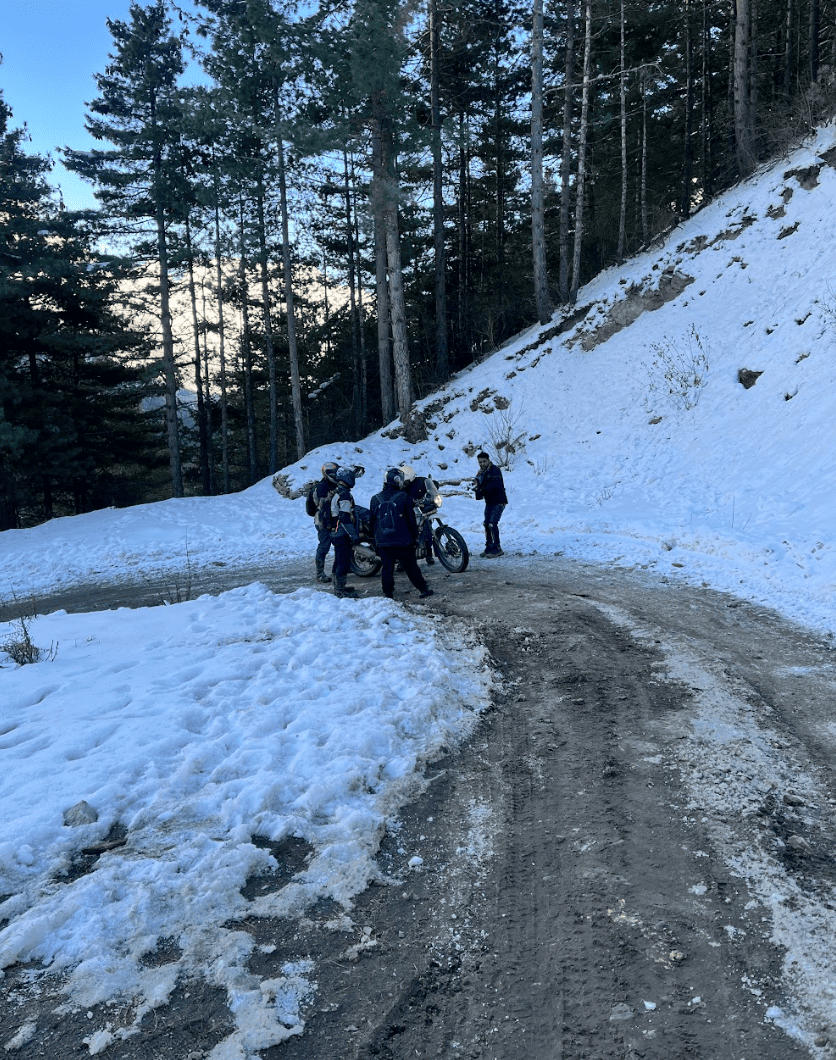
Terrain: The Core Physical Challenge
The Besisahar to Manang road has a split personality, and understanding that split is essential for honest difficulty assessment.
This 63-kilometre mountain road connects Besisahar at 760 metres with Chame, the district headquarters of Manang, perched at 2,710 metres along the Annapurna Circuit route. The road follows the Marsyangdi River valley through dramatic gorges, past traditional villages, and alongside steep cliffs.
Beyond Chame, conditions change further. Besisahar to Manang involves bumpy, narrow, landslide-prone, and cliff-section roads — approximately 70km of road distance that takes 10–12 hours by jeep in the dry season. On a motorcycle, the experience is simultaneously more exposed and more rewarding than a jeep affords.
The terrain categories you'll navigate:
- Prithvi Highway from Kathmandu to Besisahar — sealed, manageable, busy with trucks
- Besisahar to Chame — rocky river valley, narrow gorge sections, occasional river crossings
- Chame to Pisang — improving somewhat, but loose and unpredictable
- Pisang to Manang — rough but manageable, with stunning views of Annapurna II, Annapurna III, Gangapurna, and Tilicho Peak
- Manang to Khangsar — serious off-road, altitude compounding
The honest verdict on terrain: no single section is beyond intermediate off-road capability. The challenge is the accumulation — day after day of demanding surfaces with altitude fatigue building throughout.
Altitude: Where Manang Earns Its Difficulty Rating
Manang sits at 3,519 metres above sea level, making altitude sickness a real concern. Your body needs time to adjust to reduced oxygen levels, so plan for gradual ascent whenever possible.
For motorbike riders specifically, altitude creates effects that go beyond the well-known breathlessness:
- Reaction time measurably slows above 3,000m
- Cognitive load for surface-reading and hazard assessment increases
- Engine power drops — typically 10–15% at 3,500m compared to sea level, meaning climbs that look manageable need more throttle management than expected
- Sleep quality at altitude is poor for the first several nights, meaning each riding day starts with a deficit
Manang at 3,519m — you can expect to feel some symptoms of altitude sickness after climbing from 760m in Besisahar the same morning. Plenty of rest and hydration are essential.
The standard medical guidance applies: watch for early AMS symptoms — headache, nausea, loss of appetite, disturbed sleep — particularly on the day of arrival at Manang. These symptoms can appear within 6–12 hours of arrival. A mandatory rest day at Manang before any Khangsar or Tilicho Lake extension is not optional — it is the difference between completing the upper section and turning back early.
The Marsyangdi Gorge: The Section Nobody Warns You About Specifically
The gorge section between Chamche and Dharapani deserves specific attention because it consistently surprises riders who've read general descriptions of the route without understanding this particular stretch.
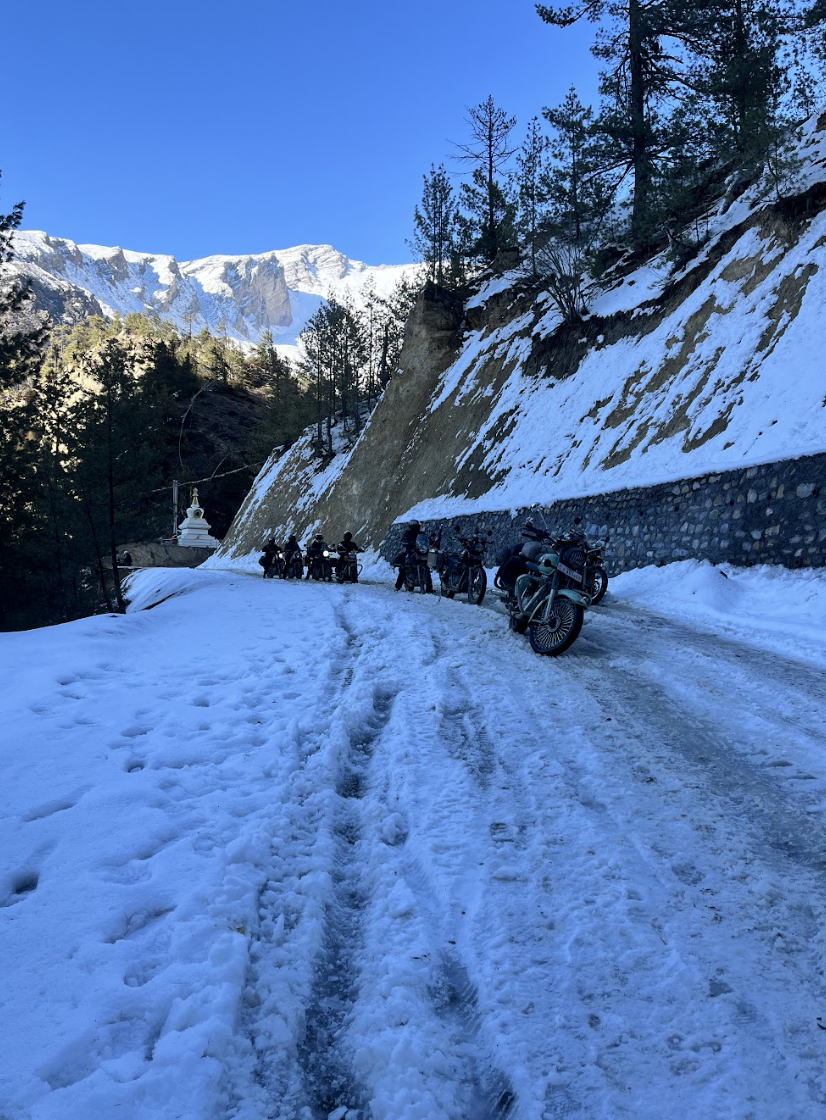
At some points the road is carved into a vertical cliff with drops of 500 metres vertically down to the river. The road itself is not more than two to three metres wide.
This is not hyperbole for marketing purposes. It is a genuine description of a narrow cliff track where width management and smooth throttle control are non-negotiable. Riders who carry tarmac habits — late braking, wide lines, inattention to road edge — encounter this section as a sharp correction. Riders who arrive with off-road positioning habits and active surface reading find it demanding but navigable.
Traffic on this section includes local jeeps which, as with other Nepal mountain routes, operate with a confidence and speed that surprises foreign riders. Width negotiation on blind cliff corners requires active anticipation, not reactive response.
Daily Endurance: What the Numbers Mean in Practice
Riding from Besisahar to Manang village covers approximately 50km and takes around 7 hours on rough road — plateau landscape with Buddhist mani walls, monasteries, and mountain views.
Seven hours for 50km is the number that resets most riders' expectations. Highway logic — distance equals predictable time — breaks completely on this route. Terrain, surface variability, jeep traffic, river crossings, altitude-affected pace, and the sustained concentration required for cliff and gorge sections all stretch time in ways that accumulate daily.
A standard Manang itinerary involves 5–7 hours of active riding per day across 4–5 consecutive riding days on the approach alone. Altitude sickness is a serious concern, and riders need to be aware of its symptoms and take necessary precautions. The Manang rest day is built into every serious itinerary for this reason.
Section-by-Section Route Difficulty
Kathmandu to Besisahar — Moderate
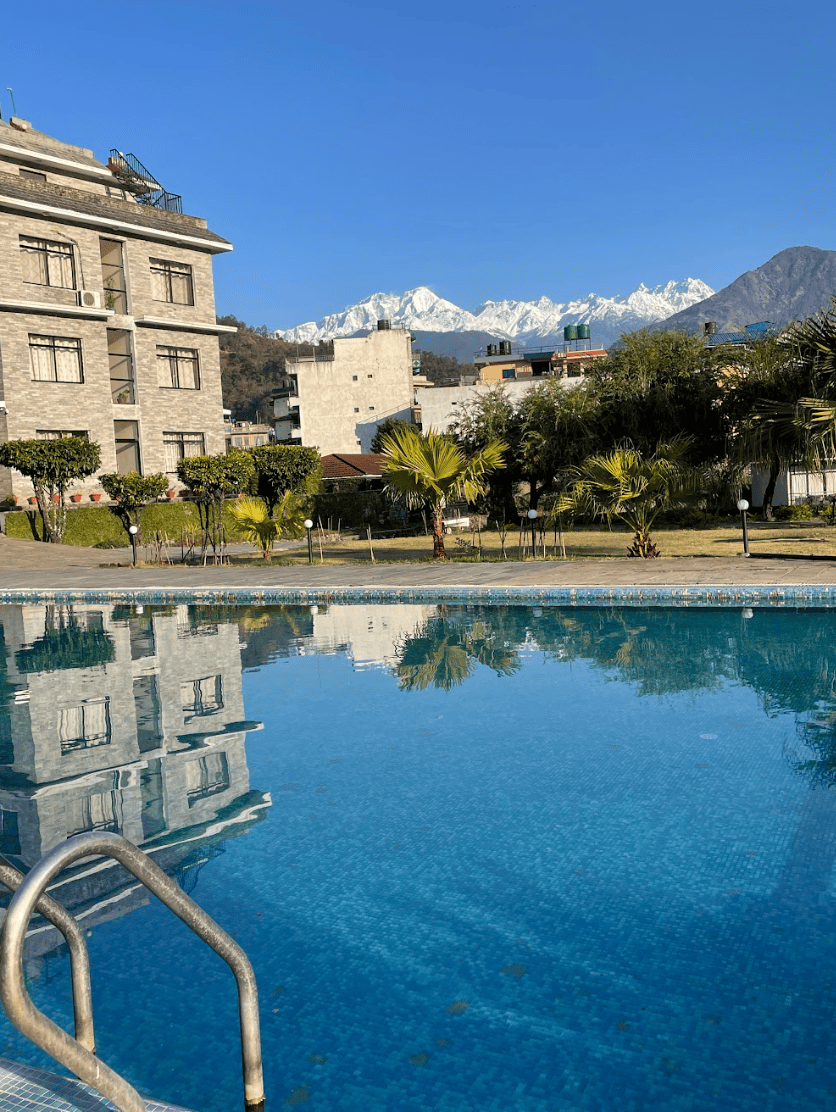
Kathmandu to Besisahar is smooth concrete road, about 175km, taking 5–7 hours by private vehicle. Prithvi Highway traffic — trucks, buses, local vehicles, the occasional yak — is the primary challenge here. It's chaotic by European or North American standards; it's normal Nepal highway riding. Use this day to dial in your bike setup and settle into Nepal's traffic flow logic.
Besisahar to Chame — Hard
Besisahar to Chame spans 63 kilometres, climbing from 760 metres to 2,710 metres. The terrain transitions from valley road to the first genuine gorge sections. Waterfalls cascade directly across the track in places. The Marsyangdi River runs loud and close. This is where the tour's character declares itself clearly for the first time.
Cliff sections begin appearing through the Chamche gorge area. The road is narrow. Jeep encounters require active positioning. This section reliably recalibrates riders who arrived thinking Manang was a Himalayan scenic drive.
Chame to Pisang — Moderate to Hard
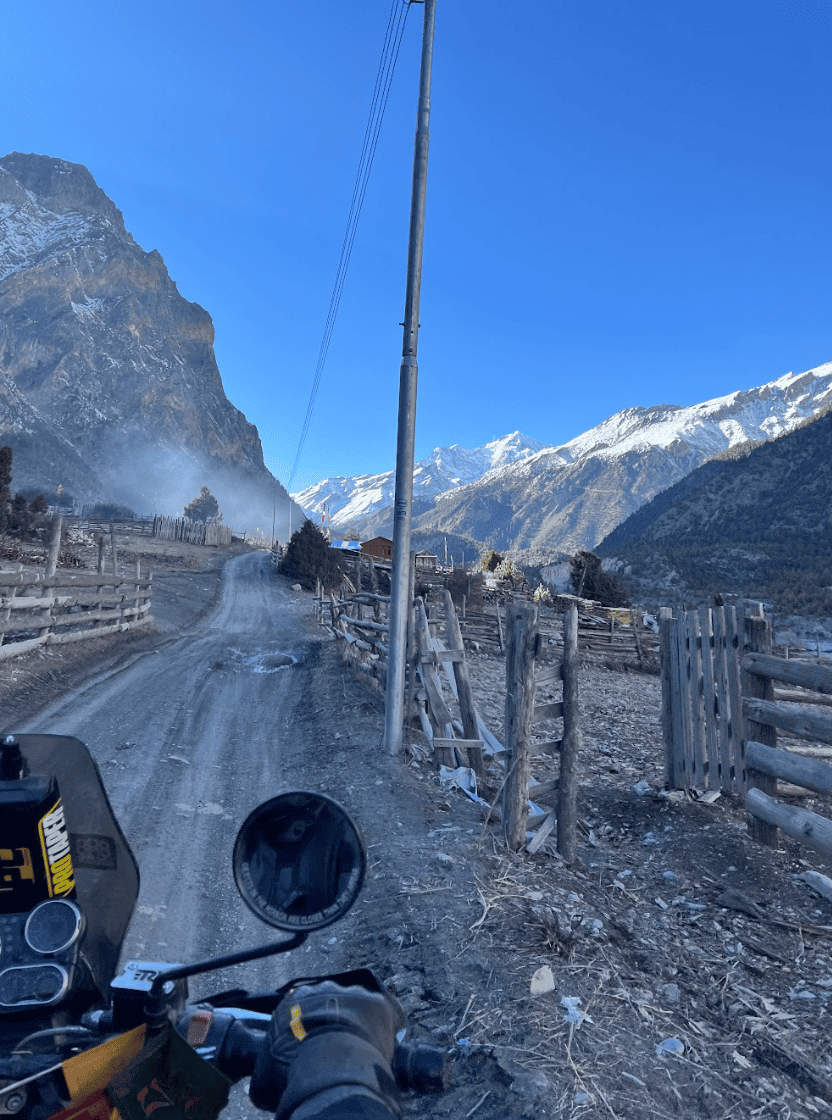
From Chame the road is unpaved and rough. The valley opens somewhat beyond Chame, giving riders visual space that the gorge denied. The famous Paungda Danda — a massive vertical rock face — appears on the approach to Pisang. A long good suspension bridge takes you toward this 1,400m high rocky boulder, then the scaling road along loose stones and dust passes through Lower Pisang and then to Upper Pisang.
Upper Pisang offers one of the best viewpoints on the entire Annapurna Circuit — Annapurna II (7,937m) dominates the skyline. The detour to Upper Pisang involves a short but steep climb on loose track that rewards the effort with views that justify the entire expedition.
Pisang to Manang — Hard
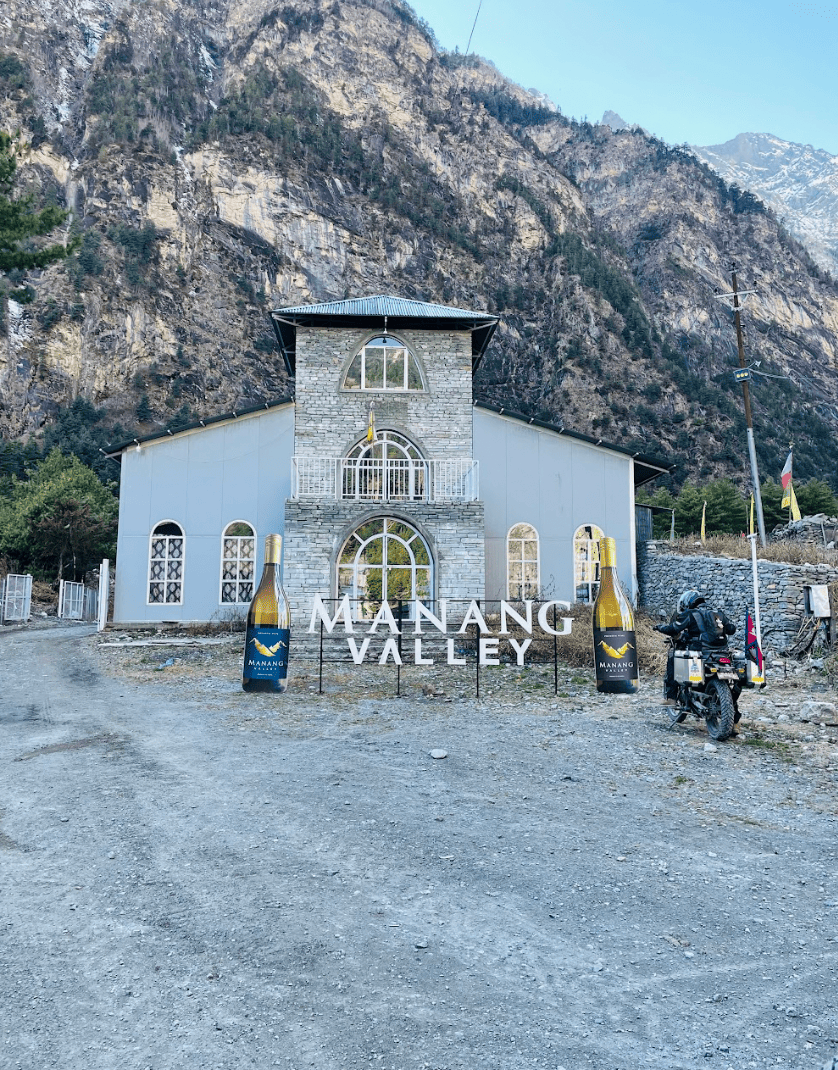
This is the section that defines the tour's upper character. The landscape transitions from river gorge to high alpine valley — drier, wider, with the Annapurna range rising to impossible heights on all sides. By late afternoon, riders arrive in Manang, a beautiful village nestled at 3,540 metres.
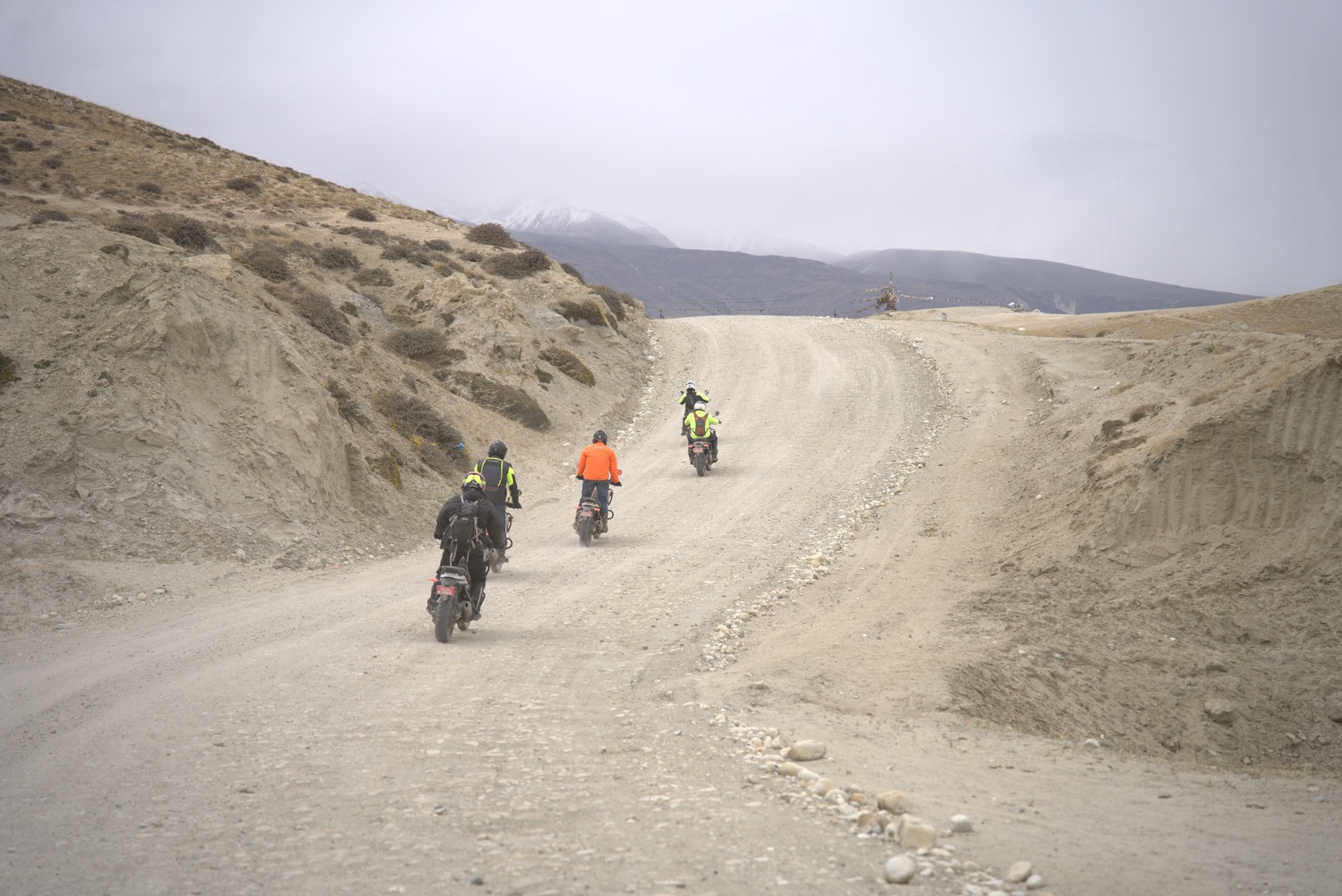
The road surface through this section is rough in the conventional Upper Mustang sense — loose gravel, rocky sections, dust. What changes from the gorge section is the altitude effect. At 3,200–3,500m, concentration degrades slightly and engine performance drops noticeably. Standing position on the pegs becomes more necessary than optional.
Manang to Khangsar — Very Hard
Khangsar sits at an altitude of 3,756 metres and is the last stop for riding before Tilicho Lake. The 5km between Manang and Khangsar involves serious off-road terrain at altitude — exactly the conditions where accumulated fatigue, reduced oxygen, and technical demands converge.
This section should only be ridden after the Manang rest day. Riders who push straight through from Pisang to Manang to Khangsar in a single push are making a mistake that guides see every season — attempting to compress the itinerary at the precise section where the altitude demands the opposite.
Bikes are left at Khangsar and the approach to Tilicho Base Camp and Tilicho Lake is completed on foot. The glacial lake Tilicho lies at 4,919m — you can view it from above, climbing first to just over 5,000m. The motorcycle section ends at Khangsar; the final ascent is a 2-day hike.
Skill Requirements: What "Intermediate" Means for This Route
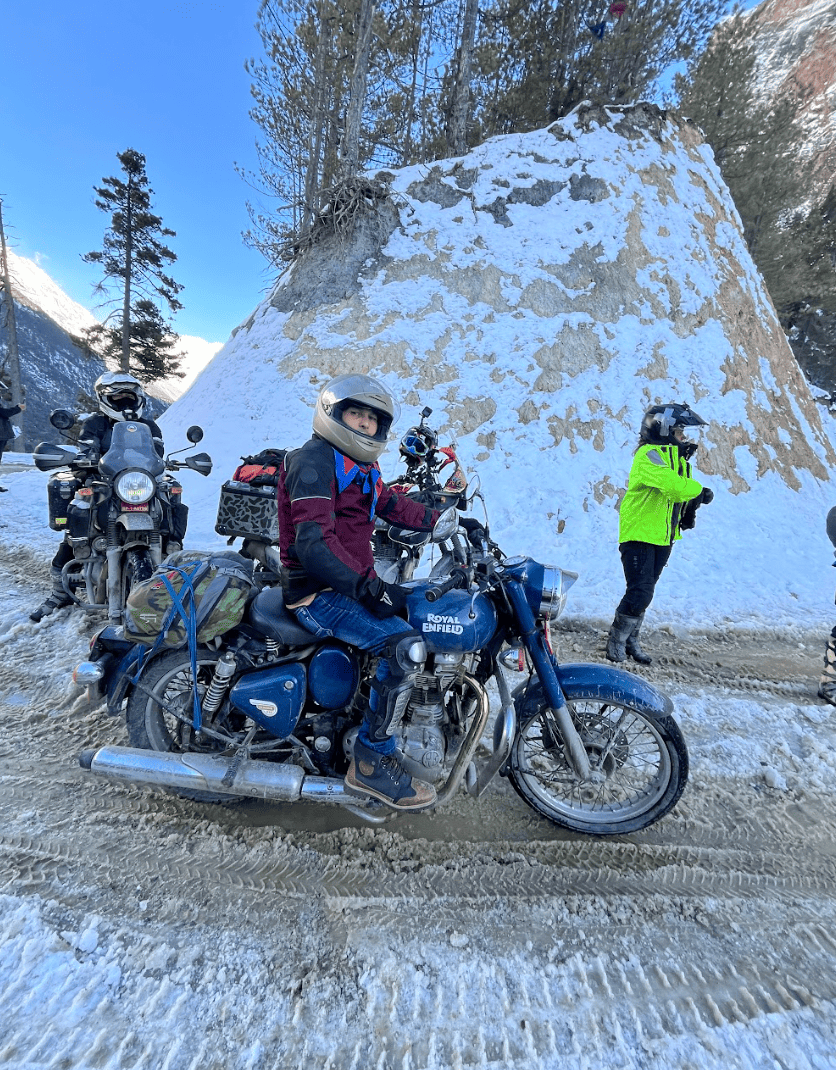
The Manang motorbike tour is consistently described as requiring intermediate off-road skill. Here is what that actually means in concrete terms.
Skills You Must Have
Off-road balance and traction management: You need to have ridden on loose gravel, rocky tracks, and unpredictable surfaces before. Not mastery — but genuine familiarity. First contact with loose-surface riding should not be the Marsyangdi gorge.
Cliff-edge track composure: Narrow sections above significant drops require specific psychological steadiness that some riders have and others develop. This is not about bravado — it's about the ability to maintain controlled, deliberate riding when the consequences of an error are serious.
Standing riding position: Extended standing on pegs is mandatory for rough sections. If you've never ridden standing for 20–30 minute stretches, practice before arrival.
Altitude awareness: Understanding AMS symptoms and the discipline to rest rather than push through them is a genuine skill requirement on this route.
Skills That Help Enormously
Annapurna Circuit or similar experience means you've encountered Nepal's traffic, its mountain road logic, and have calibrated your expectations before the Manang section. First-time Nepal riders who go straight to Manang without prior Himalayan riding experience consistently find it harder than those who've done any prior Nepal riding.
Sand and river crossing technique is useful but not mandatory — crossings exist seasonally and are typically manageable for prepared riders.
Skills You Do Not Need
You do not need technical enduro ability. You do not need motocross experience. The Manang route rewards patience, surface reading, and controlled riding — not aggression or speed. The fastest riders on this tour are not having the best time; the most attentive ones are.
Manang vs Upper Mustang: Which Is Harder?
This comparison comes up frequently because many riders are choosing between the two routes or sequencing them. The honest answer involves a specific distinction.
Upper Mustang is harder in sustained terms — longer consecutive days, more remote from support, higher altitude at Lo Manthang (3,840m vs Manang's 3,519m), stronger wind exposure, and more consistent off-road riding from Kagbeni onwards. Upper Mustang also requires the Restricted Area Permit ($50/day), mandatory licensed guide, and minimum two foreign riders.
Upper Manang has individual moments — the Marsyangdi gorge, the cliff sections, the Pisang to Manang altitude push — that are technically more demanding than anything on the standard Upper Mustang route. Its gorge section is arguably the most exposed riding on any Nepal motorbike tour.
The practical recommendation for riders choosing a sequence: Manang first, Upper Mustang second. Manang builds the core skills — off-road technique, altitude management, Nepal traffic adaptation — in a context that is logistically more accessible (no restricted area permit, more flexible itinerary, more forgiving infrastructure). Upper Mustang then becomes the deeper, more immersive challenge for which Manang has prepared you. Nepal Moto Tours offers both as dedicated guided expeditions, and their guides consistently recommend this sequencing for riders new to Himalayan riding.
Permits and Access: What Manang Actually Requires
Unlike Upper Mustang, Manang does not require a Restricted Area Permit. You need a TIMS Card (Trekkers' Information Management System) and an Annapurna Conservation Area Permit (ACAP). Both are available in Kathmandu or at the trailhead in Besisahar.
ACAP costs approximately NPR 3,000 (around USD 22–25) for foreign nationals. TIMS costs approximately NPR 2,000 (around USD 15). These are straightforward permits compared to Upper Mustang's restricted zone documentation.
There is no mandatory guide requirement for Manang (unlike Upper Mustang), and no minimum group size. Individual foreign riders can technically ride independently with valid permits. However, the terrain complexity, altitude management requirements, and the value of local route knowledge make a guided expedition the strongly recommended approach for first-time visitors.
For detailed permit requirements and processing, Our Manang Motorbike Tour covers current documentation as part of their guided package structure.
Best Season for the Manang Motorbike Tour
The best months to ride Manang are March to May and September to November. At these times the skies are clear, offering stunning views of the mountain ranges.
Spring (March–May): Good conditions, manageable temperatures, clear mountain views. Road conditions are generally stable before the monsoon begins loosening the surface. The rhododendron forests below Chame are spectacular in March–April.
Monsoon (June–August): Not recommended. The Marsyangdi valley gorge sections are landslide-prone during monsoon, and the cliff tracks above river gorges become genuinely dangerous with wet conditions and reduced visibility.
Autumn (September–November): The premium season. Crystal clear skies, the best mountain visibility of the year, and stable road conditions post-monsoon. The Annapurna range views from Manang and the Pisang section in October are extraordinary.
Winter (December–February): Possible in lower sections but in high mountains like Manang, passes can be closed due to snow and extreme cold. Not recommended without substantial prior high-altitude winter riding experience.
Practical Preparation: What Makes the Difference
Bike Selection
The same guidance that applies to Upper Mustang applies here: a 250cc–450cc adventure bike with off-road biased tyres and adequate ground clearance. Royal Enfield 411 or 450 adventure or Honda CRF 250L are popular choices. Lighter bikes like the XR, and XPulse are also suitable options. Due to the off-road and challenging roads, these bike types are recommended for the Himalayas.
Heavy touring bikes (800cc+) are not advantageous here. The gorge sections and the Khangsar approach will expose their weight liability more than any other Nepal route.
Physical Preparation
Cardiovascular fitness matters more than raw strength for this tour. The altitude effect on endurance means riders who arrive with reasonable aerobic fitness acclimatise faster and perform better on the upper sections. 8–10 weeks of regular aerobic activity before the trip makes a measurable difference by day four.
Core strength — specifically lower back and hip flexors — determines how your body handles 6–7 hours of daily vibration on rough roads. Riders who haven't conditioned these muscle groups feel it specifically on the Pisang to Manang section.
Acclimatisation Strategy
Spend at least one night in Kathmandu (1,350m) before heading to Besisahar. Consider an overnight stop in Besisahar (760m) or Chame (2,710m) before pushing to Manang. Do not attempt to ride Kathmandu to Manang in a single push — the altitude gain is too rapid and AMS risk is significant.
The mandatory rest day at Manang before continuing to Khangsar is the single most important acclimatisation decision of the tour. Use it for a short hike to Gangapurna Lake or the viewpoint above the village — light activity at altitude acclimatises faster than complete rest.
The Honest Verdict
The Manang motorbike tour is not the hardest ride in Nepal. It is, however, one of the most technically varied — and the gap between "difficult but rewarding" and "overwhelming and dangerous" is almost entirely determined by preparation, honest self-assessment of skill level, and the quality of the guide and operator you choose.
The gorge sections will test riders who've never navigated exposed cliff tracks. The altitude will test riders who've never managed AMS. The daily distance-to-time ratio will test riders who've never let go of highway logic.
Get those three things right — through prior experience, honest preparation, and a credible guided operator — and the Manang motorbike tour delivers the kind of Himalayan riding that changes how you think about what motorcycles are capable of.
The Annapurna range seen from Manang village at dawn, with Gangapurna's glacier catching the first light, surrounded by silence broken only by prayer flags — is one of those views that rewards every hour of the approach that led you there.
Planning your Manang ride? Nepal Moto Tours runs an 8-day guided Manang Valley motorbike expedition with experienced local guides, terrain-appropriate bikes, and full permit handling. View their complete tour listings or get in touch to plan your 2026 dates.
Frequently Asked Questions
Is the Manang motorbike tour suitable for beginners?
Not for riders with no prior off-road experience. The gorge sections and cliff tracks require confident loose-surface handling. Riders who have done some off-road riding and want a step up from tarmac touring can manage the Manang tour with a good guide — but should not treat it as their first off-road experience.
Can I ride to Tilicho Lake on a motorbike?
You ride to Khangsar village and leave your bike safely there. The approach to Tilicho Base Camp is a 5–6 hour hike each way. No motorcycle access exists beyond Khangsar to the lake itself.
How does Manang compare to the Annapurna Circuit motorbike tour?
Manang is a component of the full Annapurna Circuit route. The full circuit continues over Thorong La Pass to Muktinath and Jomsom — but motorcycles cannot cross Thorong La. The Manang tour covers the eastern approach and upper valley; the full circuit ride connects to the western descent via Lower Mustang. For riders wanting the complete circuit experience on two wheels, Nepal Moto Tours' Annapurna Circuit Motorbike Ride handles the routing and logistics of the full journey.
What permits do I need for the Manang motorbike tour?
TIMS Card (approximately USD 15) and ACAP permit (approximately USD 22–25). Both are available in Kathmandu before departure. No Restricted Area Permit is required — Manang is not a restricted zone.
Is travel insurance mandatory?
Not legally required by Nepal's government, but practically essential given the altitude, remote terrain, and helicopter evacuation costs. Your policy must explicitly cover high-altitude activities (minimum 4,000m) and motorcycle riding. This is the same standard that applies to Upper Mustang — see our full travel insurance guide for Nepal motorbike tours for what coverage actually covers this terrain.
External resources:
- Annapurna Conservation Area Permit (ACAP) — Official Nepal Tourism Board
- Altitude sickness (AMS) prevention guide — Wilderness Medical Society
- Manang weather and conditions — Nepal Department of Hydrology and Meteorology
- Tilicho Lake trekking permit information — Nepal Trekking Agencies Association
- Road Conditions in Nepal for Motorcycling
- Guided vs Self-Guided Motorcycle