
A decade ago, riding a motorcycle through Nepal's Himalayan highways and off-road trails was a niche pursuit, something long-distance adventure riders talked about in forum threads and at rallies, but that existed well outside mainstream adventure tourism.
That is no longer the case.
Nepal's motorcycle tourism sector has undergone a structural transformation in the last five years, driven by a convergence of factors: global growth in adventure travel, the rise of digital communities that make expedition planning more accessible, infrastructure improvements across key Himalayan corridors, and a post-pandemic surge in experiential travel that sent riders searching for destinations with genuine depth.
The result is a sector that has grown from a fringe activity into one of Nepal's most significant and fastest-expanding adventure tourism segments — one that is reshaping how tour operators structure their businesses, how remote communities experience tourism, and how Nepal positions itself in the global adventure travel market.
Here is the full picture, grounded in data, for 2026.
Nepal's Tourism Baseline: The Foundation Context
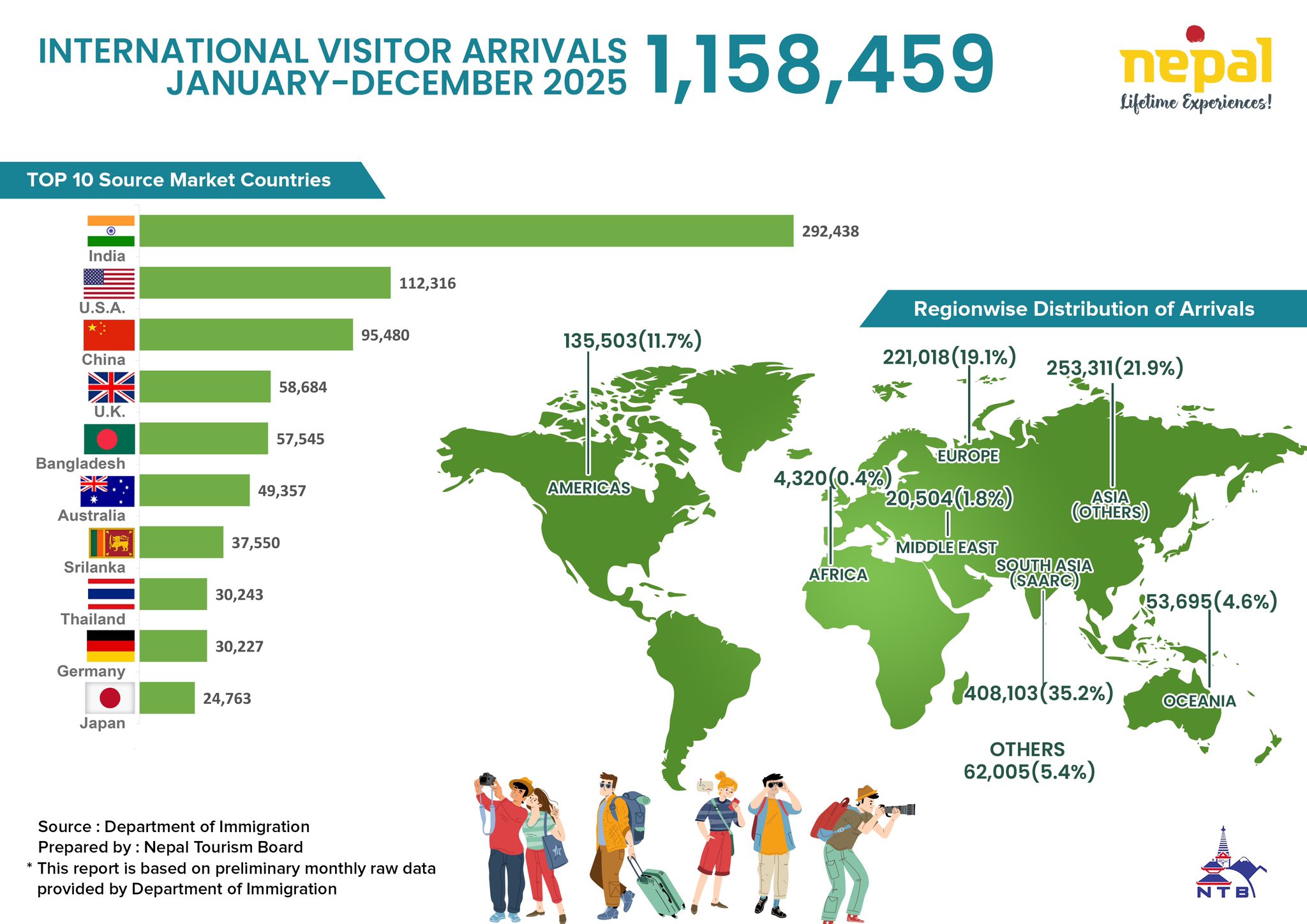
img src: Nepal Tourism Board (NTB)
Before examining motorcycle tourism specifically, the broader Nepal tourism picture provides the essential baseline.
Nepal's tourism sector recorded approximately 1.15 million international visitor arrivals in 2025, according to Nepal Tourism Board (NTB) annual statistics — marking the country's first full post-pandemic recovery year and approaching the pre-COVID peak of 1.17 million arrivals in 2019.
Tourism's contribution to Nepal's economy:
- Tourism accounts for approximately 6.7% of Nepal's GDP in normal operating years, per World Travel & Tourism Council (WTTC) Nepal data
- The sector supports an estimated 1 million jobs directly and indirectly across the country, according to Nepal's Ministry of Tourism
- Foreign exchange earnings from tourism reached approximately USD 736 million in 2023, per Nepal Rastra Bank foreign exchange reports
- Adventure tourism — which includes trekking, mountaineering, rafting, and motorcycle touring — accounts for an estimated 35–40% of total tourism activity by value, per Adventure Travel Trade Association (ATTA) global research
Within that adventure tourism segment, motorcycle touring has emerged as one of the most rapidly growing subsectors — and one of the most economically interesting for remote communities that see relatively little benefit from high-altitude trekking traffic that passes through rather than staying.
The Scale of Nepal's Motorcycle Tourism Sector
Precise isolation of motorcycle tourism within Nepal's broader tourism statistics is complicated by the fact that the NTB does not classify riders as a separate visitor category in its primary reporting. However, a combination of permit data, operator registrations, trekking agency association figures, and route-specific data allows a detailed picture to be constructed.
Permit Data: The Most Reliable Indicator
The Restricted Area Permit (RAP) for Upper Mustang — the most data-rich single indicator for motorcycle tourism in Nepal — provides the clearest window into sector growth. Upper Mustang is the route that defines Nepal's international motorcycle tourism reputation, and RAP issuance trends directly reflect rider interest.
Upper Mustang RAP permit trends:
- Pre-2015 (pre-earthquake): Approximately 3,000–4,000 permits issued annually across all visitor types
- 2016–2019 (recovery and growth phase): Consistent annual growth, with motorcycle-specific visitors representing an increasing share of total RAP holders
- 2022–2023 (post-pandemic surge): Permit issuance recovered strongly, with motorcycle tour operators reporting 40–60% increases in bookings compared to pre-pandemic baselines
- 2024–2025: Continued growth, with the spring and autumn seasons reaching near-capacity levels at the most popular guesthouses in Lo Manthang
The Annapurna Conservation Area Permit (ACAP) — required for the Manang route and lower Mustang — is issued in significantly higher volumes. The NTB reported over 150,000 ACAP permits issued in 2023, with motorcycle riders representing a growing but still minority share of total ACAP holders relative to trekkers.
Operator Growth: Industry Expansion in Numbers
The number of registered motorcycle tour operators in Nepal has expanded dramatically in the past decade.
- Nepal's Department of Tourism lists over 3,500 registered trekking and tour agencies, a significant proportion of which now offer motorcycle-specific products
- Dedicated motorcycle tour operators — businesses whose primary or exclusive product is motorcycle expeditions — number approximately 80–120 active operators as of 2025, up from an estimated 20–30 a decade earlier
- This represents a 300–400% increase in dedicated motorcycle tourism operators over a ten-year period
- The majority are concentrated in Kathmandu and Pokhara, with a smaller cluster in Besisahar serving the Manang corridor
International operators from Germany, the United Kingdom, Australia, and the United States who run guided Nepal motorcycle expeditions for their own client bases represent an additional layer of market activity that does not fully appear in Nepal's domestic registration data but contributes significantly to visitor numbers and per-trip spending.
Source Markets: Where Nepal's Motorcycle Tourists Come From
Nepal's motorcycle tourism draws from a genuinely international source market base — one that is distributed differently from Nepal's general tourism market and reflects the specific demographics of adventure motorcycle travel.
India: The Largest and Fastest-Growing Source Market
India is Nepal's single largest source of motorcycle tourists, and the market is growing at a pace that is reshaping how Nepal's operators structure their products.
- India accounted for approximately 200,000 of Nepal's total tourist arrivals in 2023 across all travel categories — the largest national source market, per NTB Tourism Statistics 2023
- Within motorcycle tourism specifically, Indian riders represent an estimated 35–45% of total motorcycle tourist volume to Nepal
- The growth driver is India's rapidly expanding adventure motorcycle culture — fuelled by the popularity of the Royal Enfield Himalayan, Bajaj Dominar, and KTM Adventure models — which has created a generation of riders seeking Himalayan expedition experiences beyond India's domestic routes
- Cross-border accessibility via Sunauli, Raxaul, and Kakarbhitta entry points makes Nepal logistics straightforward for Indian riders
- Weekend and long-weekend riders from Delhi, Mumbai, and Kolkata represent a growing short-trip segment focused on lower Mustang and the Annapurna foothills rather than full upper-zone expeditions
European Markets: High-Value, Long-Duration Visitors
European motorcycle tourists are a smaller volume but significantly higher value segment for Nepal's tourism economy.
- Riders from Germany, the United Kingdom, France, Switzerland, and the Netherlands constitute the core European source market, aligned with UNWTO's European outbound adventure travel data
- European motorcycle tourists typically spend 14–21 days in Nepal, compared to average stays of 7–10 days for other source markets
- Per-trip spending by European riders is estimated at USD 2,500–5,000+, including flights, permits, guided tour costs, and in-country expenditure
- Germany is consistently the largest European source market for Nepal adventure tourism broadly — a pattern documented in ATTA's Adventure Tourism Market Study — and this holds within motorcycle tourism specifically
- The UK and Australian markets have shown particularly strong post-pandemic recovery growth in motorcycle expedition bookings to Nepal
North American and Australian Markets: Growing but Underdeveloped
The North American market — United States and Canada — represents a significant growth opportunity that has not yet been fully realised.
- US and Canadian riders currently represent an estimated 8–12% of international motorcycle tourist volume to Nepal
- Long-haul flight requirements and the perception of complex logistics have historically limited North American rider numbers
- The increasing availability of organised guided expedition packages that handle all permit and logistics complexity has begun to remove these barriers
- Australia represents a disproportionately active market relative to its population — Australian riders have a strong adventure motorcycle culture and high historical engagement with Asia as a travel destination, consistent with Tourism Australia's outbound adventure market data
Domestic Nepali Riders: The Underreported Segment
Nepal's domestic motorcycle touring community is substantial and growing — and almost entirely absent from international statistics that focus on foreign visitor numbers.
- Nepal has experienced rapid growth in domestic motorcycle ownership and culture, driven by affordable Indian and Chinese motorcycle imports — a trend documented by the Nepal Automobile Dealers Association
- Domestic riders on routes like the Annapurna Circuit road, the Prithvi Highway, and the lower Mustang valley represent significant route traffic
- The domestic market creates important economic infrastructure — guesthouses, fuel points, and mechanical support — that also serves international riders
Revenue and Economic Impact
The economic impact of motorcycle tourism on Nepal's communities — particularly in remote high-altitude areas — is disproportionately significant relative to visitor numbers.
Per-Trip Spending Analysis
Motorcycle tourists are high-yield visitors by the standards of Nepal's adventure tourism sector:
- Average international motorcycle tourist trip expenditure: USD 1,500–4,500 depending on origin market, trip duration, and guided vs independent format, consistent with WTTC's high-yield adventure visitor profiling
- Guided Upper Mustang expedition cost (full package): USD 1,200–2,500 per person including permits, guide, accommodation, and support vehicle
- Upper Mustang RAP permit alone: USD 500 per person for 10 days — a significant mandatory contribution to Nepal's government revenue
- Daily in-country spend by motorcycle tourists: Estimated USD 80–150 per day, above Nepal's average tourist daily expenditure of approximately USD 50–70 per NTB visitor expenditure surveys
Community-Level Economic Distribution
One of motorcycle tourism's most significant economic characteristics is the geographic distribution of spending — reaching communities that receive relatively little benefit from high-volume trekking traffic.
- Guesthouses in Lo Manthang, Ghami, Tsarang, and Chele — villages that trekkers pass through but rarely spend multiple nights in — receive sustained multi-night accommodation revenue from motorcycle expeditions
- Local guide income from motorcycle tours: A licensed local guide on a 10-day Upper Mustang motorcycle expedition earns approximately NPR 15,000–25,000 (USD 110–185) per trip — significant income relative to Nepal's average per capita income of approximately USD 1,336 (World Bank, 2023)
- Support vehicle drivers, fuel sellers at permitted points, and local mechanics collectively generate income that is directly attributable to motorcycle tourism and not captured in standard tourism revenue analysis
Key Routes by Popularity and Growth
Upper Mustang: The Flagship Route
Upper Mustang remains Nepal's most internationally recognised motorcycle destination and the route that most consistently drives first-time visitor interest. Its status as a UNESCO-recognised cultural heritage zone adds a layer of cultural prestige that reinforces its position as the premier destination.
Upper Mustang route by numbers:
- Route length (Pokhara to Lo Manthang): Approximately 210–230 km
- Typical expedition duration: 8–12 days return
- Peak season occupancy at Lo Manthang guesthouses: 85–95% during April–May and September–October
- Spring season accounts for approximately 45% of annual Upper Mustang motorcycle visitor volume
- Autumn accounts for approximately 40%, with summer and shoulder periods making up the remainder
Manang Route: The Fastest-Growing Segment
The Manang motorcycle route — through the Marsyangdi valley to Manang village in the Annapurna Conservation Area — has emerged as Nepal's fastest-growing motorcycle tourism route by visitor volume growth rate.
Why Manang is growing faster than Mustang:
- No restricted area permit required — dramatically lower barrier to entry at just NPR 3,000 for the ACAP permit
- Shorter expedition duration suits riders with limited time budgets
- Increasing road accessibility has made the route viable for a wider range of motorcycle types
- Strong digital community content — ride videos, blogs, and social media coverage — has raised route awareness significantly in the past three years
- Indian weekend rider market finds the Manang route particularly accessible as a 7–10 day expedition from border crossing points
Emerging Routes: The Next Growth Frontier
Beyond the established Upper Mustang and Manang corridors, several routes are seeing increasing motorcycle tourist interest:
- Dolpo circuit: Extremely remote, requiring additional restricted area permits via Nepal's Department of Immigration, but attracting experienced expedition riders seeking routes beyond the established itineraries
- Tsum Valley: A recently opened restricted area with limited motorcycle visitor history but growing operator interest
- Nar Phu Valley: Adjacent to the Annapurna Circuit, this restricted valley has seen early-adopter motorcycle tourism interest from operators looking to diversify product offerings
- Far Western Nepal (Humla, Jumla): Largely underdeveloped for motorcycle tourism but identified by multiple operators as the region with the highest long-term growth potential
What Is Driving the Growth?
The numbers above reflect growth — but understanding the mechanisms behind that growth is what makes the data actionable for riders, operators, and policymakers.
Digital Communities and Content Creation
The single most significant driver of Nepal motorcycle tourism growth in the past five years is the explosion of digital content — YouTube expedition videos, Instagram route coverage, and dedicated forum and Facebook group communities where riders share detailed trip intelligence.
- Searches for "Nepal motorcycle tour" and related terms have grown significantly on Google Trends over the 2020–2025 period, with consistent year-on-year increases
- YouTube channels documenting Nepal motorcycle expeditions regularly accumulate millions of views — functioning as more effective destination marketing than any paid campaign
- Online communities like ADVrider forums and dedicated Nepal riding Facebook groups now have tens of thousands of active members who collectively represent a self-sustaining pipeline of future visitors
The Royal Enfield Effect
The resurgence of Royal Enfield as a global adventure motorcycle brand has had a specific and measurable impact on Nepal's motorcycle tourism market.
- Royal Enfield's Himalayan model — designed specifically for the conditions that Nepal's routes present — has become the default motorcycle for organised Nepal expedition tours
- Royal Enfield's own brand-building activities in the Himalayan region, including supported ride events and brand ambassador partnerships, have directly raised awareness of Nepal as a motorcycle destination
- The brand's strong presence in India has contributed to the domestic-to-Nepal motorcycle tourism pipeline; Royal Enfield reported selling over 950,000 units globally in FY2024, reflecting the scale of the riding community it serves
Post-Pandemic Experiential Travel Shift
The broader shift in travel behaviour that followed the COVID-19 pandemic — toward longer, more meaningful, more experiential trips — aligned precisely with what Nepal's motorcycle expedition routes offer.
- Adventure travel bookings globally grew at approximately 70% above pre-pandemic baseline in 2022–2023, per ATTA's 2023 Adventure Tourism Market Study
- Nepal specifically benefited from this shift, with adventure tourism recovering faster than cultural or city-break tourism segments, per UNWTO recovery data
- Motorcycle expeditions — which require planning, preparation, and genuine physical and mental investment — represent exactly the kind of high-commitment, high-reward travel that post-pandemic travellers were seeking
Infrastructure Development
Nepal's ongoing investment in road infrastructure has both improved and, in some cases, extended the motorcycle-accessible route network.
- Road improvements in the Kali Gandaki corridor have reduced the logistical barrier to the lower Mustang approach, supported by Nepal's Department of Roads development programme
- The Marsyangdi valley road extending toward Manang has been progressively improved under Nepal's Strategic Road Network plans
- Bridge construction at key river crossing points has improved reliability and safety on several routes during peak season
Challenges and Constraints on Growth
Responsible analysis of sector growth requires honest accounting of the constraints that could limit or redirect that growth.
Permit System Capacity Questions
The Upper Mustang RAP permit system at USD 500 per person was designed to limit visitor numbers and protect the restricted zone's cultural and environmental integrity. As motorcycle tourism volumes grow, questions about carrying capacity are becoming more urgent:
- Peak season guesthouse capacity in the upper zone is limited — Lo Manthang has a finite number of beds, and spring peak season is already at near-capacity
- Trail condition degradation from increased traffic is a documented concern being monitored by Nepal's Annapurna Conservation Area Project (ACAP)
- The balance between economic benefit to remote communities and environmental and cultural preservation is the central policy challenge for Upper Mustang motorcycle tourism management
Road Development: Opportunity and Risk
Road improvement in Nepal's mountain regions is a double-edged development for motorcycle tourism.
- Better roads reduce mechanical stress on bikes and improve safety — a clear benefit tracked by Nepal's Department of Roads
- Roads that become too accessible lose the expedition character that defines their appeal to the adventure rider market
- Several routes in Nepal that attracted early motorcycle tourism interest have seen visitor volume decline as road improvements attracted jeep and car traffic that fundamentally changed the riding environment
Guide and Operator Quality
Rapid sector growth has created quality variance in the guide and operator market that the industry is actively working to address.
- The mandatory guide requirement for Upper Mustang ensures a level of structure, but guide quality varies significantly
- Nepal's Trekking Agencies' Association of Nepal (TAAN) and the Nepal Association of Tour Operators (NATO) have expanded training programmes, but formal motorcycle guide certification remains less developed than trekking guide standards
- Riders selecting operators on price alone — rather than evaluating guide quality, safety standards, and mechanical support capacity — are an underserved segment in terms of quality assurance
2026 Outlook: Where the Sector Is Heading
Based on current trajectories, Nepal's motorcycle tourism sector in 2026 presents a picture of continued strong growth with some significant structural developments underway.
Key 2026 indicators and projections:
- Overall visitor arrivals to Nepal are projected to exceed 1.5 million in 2026 as air connectivity continues to improve, including the expanded infrastructure at Pokhara International Airport, per NTB forward projections
- Motorcycle tourism as a share of adventure tourism is expected to continue growing, potentially reaching 8–10% of total adventure visitor volume compared to an estimated 5–6% in 2023
- Indian market growth is projected to continue at above-average rates, driven by the expanding Royal Enfield Himalayan ownership base and growing digital community infrastructure
- New route development — particularly in Far Western Nepal and the Tsum Valley corridor — is expected to add meaningful product diversity that attracts experienced riders seeking routes beyond the established Upper Mustang and Manang itineraries
- Digital-driven bookings are expected to increase as the proportion of riders who discover and book Nepal motorcycle expeditions through digital channels continues to grow, a trend consistent with WTTC's digital travel booking research
What the Numbers Mean for Riders Considering Nepal in 2026
Data has a context problem — it describes the sector but does not always translate into what it means for the individual rider making a booking decision.
Here is what the 2026 growth picture actually means practically:
Book earlier than you used to. Peak season — April–May and September–October — on the Upper Mustang route is consistently at or near guesthouse capacity at key stops like Lo Manthang and Ghami. Riders who approach Nepal bookings with the assumptions of five years ago will find preferred dates unavailable.
Operator selection matters more than it did. With 80–120+ dedicated operators in the market, quality variance is real. Verify operator legitimacy through Nepal's Department of Tourism registration database before booking.
Emerging routes offer the early-adopter advantage. The Dolpo circuit, Tsum Valley, and Far Western Nepal routes are where Upper Mustang was fifteen years ago — extraordinary, undervisited, and available without the advance planning that peak Mustang season now requires.
The market will keep growing. Nepal's fundamental attractions — the combination of terrain, altitude, culture, and accessible logistics relative to comparable destinations in Tibet or Bhutan — are not diminishing. Riders who are waiting for the "right time" to do Nepal should note that the direction of travel is toward more visitors, not fewer.
Conclusion: Nepal Motorcycle Tourism in 2026
Nepal's motorcycle tourism has moved decisively beyond niche status. The data — permit volumes, operator growth, source market diversification, per-trip economic impact, and the structural drivers of continued expansion — describe a sector in confident maturity, not early development.
What has not changed is the fundamental quality of the experience that drove the growth in the first place. The Upper Mustang route is not more crowded in the way that overcrowded destinations become diminished. The Manang gorge is not less dramatic for having more riders in it. The people of Nepal's mountain communities are not less warm for having hosted more visitors than before.
The numbers reflect a destination that deserves the attention it is receiving. The experience confirms it.
FAQ: Nepal Motorcycle Tourism Statistics and Growth
Q1: How many motorcycle tourists visit Nepal each year?
Precise figures are not separately classified in Nepal Tourism Board primary reporting, but industry estimates based on permit data, operator bookings, and sector analysis suggest that dedicated motorcycle tourists number approximately 50,000–80,000 annually across all routes — a figure that has grown substantially from pre-pandemic baselines and continues to increase. This figure includes both international and domestic Nepali riders on formal touring routes.
Q2: What is the most popular motorcycle route in Nepal?
Upper Mustang — the restricted area route from Pokhara through Jomsom and Kagbeni to Lo Manthang — is Nepal's most internationally recognised motorcycle destination and consistently the most booked route among international riders. The Manang route through the Marsyangdi valley and the Annapurna Conservation Area is the fastest-growing route by year-on-year visitor increase, driven particularly by the Indian market and riders seeking a shorter, more accessible expedition.
Q3: How much does the average motorcycle tourist spend in Nepal?
International motorcycle tourists are among Nepal's highest-spending visitor segments, with average per-trip expenditure estimated at USD 1,500–4,500 depending on trip duration, origin market, and guided vs independent format, per WTTC visitor expenditure analysis. The mandatory USD 500 RAP permit for Upper Mustang alone represents a significant government revenue contribution per visitor, and guided expedition packages for upper-zone routes typically run USD 1,200–2,500 per person.
Q4: Which countries send the most motorcycle tourists to Nepal?
India is the largest source market by volume, accounting for an estimated 35–45% of total motorcycle tourist arrivals per NTB source market data, driven by geographic accessibility and India's rapidly growing adventure motorcycle culture. European markets — particularly Germany, the United Kingdom, and France — are the largest sources of high-value, long-duration visitors. Australia and North America represent significant growth markets that are expanding as guided expedition packages reduce the logistics barrier for long-haul riders.
Q5: Is Nepal's motorcycle tourism sector sustainable at current growth rates?
The sustainability question is genuinely complex. Upper Mustang's carrying capacity — in terms of guesthouse beds, trail condition, and cultural preservation — is finite, and peak season pressure is already visible. Nepal's Annapurna Conservation Area Project and the Department of Tourism are actively evaluating permit structures and visitor management frameworks for the restricted zones. The most likely direction is toward maintaining or increasing permit costs rather than increasing volume caps — which would shift the market toward higher-value, lower-volume visitors. Routes outside the established Upper Mustang corridor have significant unrealised capacity that responsible growth can be channelled toward.