
8 Himalayan Ranges from One Ridge • Motorcycle Ride Report
Nepal Moto Tours • April 3–4, 2026
Ride Report by Prabhash Thakur
Overview
| Field | Details |
|---|---|
| Ride Dates | April 3–4, 2026 |
| Duration | 2 days / 1 night |
| Start / End Point | Kathmandu (loop) |
| Total Distance | ~130 km (outbound via Bhaktapur / Sankhu; return via Changunarayan descent to Bhaktapur) |
| Daily Riding Time | Day 1: ~2–3 hrs | Day 2: ~2 hrs riding + optional hike |
| Riding Style | Road / Valley Rim |
| Difficulty | ★☆☆☆☆ — Easy |
| Max Altitude | Nagarkot View Tower: 2,175m |
| Overall Rating | ★★★★★ |
Some rides are about the destination. Some are about the journey. The Ride to Nagarkot is emphatically about what happens at 5:48am on the morning of April 4th, when the sun clears the eastern ridgeline 175 kilometres behind Everest and the Himalayan range ignites from west to east in a sequence of pink, then gold, then brilliant white. Eight ranges simultaneously visible. A 360-degree panorama from the closest point accessible by motorcycle from Kathmandu. Two days, 130 kilometres, one sunrise. The Ride to Nagarkot is the shortest ride in the Nepal Moto Tours programme with the most specific purpose. Everything else is in service of that moment.
The Route
At a Glance
| Day | Date | Segment | Accommodation |
|---|---|---|---|
| Day 1 | Apr 3 | Kathmandu → Bhaktapur (Durbar Square) → Nagarkot (via Sanga or Sankhu road) | Hotel at Nagarkot (view-room essential) |
| Day 2 | Apr 4 | Pre-dawn sunrise at View Tower → Changunarayan descent hike (optional) → Bhaktapur → Kathmandu | Kathmandu Suite Homes |
The route is a loop: outbound via Bhaktapur and the Sanga road, return via the Changunarayan descent and Bhaktapur again. The two legs are different in character and give Bhaktapur the double attention it deserves. Total riding time is under six hours across both days — the rest of the tour is for standing on a ridge, hiking through forest, eating juju dhau in a Newari courtyard, and watching the sun move across the highest mountain faces on earth.
Day 1 — Kathmandu to Nagarkot via Bhaktapur (~65 km | 2–3 hrs)
Depart Kathmandu mid-morning on Day 1 — there is no reason to rush on the outbound leg. The goal is to be on the Nagarkot ridge by late afternoon, with time for a walk, the sunset, and an early night in preparation for the 5am alarm. Leave around 9–10am after the worst of Kathmandu's morning traffic has dispersed.
The Araniko Highway east is the obvious artery: straight out through Koteshwor, along the wide highway past the Thimi pottery settlements and into the approaches to Bhaktapur. The ancient city announces itself before you arrive: the brick pagoda rooflines visible above the highway road level, the air changing slightly as the modern highway strip gives way to something older. Stop in Bhaktapur.
Bhaktapur Durbar Square deserves an unhurried hour. The finest example of Newari urban planning in Nepal — a medieval brick city that has survived earthquake, time and the relentless proximity of Kathmandu with its character intact. The 55-Window Palace of King Bhupatindra Malla, the Vatsala Temple, the Nyatapola five-storey pagoda — all in the same compact square, morning light on the brick facades, the rhythm of the city already at work around it. This is not a photo-stop. Give it the time it requires.
From Bhaktapur the road continues east to Sanga, where the enormous white Shiva statue of the Sanga Ganesh Mandir stands on a hilltop above the junction. Turn left here for Nagarkot; the road begins climbing immediately. From ~1,400m at Sanga to 2,175m at the summit is 18 km of well-surfaced pine-forest switchbacks — one of the most enjoyable short mountain roads accessible from Kathmandu. In April the rhododendrons are in full bloom on the forested slopes alongside: red and deep pink against the pine green and the pale sky. There is no traffic to speak of once past the first 2 km from the junction. Ride it at whatever pace feels right and stop wherever the views demand.
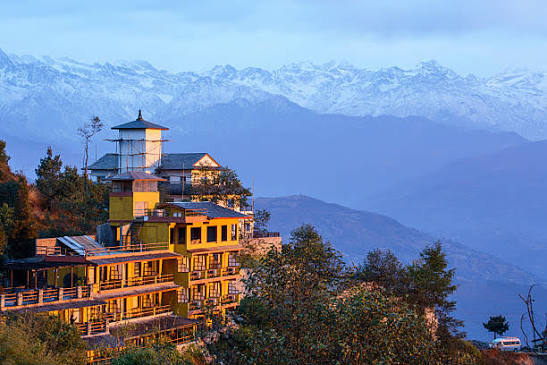
Nagarkot village and the ridge hotels appear at the top of the final climb. Check in. Confirm your room is north-facing — if it is not, ask to be moved. This is the non-negotiable accommodation requirement of this tour. A north-facing room means waking up on Day 2, opening the curtains before the 5am alarm, and seeing the Himalayan range already in pre-dawn silhouette above the valley. This single moment is worth the room change.
Walk to the View Tower or the ridge north of it for the sunset. April 3 sunset is approximately 6:20pm. The western ranges — Ganesh Himal, Langtang — catch alpenglow in the 15 minutes after the sun drops: a diffuse pinkish-orange on the snow fields that shifts to mauve and then fades. Watch it in full. Dinner back at the hotel, early to bed. The alarm is set for 4:50am.
Day 2 — Sunrise at the View Tower • Changunarayan hike • Bhaktapur return (~65 km riding + optional 3–4 hr hike)
The alarm goes off at 4:50am. The View Tower is a five-minute walk from most ridge hotels. Do not miss this window.
Nagarkot at 5am in April is cold — 6–8°C on the exposed ridge, with a northwest wind. Dress in every layer available: thermals, fleece, riding jacket zipped fully, gloves and neck gaiter. Carry the thermos of black tea. Walk to the View Tower and find a position on the north-facing side. The pre-dawn sky above the Himalayan horizon is already active: a deep violet-blue that is visibly brighter to the east, with the first ridge of the Mahalangur range appearing as a dark, jagged line where sky meets mountain. The lower peaks — Langtang Lirung, Ganesh Himal — are already visible as black silhouettes. Mount Everest is not yet identifiable; it is somewhere in the eastern darkness, 175 kilometres away.
The light sequence at Nagarkot is predictable in its structure and impossible to anticipate in its effect. At approximately 5:30am the eastern horizon brightens from dark blue to grey-blue. The silhouettes of the near peaks sharpen. At 5:40am the first pink appears on the highest snow fields — Langtang Lirung's summit, then the near-western peaks. The pink deepens to orange as it moves east along the range. At approximately 5:48am the sun clears the eastern ridge and the full sequence fires: the central and eastern peaks ignite in gold — Gaurishankar, Dorje Lakpa, the Jugal Himal — and then the far eastern peaks emerge from darkness. Everest, on a clear April morning, is identifiable: a dark triangle above and to the left of the Mahalangur range, the highest point visible, standing alone above its neighbours. Not guaranteed on every April morning. When it is there, it is unmistakable.
This sequence lasts approximately 15 minutes of maximum intensity. Then the light normalises, the colours become daylight colours, and the mountains settle into their daytime definition. The full panorama — 8 ranges, 300+ km of Himalayan ridgeline, in light — remains visible for several more hours on a clear April day. But the first 15 minutes after sunrise are why you came.
Return to the hotel for breakfast. Eat well. The morning is still young and there are options for the rest of Day 2 before the return to Kathmandu.
Day 2 continued — Changunarayan hike (optional, 3–4 hrs)
The hike from Nagarkot to Changunarayan is one of the finest half-day walks accessible from a road-reachable overnight destination near Kathmandu. The trail descends from the View Tower through pine and rhododendron forest, emerges onto ridge terraces with Bhaktapur valley views below, passes through Tamang and Brahmin villages at intervals and reaches the ancient temple after approximately 3–4 hours of walking. The descent is gradual, the trail clear, and the cultural texture of the Tamang settlements along the way is worth more attention than the walking pace usually permits.
Changunarayan temple itself — the oldest surviving Hindu temple in the Kathmandu Valley, its 464 AD Lichhavi stone inscription making it among the oldest dated inscriptions in South Asia — is dramatically undervisited compared to its significance. The carved wooden struts supporting the double-roofed pagoda are some of the finest Lichhavi-period woodwork in Nepal. The Vishnu images in the courtyard span several centuries of distinct artistic periods. Allow a full unhurried hour here.
From Changunarayan, return to the bike at Nagarkot by taxi or local jeep (20–30 min), ride down to Bhaktapur for a final Durbar Square pass and juju dhau stop, then return to Kathmandu via the Araniko Highway. Back in Kathmandu by mid-afternoon. Tour complete.
Riders who prefer not to hike: a leisurely morning on the ridge, a walk to the Kattike viewpoint, lunch at a Nagarkot cafe, then the direct descent to Bhaktapur and Kathmandu by midday. Both versions are entirely valid. The View Tower sunrise is the common centrepiece of both.
The Bike
| Field | Details |
|---|---|
| Motorcycle | Royal Enfield Himalayan 450 |
| Engine | 450cc |
| Loaded Weight | ~185 kg (minimal overnight kit) |
| Tyre Setup | Stock |
| Modifications | Luggage rack |
Bike Performance Notes
The Himalayan 450 is excellent for this ride: the suspension and comfort suit the 18 km pine-forest climb perfectly, and the engine pulls smoothly on the sustained gradient without complaint. The descent from Nagarkot to Bhaktapur via Changunarayan involves a short section of unpaved track; the bike handled it effortlessly. No mechanical notes from this tour. The Nagarkot loop requires nothing that a competent rider on any motorcycle above 125cc cannot manage — this is the programme's most accessible route for newer riders who still want a genuinely memorable Nepal motorcycle experience.
Road & Trail Conditions
| Section | Surface | Notes |
|---|---|---|
| Kathmandu → Bhaktapur (Araniko Highway) | Paved — busy | ~15 km. Congested through Koteshwor and Thimi in the morning; clear by 8am. Once past Bhaktapur the traffic drops dramatically |
| Bhaktapur → Sanga junction | Paved — good | The Sanga Ganesh Mandir hilltop with its massive white Shiva statue is visible from the road. Turn left at Sanga junction for the Nagarkot climb |
| Sanga junction → Nagarkot | Paved — winding uphill | ~18 km of sustained but well-surfaced climb through pine forest from ~1,400m to 2,175m. Classic motorcycle ascending road: consistent grade, sweeping curves, good visibility. The road narrows slightly near the summit |
| Sankhu alternative route | Paved — longer, quieter | Via Bouddha and Sankhu: adds ~10 km but avoids Bhaktapur traffic entirely. Quieter road through the northern valley; passes Sankhu Vajrayogini Temple. Excellent outbound option for those who prefer uncrowded riding |
| Nagarkot → Changunarayan (hike) | Foot trail — 3–4 hrs | Descending hike from the View Tower through Tamang villages, forest, and terraced farmland to Changunarayan UNESCO temple. Pick up the bike in Nagarkot for the return; walk one way, ride back |
| Changunarayan → Bhaktapur (by bike, Day 2 return) | Paved / narrow track | Changunarayan sits above Bhaktapur at ~1,550m; a short 8 km descent returns to Bhaktapur for the Durbar Square visit and Kathmandu return |
| Bhaktapur → Kathmandu | Paved — busy | Return via Araniko Highway; manageable mid-morning |
The Sanga–Nagarkot climb is one of the best-maintained mountain approach roads in the Kathmandu Valley. April conditions are reliable: dry surface, minimal gravel debris, clear road edges. The only caution is traffic on the climb between 9am and noon when tourist buses and jeeps are ascending — departing Bhaktapur before 9am avoids the main vehicle window. The descent via Changunarayan involves one optional trail section that mountain bikers rate as technical; on a motorcycle, use the road descent from the temple to Bhaktapur (signposted).
The Himalayan Panorama from Nagarkot
The View Tower at Nagarkot (2,175m) is positioned on an isolated ridge separating the Kathmandu Valley from the Indrawati Valley to the north, with an unobstructed northward sightline to the high Himalaya. Eight of Nepal's thirteen Himalayan ranges are visible on a clear morning — the widest accessible panorama within one hour's motorcycle ride of the capital.
| Peak | Altitude | Direction from Nagarkot |
|---|---|---|
| Annapurna I | 8,091m | West — distant but unmistakable on clear April mornings |
| Manaslu | 8,163m | West-northwest |
| Ganesh Himal | 7,422m | Northwest — dominates the near horizon on the western side |
| Langtang Lirung | 7,234m | North — closest major peak, prominent and near |
| Dorje Lakpa | 6,966m | Northeast |
| Gaurishankar | 7,134m | East — the double-headed peak visible in clear April air |
| Numbur Himal | 6,957m | East-southeast |
| Mount Everest | 8,848m | East-northeast, ~175 km distant — visible on very clear April mornings as a dark triangle above the Mahalangur range. Not guaranteed but genuinely possible from the View Tower |
April 4 sunrise note: sunrise at approximately 5:48am. Arrive at the View Tower by 5:15–5:20am to secure a good north-facing position and experience the full pre-dawn colour build. The most intense colour sequence lasts 10–15 minutes after the sun clears the eastern ridge. Cloud on the western ranges (Annapurna, Manaslu) can form by 8–9am in April — the early window is the reliable one.
Weather & Conditions
| Factor | Details |
|---|---|
| Season | Spring (early April) — one of the two optimal windows for Nagarkot |
| Temperature | Kathmandu: 22–28°C daytime. Nagarkot summit: 12–20°C daytime; 5–10°C overnight; pre-dawn at the View Tower: 6–8°C |
| Mountain visibility | April delivers clear pre-monsoon skies most mornings. Visibility typically excellent at dawn; afternoon haze builds as temperatures rise. Arrive at the View Tower by 5:30am for the best window |
| Rhododendron bloom | April is peak rhododendron season on the ridges and forest trails around Nagarkot — red and pink above the road on the climb, visible on the Changunarayan descent trail |
| Wind | Cool ridge wind at the View Tower at dawn. Bring a windproof layer for the pre-sunrise wait |
| Rain risk | April is generally dry in the Kathmandu Valley; occasional pre-monsoon afternoon thunderstorm possible but rare. Morning weather is reliably clear |
| Sunrise time | April 3–4: sunrise at approximately 5:48–5:50am. Arrive at the View Tower by 5:15–5:20am for the full pre-dawn colour sequence |
April 3–4 sits at the sweet spot of the spring riding window — warm enough for comfortable riding, clear enough for mountain views, rhododendrons still in bloom on the ridge. The one variable that cannot be controlled is morning cloud cover at the View Tower: April mornings are reliably clear in most years but not in all. If cloud is present at dawn, wait. April cloud at Nagarkot often burns off within 30–45 minutes of sunrise. If it persists, the walk to Changunarayan and the Bhaktapur visit remain excellent independent of the mountain view.
Highlights
This is the most focused ride in the Nepal Moto Tours programme. The highlights accumulate quickly:
| Stop | Why It Matters |
|---|---|
| Bhaktapur Durbar Square | Nepal's finest medieval city centre — a UNESCO World Heritage Site of brick temples, carved courtyards and the 55-Window Palace of the Malla kings. Morning light on the Durbar Square before the day-trippers arrive is exceptional. The motorcycle ride from Kathmandu to Bhaktapur along the Araniko Highway is the approach road the city deserves |
| Sanga Ganesh Mandir | The enormous white Shiva statue on a hilltop above Sanga is visible from the Araniko Highway below. A quick stop at the temple complex with its giant sculpture offers Kathmandu valley views and a vivid cultural landmark |
| The Nagarkot climb | From Sanga to the summit: ~18 km of sustained pine-forest switchbacks on a well-surfaced road. This section is the motorcycle highlight of the tour — each successive hairpin reveals a wider view of the valley below and the first glimpses of mountain ridgelines ahead. The road is empty enough in April morning to ride at your own pace |
| Nagarkot View Tower (2,175m) | The summit observation tower with a 360-degree platform. At dawn on a clear April morning, eight Himalayan ranges are simultaneously visible: Annapurna, Manaslu, Ganesh Himal, Langtang, Jugal, Rolwaling, Everest range, Numbur range. Everest is visible as a dark triangle on exceptionally clear mornings. This is the stated purpose of the entire tour |
| Sunset from the hotel terrace | April 3 sunset: approximately 6:20–6:25pm. The western ranges — Ganesh Himal and Langtang — catch alpenglow (pinkish-orange light on snow) in the 15 minutes after the sun drops below the Kathmandu Valley rim. Watch it from the hotel terrace with tea or something stronger |
| Changunarayan Temple (Day 2 hike) | The oldest Hindu temple in the Kathmandu Valley, dedicated to Vishnu, dating from the 4th–5th century AD (464 AD Lichhavi inscription — the oldest stone inscription in Nepal). A UNESCO World Heritage Site perched on a wooded hilltop above Bhaktapur. The 3–4 hour hike from Nagarkot passes Tamang villages, terraced farmland in spring and rhododendron forest before arriving at the ancient carved courtyard |
| Bhaktapur Durbar Square (Day 2 return) | A second pass through Bhaktapur on the return — this time in the afternoon light, which illuminates the brick temple facades differently from the morning visit. Stop for Bhaktapur's famous juju dhau (king curd) in clay pots at a courtyard shop before riding back to Kathmandu |
| Nagarkot ridge trail (optional) | A 45-minute walk along the ridge north of the View Tower leads to the Kattike viewpoint, with the same Himalayan panorama and fewer visitors. Excellent for early-morning photography before the sunrise crowds arrive at the main tower |
- The dawn light sequence at the View Tower: dark violet sky → grey-blue silhouettes → first pink on Langtang → orange sweeping east → full gold ignition across the range. Fifteen minutes that justify the overnight stay
- The Sanga–Nagarkot pine-forest climb: 18 km of empty April road with rhododendrons in bloom alongside and the Kathmandu Valley gradually revealed below on the switchbacks
- Bhaktapur Durbar Square without the afternoon crowds — morning light on the brick pagodas, the city already at work, the medieval architecture in full morning shadow and shine
- The Changunarayan descent hike: Tamang villages, terraced fields, ancient carvings at the end, and the specific quality of walking through forested Nepal in spring that no road can deliver
- Juju dhau twice in two days: this is correct behaviour in Bhaktapur and should not be apologised for
Lowlights & Challenges
- The Bhaktapur traffic approach on the outbound can be slow if departing Kathmandu after 9am. Leave earlier or accept 20–30 minutes of stop-start riding before the highway clears
- Mountain view is not guaranteed. April is excellent but not infallible — cloud can obscure the panorama on any given morning. There is no refund available from the weather. The alternative — Bhaktapur, Changunarayan, the climb road in rhododendron bloom — is not a consolation prize, but the sunrise is the reason for the overnight and its absence is felt
- Nagarkot is one of the most popular overnight destinations from Kathmandu and its hotels reflect that in pricing. Budget options are limited to basic rooms without views — which defeats the purpose. Mid-range hotels with north-facing rooms are the minimum for this tour. Book early for April weekends
- The cold at the View Tower at 5am is genuine: 6–8°C on the exposed ridge with wind. Riders who did not bring warm layers will be uncomfortable enough to shorten the experience. A fleece mid-layer, gloves and a neck gaiter are not optional
- The Changunarayan hike cannot be completed and the bike ridden down simultaneously without transport logistics. Either hike down and arrange a local jeep back to Nagarkot for the bike, or ride down directly and miss the trail. Both are valid; the logistics need a decision before departing the View Tower
Food & Tea Houses
| Stop | What to Eat / Experience |
|---|---|
| Bhaktapur (Day 1 morning) | Juju dhau — the famous Bhaktapur 'king curd' served in fired clay pots, available from early morning at shops near the Durbar Square. Thicker and richer than Kathmandu curd; genuinely excellent. A pre-ride ritual that Bhaktapur insists upon |
| Sanga junction canteen | Basic tea and sel roti at the junction before the climb. Nothing special but the right fuel before 18 km of uphill riding |
| Nagarkot cafes / lodges | Nagarkot has a good selection of restaurants ranging from hotel dining rooms to small cafes along the ridge road. Dal bhat is excellent at the mid-range lodge dining rooms; the local bread (roti) with honey and curd makes a good light dinner if the evening is being saved for the sunset. Ask wherever you eat for tea with mountain views — most ridge restaurants have terraces facing north |
| Pre-sunrise nothing | Do not eat a full meal before the 5am View Tower walk. Bring a thermos of black tea or coffee, a muesli bar if needed. The cold and the altitude and the darkness make a heavy meal counterproductive. Breakfast properly after the sunrise, back at the hotel |
| Post-sunrise breakfast | Return to the hotel for a full breakfast after the View Tower. April mornings at Nagarkot are beautiful for 2–3 hours after sunrise — the light on the mountains, the rhododendrons on the slopes, the valley below gradually emerging from haze. Eat slowly. There is time |
| Tamang village tea houses (hike) | The Changunarayan descent trail passes through Tamang settlements where small tea houses serve chiya (sweet tea), chiura (beaten rice), and eggs. These are informal stops with no menus — simple, warm, and perfectly calibrated for a mid-hike rest |
| Changunarayan lunch | Small restaurants below the Changunarayan temple serve dal bhat and noodle dishes. Eat here before riding down to Bhaktapur |
| Bhaktapur juju dhau (Day 2) | A second juju dhau before the return to Kathmandu. Different shop, same clay pot, same quality. Bhaktapur earns two visits |
Accommodation
| Location | Where We Stayed / Recommendation |
|---|---|
| Nagarkot (Night 1) | Any hotel on the north-facing ridge with a mountain-view room. Specific recommendations: Nagarkot Shangrila Resort (mid-range, good views), Club Himalaya Nagarkot (comfortable, reliable, view rooms), or simply any guesthouse that can confirm a north-facing window. The room view is the non-negotiable: wake up, open the curtains, see the Himalayan range from bed. This is the point of the overnight stay and a south-facing room negates it entirely. Book well ahead in April — Nagarkot fills on weekends and during the spring season |
| Kathmandu (return night) | Kathmandu Suite Homes |
The one non-negotiable accommodation rule for this tour: the room must face north. A south-facing room at Nagarkot means a hotel room in a hill town. A north-facing room means a window onto the Himalayan range from bed. When booking, confirm this explicitly and request the specific room. If the hotel cannot confirm a mountain-view north-facing room, choose a different hotel.
Permits & Entry Fees
- Bhaktapur Durbar Square entry: NPR 1,500 per foreign national (NPR 300 for SAARC nationals). Pay at the main entrance gate. The fee includes access to the full square complex
- Changunarayan Temple: small entry fee (NPR 100–300)
- Nagarkot View Tower: free
- No motorcycle permits required for this route. No conservation area or restricted zone
- Motorcycle registration papers as standard
Tips for Riders Planning This Route
- Book a north-facing mountain-view room at least two weeks ahead for April weekends. Nagarkot fills and the best rooms go first
- Set the alarm for 4:50am without negotiation. The View Tower walk takes 5 minutes; the colour sequence starts before 5:30am. Missing the pre-dawn is missing the point
- Bring every warm layer you have for the View Tower. The ridge wind at 5am is not the same as the valley temperature you packed for. A fleece, a riding jacket, a neck gaiter and riding gloves are the minimum
- Carry a thermos of hot tea or coffee for the pre-dawn wait. The View Tower has no catering at 5am and the cold makes a hot drink feel genuinely important
- Depart Kathmandu before 9am on Day 1. The Araniko Highway approach to Bhaktapur clears considerably by 8–8:30am; traffic after 9am adds 20–30 minutes to a straightforward journey
- Take the Sanga road outbound and the Changunarayan–Bhaktapur road on return for maximum variety. The two directions of the loop are genuinely different experiences
- Budget NPR 6,000–8,000 for the 2-day loop: mid-range hotel ~NPR 3,000–4,500, meals ~NPR 1,500, entry fees ~NPR 1,800, incidentals
- The Kattike viewpoint (45-minute ridge walk north from the View Tower) offers the same Himalayan panorama with fewer visitors. If the main tower is crowded on the morning of April 4, walk to Kattike instead for the sunrise
- If cloud obscures the View Tower at dawn, wait 30–45 minutes before abandoning the spot. April cloud at Nagarkot regularly clears within an hour of sunrise
- Do not rush through Bhaktapur on the outbound. It is one of the finest ancient cities in Asia and the motorcycle provides the exactly right way to arrive there: through the approaches on the Araniko Highway, past the rice paddies, into the old city at street level. Give it the hour it earns
Emergency & Practical Information
| Item | Details |
|---|---|
| Mobile Signal | Excellent throughout. Kathmandu, Bhaktapur, the Nagarkot climb and the ridge all have strong NTC and Ncell coverage. No signal gaps on this route |
| ATM | Bhaktapur (multiple), Kathmandu before departure. Nagarkot has some ATMs in the village but carry sufficient cash from Kathmandu. NPR 5,000–6,000 covers 1 night accommodation, all meals, entry fees and incidentals comfortably |
| Entry Fees | Bhaktapur Durbar Square charges foreigners NPR 1,500 (SAARC NPR 300). Changunarayan Temple charges a small entry fee. Nagarkot View Tower is free. Budget accordingly |
| Medical | Nagarkot has no hospital; nearest facility is in Bhaktapur or Kathmandu. This is a low-risk, low-altitude route. A standard first-aid kit is sufficient |
| Altitude | 2,175m at the View Tower — negligible altitude sickness risk for most riders. A mild headache and thirst in the pre-dawn cold are possible; water and warm clothing are the mitigation |
| Road hazards | The Nagarkot climb above Sanga has occasional large vehicles (tourist buses) in peak season. Stay left and use your horn on blind corners. The descent to Changunarayan by bike (if not hiking) is winding; standard downhill caution applies |
| Sunrise guarantee | Clear visibility at dawn is not guaranteed. April is excellent but not infallible. If the View Tower is in cloud on Day 2 morning, wait 30–45 minutes — April cloud often clears. If it does not clear by 7am, the hike to Changunarayan and the Bhaktapur visit remain excellent independent of the mountain view |
Final Verdict
Would we recommend this ride? Without any reservation whatsoever.
The Ride to Nagarkot is the programme's most accessible and most laser-focused tour. Two days. One hundred and thirty kilometres. Three stops worth deep attention: Bhaktapur, the View Tower, Changunarayan. One sunrise that is the documented reason for the overnight stay. Everything else is logistics, road, and the enjoyment of the Sanga–Nagarkot climb in rhododendron season.
April is the right month for this ride. The spring air is clear enough for eight Himalayan ranges, warm enough for comfortable riding, and the forest on the approach is pink-and-red with bloom. The View Tower at 5:48am on April 4th delivers what it promises: Ganesh Himal, Langtang, Gaurishankar, Dorje Lakpa, the Jugal range, the Rolwaling peaks, and — on a clear morning, which April usually provides — the unmistakable dark triangle of Everest standing above everything else in the eastern distance.
The entire morning sequence at Nagarkot — from the pre-dawn violet sky to the first pink on Langtang to the full gold ignition across the range — takes fifteen minutes. It requires one overnight stay, one pre-dawn alarm, and one properly booked north-facing room. The Nepal Moto Tours programme includes rides of ten days to Lo Manthang, five days to Manang, four days to Pattale. The Ride to Nagarkot is two days. All of those tours are worth doing. So is this one.
★★★★★
Ride Report by Prabhash Thakur | Nepal Moto Tours | Published April 2026
Tags: Nagarkot • Sunrise • Himalayan Panorama • Bhaktapur • Changunarayan • Kathmandu Valley • Nepal Weekend Ride • View Tower