

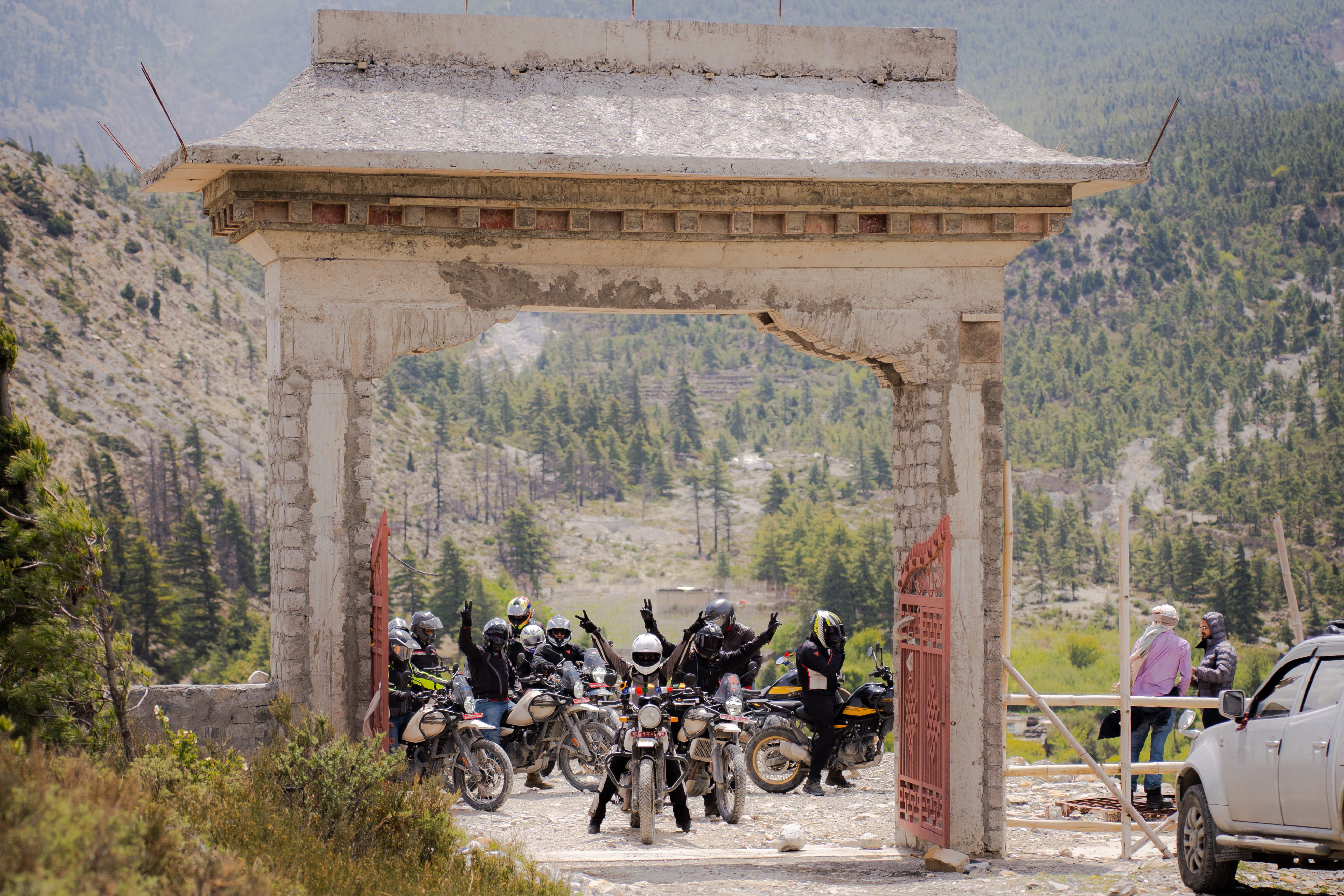
RIDE REPORT — KATHMANDU TO NUWAKOT
The City of Nine Hills in the Monsoon • Motorcycle Ride Report
Nepal Moto Tours • July 11–13, 2026
Ride Report by Prabhash Thakur
Monsoon Riding Advisory
⚠ July is peak monsoon season in Nepal. This ride is planned with that reality acknowledged, not avoided. Read this section before planning.
The Nuwakot route is manageable in July — but it is not the same ride as October. The road between Kathmandu and Nuwakot via Kakani has a documented history of monsoon landslide closures, with slides recorded specifically on the Kakani Rural Municipality-4 section (Pasang Lhami road) in July. This does not make the route impassable; it makes it a route that requires morning departure, road condition checking, and a documented alternative plan.
Nepal Police road status updates are the most reliable source for current conditions. Check them the evening before and again on the morning of departure. If any fresh slide activity is reported on the Kakani road, use the alternative outbound route via the Trishuli valley (see Emergency & Practical Information section). The return route — always via the Trishuli–Galchi road — carries significantly lower landslide risk than the Kakani descent and should always be the return direction in July.
With these conditions acknowledged and planned for: the Nuwakot ride in July is a genuinely excellent experience. The valley is at its greenest. The Trishuli is at its most powerful. The Devighat confluence in monsoon is extraordinary. The Famous Farm in July quiet-season is intimate and unhurried. And the Nuwakot Durbar in overcast light, with the wet terraces below it and the mist in the valley, has an atmospheric quality that no October visit delivers.
Overview
| Field | Details |
|---|---|
| Ride Dates | July 11–13, 2026 |
| Duration | 3 days / 2 nights |
| Start / End Point | Kathmandu (loop) |
| Total Distance | ~160 km (outbound via Kakani; return via Trishuli–Galchi) |
| Daily Riding Time | Day 1: ~3–4 hrs | Day 2: Exploration on foot | Day 3: ~3–4 hrs |
| Riding Style | Road / Monsoon Heritage Ride |
| Difficulty | ★★☆☆☆ — Easy to Moderate (elevated by monsoon conditions) |
| Season | Peak monsoon — maximum green, real landslide awareness required |
| Overall Rating | ★★★★★ |
We wrote a Nuwakot ride report for a clear October visit. This is the same destination in a different month — which means a different Nuwakot entirely. The mountain panorama from Kakani is gone, replaced by mist. The Trishuli has gone from a wide, shallow river to a fast, brown, full-volume force. The rice terraces below the Durbar, bare or stubbled in October, are uniformly and impossibly green. The Famous Farm has fewer guests, lower rates, and more time for its own quiet quality to emerge. July Nuwakot is not October Nuwakot's lesser version. It is a parallel version, with its own particular character, available only to the riders who choose to go when the weather tells them not to.
The Route
At a Glance
| Day | Date | Segment | Accommodation |
|---|---|---|---|
| Day 1 | Jul 11 | Kathmandu → Kakani ridge → Nuwakot Durbar → Bidur / Trishuli | The Famous Farm, Nuwakot |
| Day 2 | Jul 12 | Nuwakot Durbar (early morning) • Village walks • Devighat confluence • Farm afternoon | The Famous Farm, Nuwakot |
| Day 3 | Jul 13 | Nuwakot → Trishuli valley road → Galchi → Prithvi Highway → Kathmandu | Kathmandu Suite Homes |
The classic Nuwakot loop — outbound via Kakani, return via the Trishuli valley road — is the right format even in July, with one important monsoon-specific rule: always take the Trishuli–Galchi return. Never return via Kakani in active rain or after heavy overnight rainfall. The Trishuli valley road is wider, better-drained and carries significantly lower landslide risk than the Kakani descent in monsoon conditions. The two-directional loop still delivers maximum variety in the landscape and road character.
Day 1 — Kathmandu to Nuwakot via Kakani (~80 km | 3–4 hrs)
Depart Kathmandu by 7:00–7:30am. This is not a guideline in July — it is the operational requirement for a safe and enjoyable ride. The morning window between dawn and mid-morning is when the rain is lightest, road surface visibility is best, and the small landslide risk on the Kakani section is at its lowest. Check Nepal Police road status the evening before. Check again on the morning of departure. If the Kakani road is clear, proceed.
The Balaju–Trishuli Highway climbs from the valley floor through Mulpani and into the pine forest above Mudkhu. July transforms this section: the roadside vegetation overhangs the tarmac with monsoon growth, the drainage channels run with brown water, and the pine trees are wet-dark. The Shivapuri National Park corridor alongside the road is at its birdwatching peak in July — Himalayan species in the forest above and migratory arrivals taking shelter in the mid-altitude trees. The drone of rain on the helmet visor is intermittent in the morning; manageable and not unpleasant.
Kakani ridge at approximately 1,400m: no mountain panorama today. The ridge is likely in cloud — a grey-white wall where the Langtang and Ganesh Himal lineup would be in October. What is present instead: the smell of pine and wet earth, the cool air dropping five degrees from the valley, and the specific quality of a mountain road in cloud that makes navigation both more demanding and more atmospheric. A brief stop for tea at a canteen on the ridge, then the descent begins.
The descent from Kakani to Nuwakot is the section requiring most attention in July. The road is narrow, the bends are tight, the surface is wet, and the corners often carry gravel or leaf debris washed from the hillside above. Reduce speed from the already-measured Kakani standard to something approaching careful. Oncoming vehicles — jeeps and small trucks that approach corners with monsoon-season confidence — require anticipatory lane positioning. The views, obscured in cloud, are not the distraction they present in October; attention stays where it belongs, on the road.
Nuwakot Durbar appears through the cloud on its hilltop above the valley as the descent levels: the seven-storey Saat Tale Durbar, terracotta-ochre against green hills, the Trishuli valley spread below in monsoon fullness. In July, the rice paddies terracing the hillsides below the palace are at the precise stage of fresh planting — uniformly, intensely green, each flooded terrace reflecting the overcast sky. Prithvi Narayan Shah built this palace in 1744 as the military headquarters for his Nepal unification campaign; standing in its courtyard in July, with green terraces falling away below and the valley mist rising, the choice of this hilltop site is immediately intelligible.
Check in at The Famous Farm before the afternoon rain. The property — an 18th-century Newari manor house restored across eight terraces of organic garden — is quieter in July than any other month. The resident dog meets you at the gate. Ramesh at reception has been running the property with the same quiet warmth for years. In July, the garden is at maximum productivity: vegetables, herbs, flowers at peak season. Explore the terraces. Rest. Let the afternoon rain come.
Day 2 — Nuwakot Durbar • Village Lanes • Devighat • Farm Afternoon (foot and short bike)
The Famous Farm terrace at 6am in July: overcast, cool, the Trishuli valley below invisible in mist. Coffee. The sound of rain on the garden. The day's activities are structured entirely for the morning window.
Nuwakot Durbar before 9am. Walk up from The Famous Farm in fifteen minutes. The palace complex in monsoon light has qualities the October visit does not: the stone courtyard gleams wet, the carved wooden windows of the five-storey facade are deep-shadowed and vivid, and there are no other visitors. The 1744 palace — built by Prithvi Narayan Shah as his command centre for the Nepal unification, its seven floors visible from miles of the surrounding valley — is best experienced without crowds, and July delivers that absolutely. Allow an unhurried hour in the complex. Visit the Bhairavi Temple and the Taleju shrine in the same courtyard. These temples pre-date the palace and carry their own layered history that the Durbar's fame often overshadows.
Descend through the old Nuwakot bazaar lanes below the Durbar hill. In July, the lanes are quiet. The grain merchants and tea stalls operate for local customers, not tourists. Stone houses with carved wooden window frames, some clearly dating from the Malla period, line the narrow path. A morning tea stop at one of the basic tea stalls here — Nepali milk tea, sel roti — is the most authentic Nuwakot food experience available on this tour.
After the Durbar visit: ride or walk to Devighat, 6 km from Bidur. The Trishuli–Tadi confluence in July is a completely different experience from any other season. Both rivers are running at full monsoon volume: fast, powerful, brown with silt from the surrounding hills. The Jalpa Devi Temple at the confluence — where King Prithvi Narayan Shah died and was cremated in 1775 — is surrounded by full green forest, the river roaring below the temple steps. This is where the founder of Nepal drew his last breath. The monsoon gives it a raw, elemental quality that the spring pilgrimage crowds at this site never allow visitors to access.
Return to The Famous Farm by noon. The afternoon rain arrives and settles in. Read on the terrace until the rain makes that untenable, then move inside. The farm kitchen produces lunch and then, later, the lantern-lit evening meal in the courtyard. In July, the kitchen is drawing from the garden at its peak productivity: whatever is ready from the eight terraces is what is on the plate tonight. Ask. The food is excellent.
Day 3 — Nuwakot to Kathmandu via Trishuli–Galchi Road (~80 km | 3–4 hrs)
Depart before 9am. Take the Trishuli valley road south — not the Kakani road. In July, this is the non-negotiable return direction regardless of how clear the morning appears.
The road from Bidur south along the Trishuli to Galchi in July is one of the finest monsoon road experiences near Kathmandu. The river is immediately alongside for most of the journey: wide, fast, brown and full, its volume in July five to ten times what it carries in March. Waterfalls pour directly from the hillsides above the road — not the occasional trickle of dry season but full cascades that cross the road in places, requiring a brief slow-down and a face full of cold water. The valley walls are intensely green on both sides, every surface saturated by weeks of monsoon rain.
The Galchi junction arrives where the Trishuli valley road meets the Prithvi Highway. Turn right for Kathmandu. The Prithvi Highway is wide, well-maintained and carries normal monsoon hazards — standard riding care, not special monsoon riding. Back in Kathmandu by late morning or noon. Tour complete.
The Bike
| Field | Details |
|---|---|
| Motorcycle | Royal Enfield Himalayan 450 |
| Engine | 450cc |
| Loaded Weight | ~190 kg (light kit for 3-day loop) |
| Tyre Setup | Stock |
| Modifications | Luggage rack |
Bike Performance Notes
The Himalayan 450 is more machine than the Nuwakot route strictly requires, but the weight and ground clearance are genuine assets in monsoon conditions: the suspension absorbs wet road imperfections smoothly, and the engine's low-end torque provides progressive, controllable power delivery on wet tarmac where aggressive throttle application would cause wheel spin on a lighter machine. The stock tyres have adequate grip in normal monsoon road conditions — not off-road mud, but wet tarmac with debris. No mechanical issues on this tour.
Specific monsoon note: chain lubrication is accelerated by rain. Check and lubricate the chain at The Famous Farm on the evening of Day 1 if it has been raining throughout the outbound ride. A dry chain in monsoon conditions wears significantly faster.
Road & Trail Conditions
| Section | Surface | Monsoon Condition & Notes |
|---|---|---|
| Kathmandu → Kakani (via Balaju, Trishuli Hwy) | Paved — mostly good | LANDSLIDE RISK: The Trishuli–Kakani–Balaju road is one of three Nuwakot–Kathmandu corridors documented as landslide-prone in monsoon. A slide at Kakani RM-4 (Pasang Lhami section) has blocked this road in previous July seasons. Check conditions with Nepal Police or local contacts before departing. Ride early morning (before 8am) when risk window is lowest |
| Kakani descent to Nuwakot | Paved, narrow — winding | Wet surface after overnight rain; leaf and gravel debris on corners. The descent is tight with limited sightlines in normal conditions — reduce speed further in wet. Take it slow; the views through the cloud are worth the patience |
| Nuwakot to Bidur / Trishuli | Paved — good | Short 7 km link from Nuwakot village to the main valley road. Manageable even in heavy rain; no significant landslide exposure |
| Devighat detour (Day 2 or Day 3) | Paved / compact track | 6 km from Bidur along the Tadi River. Good condition. The confluence is spectacular in monsoon — both rivers swollen and fast |
| Bidur → Galchi → Prithvi Highway (return Day 3) | Paved — excellent | The return via the Trishuli valley road is the safest and most scenic return option in monsoon. Wide, well-drained road following the river south. Joins Prithvi Highway at Galchi. AVOID the Kakani return road in heavy ongoing rain — always use the Trishuli–Galchi return in July |
⚠ IMPORTANT: The Kakani road (Trishuli–Kakani–Balaju) has documented July landslide closure history. Check Nepal Police road status before departing on Day 1. If slides are reported, use the alternative via Trishuli–Galchi. ALWAYS return via the Trishuli valley road, not via Kakani, in July.
The route avoids all high-risk monsoon roads used by other Nepal Moto Tours programmes (Prithvi Highway Muglin section, Araniko Highway, BP Highway). The Kakani road is the one section carrying meaningful July risk, and it is manageable with proper morning-timing and condition-checking protocols. The Trishuli valley return road is one of the safer near-Kathmandu road options in monsoon.
Weather & Conditions
| Factor | Details |
|---|---|
| Season | Peak monsoon (July) — Nepal's wettest month |
| Kathmandu | Warm, humid; 22–28°C. Overcast most mornings, heavy rain most afternoons. July 11–13 sits mid-monsoon; plan all riding for before noon |
| Kakani ridge (1,400m) | Frequently in cloud during July; mountain views (Langtang, Ganesh Himal etc.) almost certainly obscured. The ridge in monsoon mist is atmospheric in a completely different way — accept the cloud; the view is not the reason for this trip |
| Nuwakot valley (~900m) | Warm and green; 20–26°C daytime. July brings the valley to its most vivid condition: terraced rice paddies freshly planted and uniformly green, the Trishuli running fast and full, every stream on the hillsides active |
| Rain pattern | Morning: often overcast but rideable. Afternoon: heavy rain expected daily. All outdoor activities and riding should be completed before 2pm. Shelter at The Famous Farm from mid-afternoon |
| Landslide risk | Real and documented on the Kakani road in particular. Check Nepal Police road status updates and local contacts before each riding day. Never ride at night in monsoon. Do not shelter under cut slopes during rain |
| Visibility | Mountain views cloud-covered throughout July. This is not the Nuwakot of October panoramas. It is the Nuwakot of saturated green hills, mist in the valley, a swollen Trishuli below the Durbar, and lantern-lit dinners at The Famous Farm |
| Best time of day | Depart Kathmandu by 7:00–7:30am. Complete all riding and outdoor activity before 1pm. Accept the afternoon rain as part of the experience |
July 11–13 sits in the middle of Nepal's peak monsoon period. There is no framing this as a comfortable weather window — it is wet, it is humid, and the afternoon rain is daily and heavy. The specific case for riding to Nuwakot in July is not the weather; it is what the weather does to the destination. The Trishuli at full monsoon volume. The rice terraces at maximum green. The Devighat confluence at its most powerful. The Famous Farm garden at its most productive. These things exist only in July. The rider who chooses this trip understands that the rain is part of the point, not an obstacle to it.
Permits Required
No permits required. No conservation area, restricted zone or heritage entry fees on this route. The Nuwakot Durbar charges a small entry fee (NPR 100–200) for the palace complex. No other fees.
- Motorcycle registration papers as standard
- No ACAP, TIMS or special documentation required
July-Specific Highlights
The Nuwakot October ride report catalogues the Kakani mountain panorama, the golden afternoon light on the Durbar, the clear river and the easy return road. This is the complementary list — the things that only July delivers.
| Stop | July-Specific Notes |
|---|---|
| Kakani ridge — monsoon version | No mountain panorama in July — but the ridge in cloud has its own character. Pine forest dripping with rain, the valley below invisible, the road ahead emerging from mist. A brief stop rather than a lingering one; the payoff is in Nuwakot |
| Nuwakot Durbar (Saat Tale Durbar) | The 7-storey palace in monsoon context: the green terraces below it at their most saturated, the Trishuli valley mist-filled, the stone courtyard wet and gleaming. The restored woodwork takes on depth in overcast light that harsh sun never reveals. Arrive before 10am for the best experience and fewest visitors |
| Bhairavi Temple | Adjacent to the Durbar; ancient woodwork, quiet inner courtyard, monsoon atmosphere. One of the finest small temples in the Nuwakot complex |
| Taleju Temple (Nuwakot complex) | The royal Taleju shrine, closely related to the Taleju temples of Kathmandu. In July, the courtyard is often empty and the surrounding vegetation at its most lush |
| Nuwakot old bazaar lanes | The tight Newari lanes below the Durbar hill are at their quietest and most genuine in off-season July. No day-trippers from Kathmandu, no tour groups. The local tea stalls, grain merchants and stone houses in the rain have a quality the October visits never deliver |
| The Famous Farm organic garden | Eight terraces of organic produce in full July growth: vegetables, herbs, fruits at peak season. The resident dog. Lantern-lit evening meals in the courtyard. July is one of the quietest months at the property — more intimate, more personal, and 30–40% cheaper than peak season rates |
| Devighat confluence | The Trishuli–Tadi confluence in monsoon is extraordinary: both rivers in full July flood, running fast and brown with silt, the sacred site of Jalpa Devi Temple surrounded by full green forest. The river's power at this season is something the October visit cannot approximate. A genuinely moving July-specific experience |
| Trishuli valley road (return) | The return along the Trishuli south to Galchi in July is a different ride from any other season: the river running at full volume alongside, waterfalls streaming down the hillsides directly to the road, and the valley walls intensely green. One of the finest monsoon road experiences near Kathmandu |
- Riding the Trishuli valley return on Day 3: the river at full July volume alongside the road, waterfalls crossing from above, the valley walls saturated green on both sides. Nothing in the programme's other routes near Kathmandu offers this specific monsoon road experience
- Devighat in full monsoon flood: the confluence of two rivers at their annual maximum, the Jalpa Devi Temple surrounded by forest at its most vivid, the site of Prithvi Narayan Shah's cremation in full elemental July context
- The Famous Farm at off-season quietude: 30–40% lower rates, no other groups, Ramesh with more time for conversation, the kitchen drawing from the garden at peak productivity. The most intimate version of this property available in any month
- Nuwakot Durbar before 9am in July: the stone courtyard empty and gleaming wet, the carved windows deep-shadowed in overcast light, the terraces below uniformly green. This version of the Durbar exists only in the monsoon
Lowlights & Challenges
- The Kakani mountain panorama — the October ride's centrepiece stop — is absent in July. The ridge is in cloud. This is the single biggest trade-off for the July Nuwakot ride, and it is real. If the mountain view is the primary motivation, ride in October
- Landslide risk on the Kakani road is genuine and documented. This is not a guidebook disclaimer but a real operational hazard that requires morning-departure discipline and pre-ride road condition checking. Riders who ignore this are not being adventurous — they are being careless
- The afternoon rain in July is daily and heavy. Every outdoor activity on Day 2 must be completed before 1:30–2:00pm. No exceptions; the rain is not light and it is not brief
- The Kakani descent is more demanding in wet conditions than it appears on paper. Wet tarmac with debris, tight sightlines and confident oncoming vehicles require speed reduction and full attention. Riders who treat the descent as the same as October will be surprised. Reduce speed by 20–30% in wet conditions
- The Famous Farm terrace views — Ganesh Himal and the Trishuli valley panorama in clear weather — are cloud-obscured in July. The valley view through mist is beautiful but different. Know what you are arriving to
Notable Stops
| Stop | July-Specific Notes |
|---|---|
| Kakani ridge — monsoon version | No mountain panorama in July — but the ridge in cloud has its own character. Pine forest dripping with rain, the valley below invisible, the road ahead emerging from mist. A brief stop rather than a lingering one; the payoff is in Nuwakot |
| Nuwakot Durbar (Saat Tale Durbar) | The 7-storey palace in monsoon context: the green terraces below it at their most saturated, the Trishuli valley mist-filled, the stone courtyard wet and gleaming. The restored woodwork takes on depth in overcast light that harsh sun never reveals. Arrive before 10am for the best experience and fewest visitors |
| Bhairavi Temple | Adjacent to the Durbar; ancient woodwork, quiet inner courtyard, monsoon atmosphere. One of the finest small temples in the Nuwakot complex |
| Taleju Temple (Nuwakot complex) | The royal Taleju shrine, closely related to the Taleju temples of Kathmandu. In July, the courtyard is often empty and the surrounding vegetation at its most lush |
| Nuwakot old bazaar lanes | The tight Newari lanes below the Durbar hill are at their quietest and most genuine in off-season July. No day-trippers from Kathmandu, no tour groups. The local tea stalls, grain merchants and stone houses in the rain have a quality the October visits never deliver |
| The Famous Farm organic garden | Eight terraces of organic produce in full July growth: vegetables, herbs, fruits at peak season. The resident dog. Lantern-lit evening meals in the courtyard. July is one of the quietest months at the property — more intimate, more personal, and 30–40% cheaper than peak season rates |
| Devighat confluence | The Trishuli–Tadi confluence in monsoon is extraordinary: both rivers in full July flood, running fast and brown with silt, the sacred site of Jalpa Devi Temple surrounded by full green forest. The river's power at this season is something the October visit cannot approximate. A genuinely moving July-specific experience |
| Trishuli valley road (return) | The return along the Trishuli south to Galchi in July is a different ride from any other season: the river running at full volume alongside, waterfalls streaming down the hillsides directly to the road, and the valley walls intensely green. One of the finest monsoon road experiences near Kathmandu |
Food & Tea Houses
The food on the July Nuwakot ride is simpler in variety than the peak-season version but higher in authenticity. The Nuwakot bazaar stalls are operating for local trade, not tourism. The Famous Farm kitchen is drawing from its most productive garden month. The Trishuli dhabas on the return are busy with local truck drivers and farmers, not tour groups. Eat what is in front of you and eat it in the place it was made.
| Stop | What to Eat / Experience |
|---|---|
| Kathmandu (pre-departure) | Dal bhat or eggs at the hotel before departing. Carry a thermos of tea for the Kakani ridge section — the cloud and cool air make a hot drink welcome at the first stop |
| Kakani tea houses (brief stop) | One or two small canteens operate on the ridge even in monsoon, catering to local commuters and occasional riders. Tea and biscuits in the mist — simple and atmospheric |
| Nuwakot bazaar tea stalls | The old bazaar below the Durbar has basic tea stalls serving Nepali milk tea, sel roti and occasional fried snacks. Morning stops here before the Durbar visit are recommended — the tea is good and the bazaar quieter in monsoon than any other season |
| The Famous Farm kitchen | The primary food experience of the tour. All-inclusive meals using produce from the organic farm's eight terraces: fresh vegetables at peak July season, local honey, buffalo curd, farm-to-table cooking by a kitchen that has been doing this for years. The evening meal by lantern light in the courtyard is the social centrepiece of the two-night stay. In July, banana fritters are a reported highlight (per guest reviews). Ask Ramesh at reception what is ready from the garden |
| Devighat riverbank tea house | A small tea stall near the Jalpa Devi Temple at the confluence serves tea and beaten rice. The river, huge and brown and fast in July, is the entire dining experience here — the food is incidental |
| Trishuli Bazaar (return Day 3) | Lively riverside dhabas on the return leg. Dal bhat tarkari, noodle soup, egg dishes. Lunch stop before the Galchi junction and the Prithvi Highway run home. The river is immediately to hand and at full July volume |
One specific note: The Famous Farm reviews specifically mention the banana fritters as a standout dish in the July–August period, when the farm's banana plants are producing. Ask for them. The kitchen makes them to order and they are genuinely excellent.
Accommodation
| Night | Location | Where We Stayed |
|---|---|---|
| Nights 1 & 2 | Nuwakot | The Famous Farm, Nuwakot — the only accommodation in the district that matches the quality of the location. In July, rates are 30–40% lower than peak season and the property is quieter and more intimate. All meals included. Book at least a week ahead even in off-season; Kathmandu residents occasionally escape to The Famous Farm in the monsoon for exactly the peace it offers |
| Return night | Kathmandu | Kathmandu Suite Homes |
The Famous Farm in July is the best version of itself in one specific sense: it is most itself when it is quietest. The 13-room property was designed as an intimate retreat, not a busy hotel, and July delivers exactly that. The staff-to-guest ratio improves dramatically in monsoon, the garden is at peak colour and productivity, and the lantern-lit courtyard dinners have the quality of a private meal rather than a shared-table hospitality experience. Book at least a week ahead even in July — Kathmandu residents occasionally use The Famous Farm specifically for monsoon escapes.
Tips for Riders Planning This Route in July
- Check Nepal Police road status the evening before Day 1 and again on the morning of departure. The Kakani road (Trishuli–Kakani–Balaju) has a July landslide history. This check is not optional
- Depart Kathmandu by 7:00–7:30am. The morning window is the safest and most rideable period of the July day. Every hour of delay toward midday increases rain probability and afternoon closure risk
- ALWAYS return via the Trishuli–Galchi road, not via Kakani. This is the non-negotiable monsoon routing rule for this loop
- Have the alternative outbound route in your phone before departing: Kathmandu → Prithvi Highway → Galchi → Bidur → Nuwakot. If the Kakani road is blocked or conditions uncertain, this is the reliable backup
- Full waterproof gear is mandatory: jacket, overtrousers, waterproof gloves. Do not rely on the morning clear to last — carry the full kit and accept that you may use it
- Do not ride at night. No exceptions in July on any mountain road near Kathmandu. Arrive at all destinations before 4pm
- If riding starts during heavy ongoing rain, stop and shelter. Pull off to a safe position — not under a cut slope or at a narrow valley bend — and wait for the downpour to ease. Never ride through a monsoon cloudburst on a mountain road
- Plan Day 2 outdoor activities for before 1:30pm. The afternoon rain is daily and significant. Devighat, the bazaar walk and the Durbar visit should all be morning activities
- Carry NPR 3,000–4,000 in cash for incidentals. The Famous Farm is all-inclusive but small expenses — tea at the bazaar, Devighat refreshments, Trishuli lunch on return — add up. No ATM in Nuwakot village; Bidur has machines
- Pack a dry bag or waterproof inner liner for luggage. Even with a covered rack bag, sustained monsoon rain will penetrate most luggage over a 4-hour ride. Electronics, cameras and spare clothing should be in dry-bag protection
- Leeches are possible on the more vegetated walking sections near The Famous Farm and on the Devighat river path. Long trousers tucked into boots and a small packet of salt are sufficient countermeasures. They are part of the July experience, not a reason to avoid the walks
Emergency & Practical Information
| Item | Details |
|---|---|
| Landslide monitoring | Check Nepal Police road status (Nepal Police official social media or local contacts) before departing each morning. The Kakani road specifically has a documented July closure history. If any report of fresh landslide activity exists on the outbound route, delay departure or use the alternative outbound route via Nuwakot (see below). Never proceed on a road reported as blocked |
| Alternative outbound | If the Kakani road is reported blocked or conditions uncertain: depart via the Prithvi Highway west to Galchi, then north on the Trishuli valley road to Bidur and Nuwakot. Adds ~30 km and ~45 minutes but is the safest monsoon alternative. The Trishuli valley road is wider and better-drained than the Kakani descent |
| Mobile Signal | Good throughout. NTC and Ncell coverage on the Kakani road, in Nuwakot, Bidur and along the Trishuli valley. The Famous Farm has WiFi. No signal gaps on this route |
| ATM | Bidur/Trishuli Bazaar has ATMs. The Famous Farm is all-inclusive for accommodation and meals; carry NPR 3,000–4,000 for incidentals, Devighat tea stops, Trishuli bazaar lunch on return, and tips |
| Medical | Bidur district hospital; nearest full hospital is Kathmandu (~1.5 hrs). Carry a basic first-aid kit. Standard first aid sufficient for this route |
| Night riding | Absolutely no night riding in monsoon on any mountain road. The Kakani road and the Nuwakot descent are emphatically not safe after dark in July. Arrive at all destinations before 4pm |
| Riding in rain | Full waterproof gear required: jacket, overtrousers, waterproof gloves. If riding starts during heavy ongoing rain, pull over and shelter — never ride through a monsoon downpour on a mountain road. Wait for a break in the rain before continuing |
Final Verdict
Would we recommend this ride in July? Yes — to the right rider, with the right expectations, and with the landslide protocols in place.
The July Nuwakot ride is the same destination as the October one and a different experience. The mountain view from Kakani — the October report's opening act — is gone. In its place: the Trishuli at full monsoon force, the Devighat confluence in elemental July flood, the Nuwakot terraces in their most saturated green, The Famous Farm at its quietest and most intimate, and a ride through the Trishuli valley return that delivers a monsoon road experience available nowhere else near Kathmandu.
The Kakani road's documented July landslide risk is the single factor that requires serious operational respect. It is not a reason to cancel the ride; it is a reason to check conditions, depart early, have an alternative plan, and never return via that road in July. These are disciplines that any serious rider should maintain without drama. The reward for maintaining them: Nuwakot in the monsoon, which is genuinely a different and entirely valid version of one of Nepal's finest short rides.
The Famous Farm by lantern light in the July rain, with the valley invisible below in mist and the kitchen drawing from eight terraces of organic garden, is one of the most peaceful experiences available within two hours of Kathmandu. Prithvi Narayan Shah's palace in the morning drizzle, empty of tour groups, the carved woodwork deep-shadowed and the stone courtyard gleaming, is the Nuwakot Durbar that most visitors never see. The Trishuli running brown and fast and powerful at Devighat, with the Jalpa Devi Temple in full green forest above it, is a landscape that the October version of this ride cannot offer.
Know what you are going to. Ride it carefully. It is worth it.
★★★★★
Ride Report by Prabhash Thakur | Nepal Moto Tours | Published July 2026
Tags: Nuwakot • Monsoon Ride • Nuwakot Durbar • The Famous Farm • Devighat • Trishuli • Kakani • Nepal Heritage Tour • July Riding