
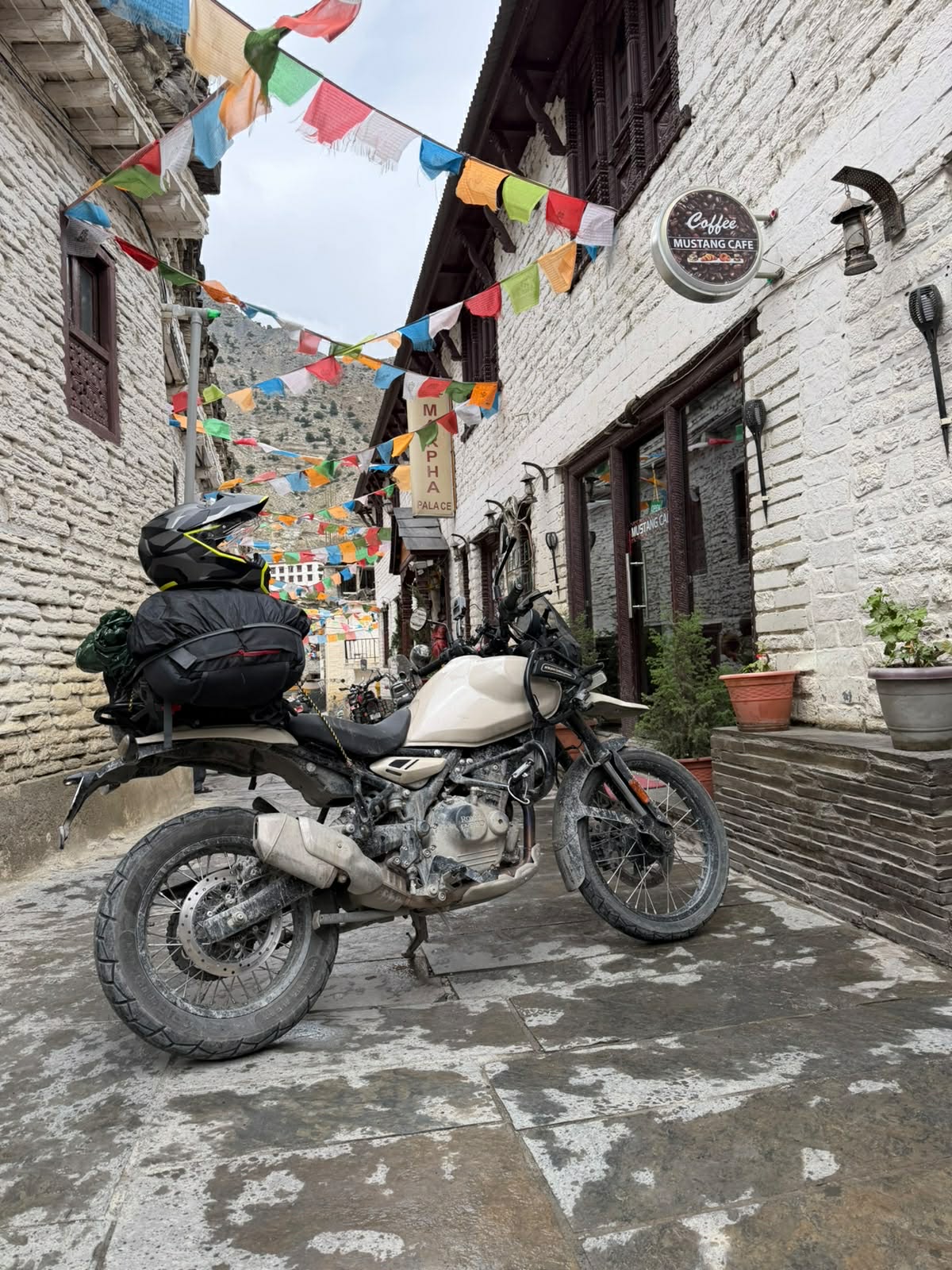
The question of which motorcycle is best for Nepal tours sounds like it should have a simple answer. It does not, or rather, it has several honest answers depending on your route, your experience level, your mechanical self-sufficiency, and whether you are renting locally or bringing your own machine. The list that works for the Kathmandu–Pokhara highway is not the same list that works for the Upper Mustang motorbike tour. The bike that is optimal for an experienced off-road rider is not the same bike that is optimal for a road-focused tourer attempting Nepal for the first time.
This guide covers the bikes that actually perform on Nepal's varied terrain, from the sealed highways of the main corridor to the technical gravel of the Kali Gandaki gorge and the high plateau tracks of Upper Mustang, with honest assessments of where each excels, where each falls short, and which rider profile each suits best.
What Nepal's Roads Actually Demand
Before bikes, terrain. Nepal's road network for motorcycle touring spans a wider surface variety than most adventure riding destinations, and understanding what that variety demands from a motorcycle changes how you evaluate any specific machine.
The Prithvi and Siddhartha Highways between Kathmandu and Pokhara are real paved roads, not European-standard in their surface consistency, but sealed, maintained, and manageable on any motorcycle. The Annapurna Circuit motorbike tour approaches combine paved lower sections with increasingly unpaved upper sections as the route climbs toward Manang. The Mustang district roads above Kagbeni are unpaved tracks of loose river gravel, exposed rock, and genuine ford crossings. The Manaslu Circuit and Tsum Valley approaches include technical single-track that rewards light, flickable machines over heavy ones. The Terai routes are substantially paved with variable surface quality.
The variables that Nepal's terrain most consistently tests are ground clearance, suspension travel, weight, tyre grip on loose surfaces, fuel range, and critically, mechanical simplicity and the availability of parts and knowledge when something goes wrong far from a city.
Any motorcycle claiming genuine suitability for Nepal's serious touring routes needs to answer credibly on all six. This immediately reduces the field from the full global adventure bike market to a shorter list of machines whose combination of specification and regional support infrastructure makes them genuinely appropriate rather than theoretically capable.
The Royal Enfield Himalayan 411: The Default Choice
Why It Dominates Nepal's Touring Fleet
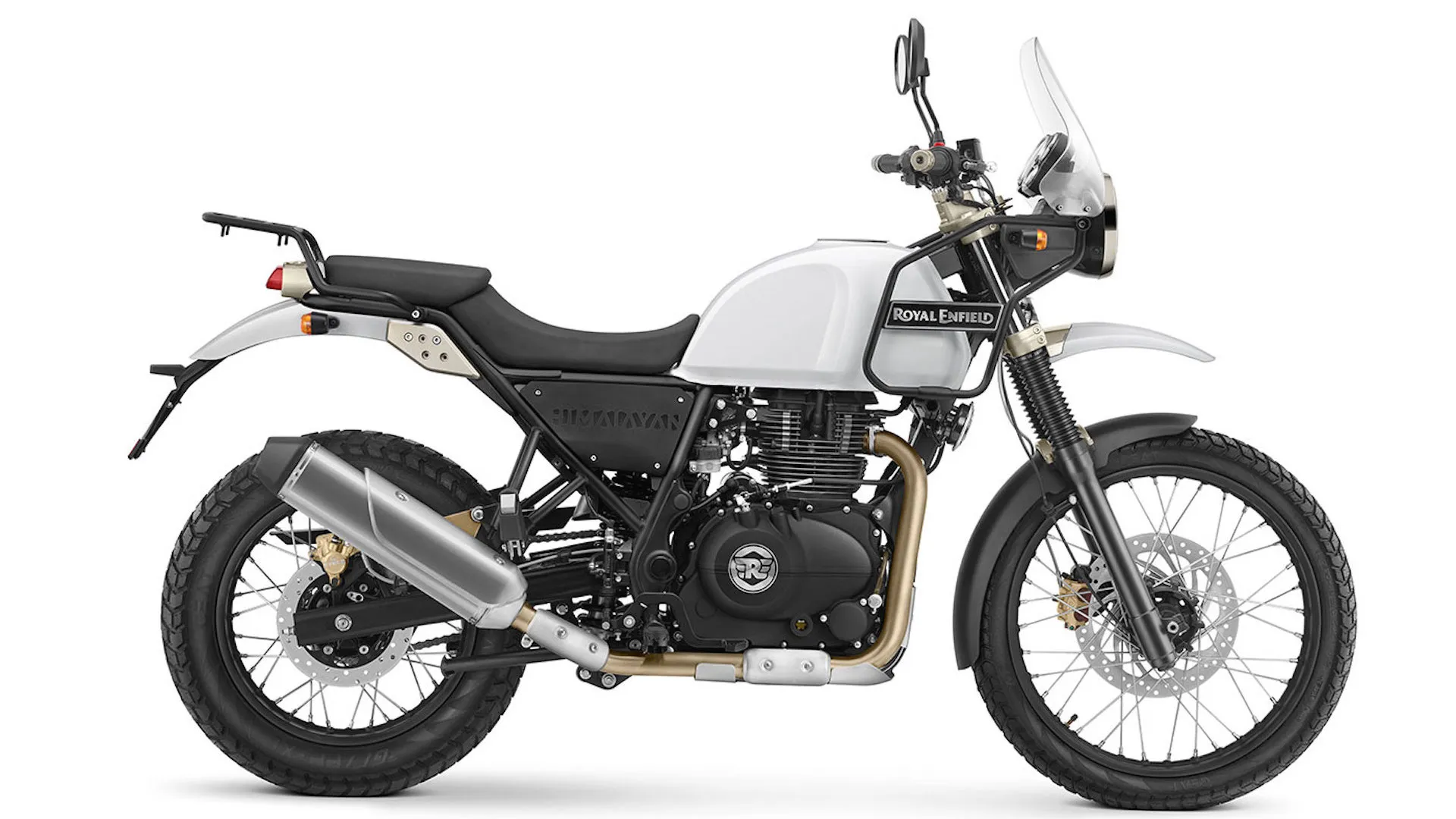
The Royal Enfield Himalayan 411 is not Nepal's most common touring motorcycle by accident or by marketing. It is the dominant machine on Nepal's serious mountain routes because it answers the six terrain variables above better than any competitor at its price point, in this specific environment, with this specific support infrastructure.
Ground clearance of 220mm exceeds most road-biased adventure competitors in its class. Suspension travel, 200mm front, 180mm rear absorbs the continuous low-frequency punishment of corrugated mountain tracks without transmitting it destructively to the rider. The 411cc single-cylinder engine produces approximately 24 bhp, adequate for Nepal's mountain speeds where the road surface sets the pace rather than the engine, with a torque delivery that is predictable and manageable on loose surfaces. The 15-litre fuel tank delivers approximately 400km of realistic mountain range, covering the gaps between reliable fuel stops on the most remote routes without requiring carrying extra fuel for the majority of itineraries.
The mechanical architecture is the Himalayan 411's most significant Nepal-specific advantage. The carbureted BS4 version — still the predominant model in Nepal's rental and privately owned fleet — uses a mechanical system that any competent general mechanic can diagnose, adjust, and repair with tools available in Nepal's mountain towns. At 4,500 metres above sea level, a carbureted engine running rich can be leaned out with a screwdriver in twenty minutes. A fuel-injected engine with an ECU fault at the same altitude requires diagnostic equipment and a dealership.
The parts ecosystem reinforces this advantage. Genuine Royal Enfield parts are available in Kathmandu with reasonable reliability. Compatible aftermarket components are stocked across Nepal's parts distribution network from the Terai to the mid-hills. A clutch cable, a brake lever, a chain kit for a Himalayan 411 can be sourced in Jomsom or Beni or Tatopani in a way that equivalent parts for a KTM or BMW cannot.
Who the Himalayan 411 Suits Best
The Himalayan 411 suits the widest range of Nepal touring profiles of any single machine available in Nepal's rental fleet. Riders with road experience building toward off-road confidence find the 411's weight, ergonomics, and predictable power delivery manageable on Nepal's technical sections without requiring advanced off-road technique. Experienced adventure riders find it capable on all but the most extreme Himalayan single-track. Fleet operators find it the most economical machine to maintain across a season of heavy use on demanding terrain.
The Himalayan 411 is the right choice for first-time Nepal riders, for riders targeting the Upper Mustang circuit, for the Annapurna approaches, for the Kathmandu–Pokhara corridor with diversions, and for any itinerary where mechanical support availability matters as much as technical specification.
Where It Falls Short
The Himalayan 411 is not fast. Its 24 bhp restricts highway cruising to speeds that more powerful machines exceed comfortably, and the vibration at sustained speeds above 80 km/h is notable and fatiguing on long paved sections. For riders spending significant proportions of their Nepal trip on the main highways rather than the mountain routes, this limitation matters.
Build quality, while improved across successive Himalayan generations, does not match Japanese or European competitors in absolute terms. The Himalayan rewards consistent maintenance and punishes neglect more sharply than a Honda, and budget rental operations with variable maintenance standards can produce machines that underperform what the specification suggests. Inspecting a rental Himalayan carefully before departure, checking chain tension, tyre condition, brake response, and basic electrical function, matters more than the equivalent check on a machine from a reputable Japanese brand.
The Royal Enfield Himalayan 450: The Next Generation
What Changes at 450cc
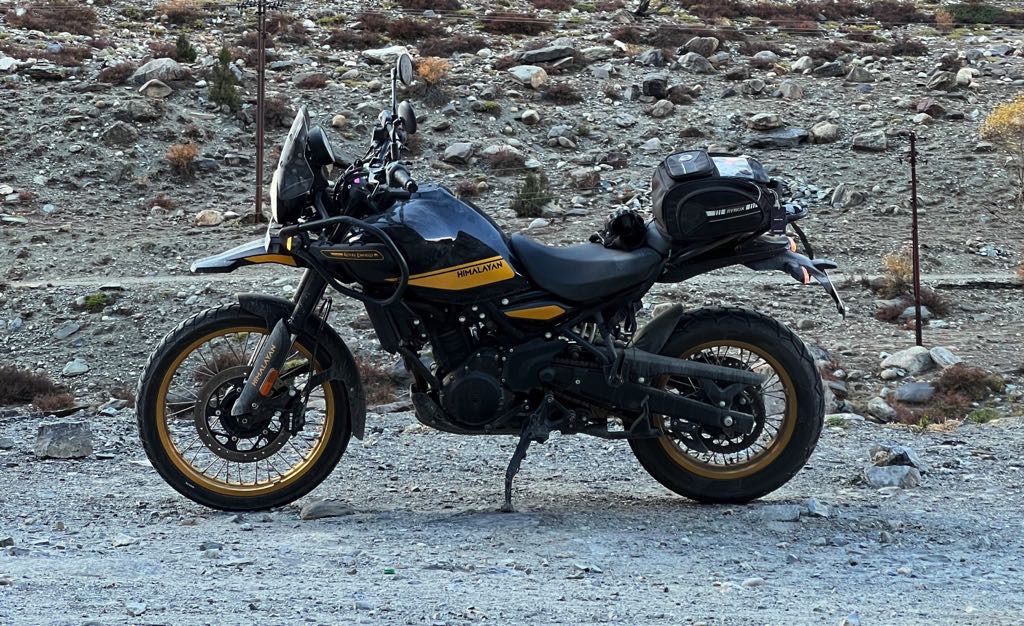
The Royal Enfield Himalayan 450, introduced into Nepal's market from 2024 onward, makes meaningful improvements over the 411 in several dimensions that matter for serious touring. The 452cc liquid-cooled single-cylinder engine produces approximately 40 bhp — a 67 percent power increase over the 411, with fuel injection and a ride-by-wire throttle system. The chassis has been substantially revised, ground clearance remains at 220mm, and the switchable ABS and multiple riding modes address criticism of the 411's limited electronic assistance.
For riders who found the 411's power adequate for Nepal's mountain speeds but insufficient for highway sections, the 450 addresses that limitation directly. The additional power provides a meaningful reserve on steep climbs at altitude where the 411's bhp, reduced by altitude-thin air, can feel genuinely pressed.
The Carburetor Trade-off Revisited
The 450's fuel injection is its most significant Nepal-specific limitation relative to the 411 — and being precise about this trade-off matters because it is frequently overstated in one direction or understated in another.
Fuel injection on the 450 means that altitude compensation is handled electronically, which is generally more precise and more consistent than a carbureted system across a wide elevation range. For riders who will use the 450 in towns and on routes with Royal Enfield dealership access, the fuel injection is an advantage in almost every condition.
For riders pushing into the most remote sections of Upper Mustang or other areas significantly distant from dealership support, the 411's carbureted simplicity retains a specific advantage: field-repairability with basic tools. The 450's electronic systems require diagnostic equipment for fault diagnosis that the 411's carburetor does not. This distinction matters most in the scenarios where it matters most — deep in a remote route, far from any town with the right equipment. Riders who are mechanically experienced and carry a basic diagnostic approach — and whose routes include the most remote sections — should weigh this trade-off explicitly.
The Himalayan 450 is available in Nepal's rental market through established operators but is not yet as ubiquitous as the 411, and the parts and mechanic familiarity advantage of the 411 will persist for several years as the 450 fleet builds.
Who the 450 Suits Best
The Himalayan 450 suits experienced riders who want meaningfully more performance than the 411 provides, are confident in managing fuel injection systems, and are touring routes with reasonable dealership proximity. For a Nepal circuit combining the Kathmandu–Pokhara corridor with the Annapurna foothills and Lower Mustang — broadly the most popular Nepal touring circuit — the 450's power, refinement, and improved electronics deliver a genuinely better riding experience than the 411. For deep Upper Mustang expeditions where remoteness is the defining variable, the 411 retains specific advantages that the 450's performance gains do not fully offset.
The Hero Xpulse 200 and 210: The Off-Road Specialist
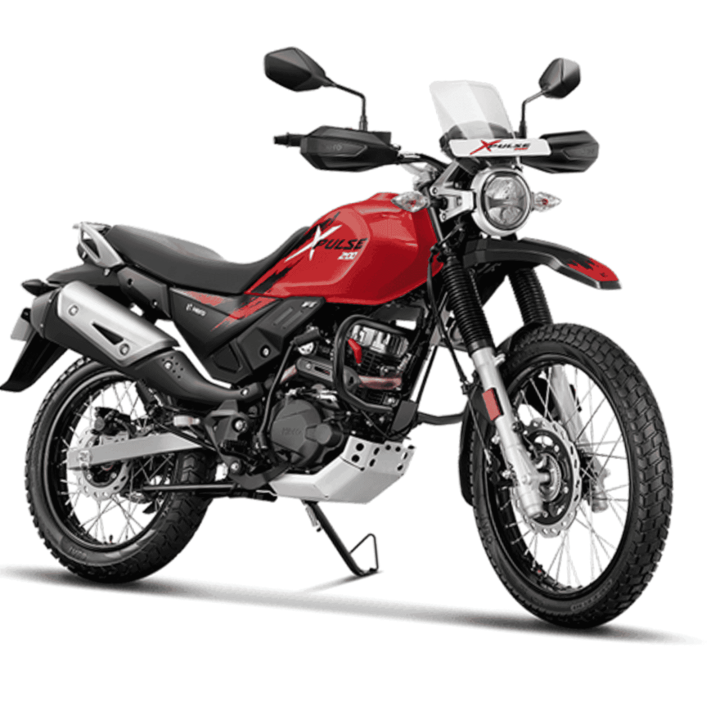
Why the Xpulse Deserves More Attention Than It Gets
The Hero Xpulse 200 and its updated 210 variant are significantly underrepresented in Nepal motorcycle touring content relative to their genuine capability on Nepal's most technical terrain. This underrepresentation reflects their modest engine displacement, 200cc and 210cc respectively which leads riders conditioned to associate capability with cubic centimetres to dismiss them. On Nepal's specific technical routes, this is a significant analytical error.
The Xpulse 200 produces approximately 18.4 bhp from its 199cc fuel-injected single, which is modest in absolute terms and entirely adequate for Nepal's mountain speeds where the limiting factor is the road surface, not the engine. What it offers in return for that modest power is a weight of approximately 157kg, roughly 25kg lighter than the Himalayan 411 and suspension travel of 190mm front and 170mm rear that is genuinely capable off-road rather than merely adventure-touring capable.
The weight difference is the Xpulse's most significant Nepal-specific advantage on technical terrain. On the loose gravel tracks between Kagbeni and Lo Manthang, in the river crossings of the Mustang approach, and on the technical single-track of the Manaslu and Tsum Valley routes, a 25kg weight reduction is directly felt in handling confidence, recovery from low-speed instability, and the physical effort of picking up the bike after an inevitable contact with the ground. Lighter bikes fall less hard, are easier to recover, and are more confidence-inspiring at the low speeds that technical terrain demands.
The Xpulse's fuel consumption is also meaningfully lower than the Himalayan 411's — approximately 35-40km per litre versus the Himalayan's 30-35km — which extends range proportionally despite the smaller tank and is a relevant consideration on routes where fuel availability is genuinely constrained.
Where the Xpulse Falls Short
The Xpulse 200 and 210 are not ideal for Nepal's long highway sections — the sustained cruising speed that the Himalayan 411 and 450 maintain comfortably approaches the Xpulse's performance limits, and the smaller engine requires more frequent gearchanges to maintain momentum on highway grades. For riders planning circuits that include substantial paved highway distance alongside the technical sections, the Xpulse demands more rider engagement on the easy sections in exchange for its technical section superiority.
The parts and mechanic ecosystem for the Xpulse in Nepal's mountain towns is less established than the Royal Enfield ecosystem — Hero Motors has a strong presence in Nepal's domestic market, but the specific Xpulse's off-road components and fuel injection system have less depth of familiarity among the mechanics in the mountain towns where rider-specific technical support is most needed. This is changing as the Xpulse's Nepal popularity grows, but in 2026 the Royal Enfield's mechanic network advantage remains meaningful.
Who the Xpulse Suits Best
The Xpulse 200 and 210 suit experienced off-road riders whose Nepal itinerary prioritises technical terrain over highway distance, who are mechanically confident enough to manage the less comprehensive remote support network, and who find the Himalayan's weight a genuine constraint on the most technical sections. For a Nepal circuit focused on Manaslu Circuit, Tsum Valley, or the more technical sections of the Annapurna approaches, the Xpulse often delivers a better experience than the Himalayan for the rider profile that suits it.
The Honda CRF300L: The Japanese Alternative
What the CRF300L Offers
The Honda CRF300L represents the most capable dedicated dual-sport option available in Nepal's rental market, offered by a small number of operators targeting experienced off-road riders who want Japanese reliability and genuine off-road capability in a single machine.
The CRF300L's 286cc single-cylinder fuel-injected engine produces approximately 27 bhp at a weight of 139kg — making it the lightest capable machine on this list and, per-kilogram, the most powerful. Suspension travel is 256mm front and 256mm rear — meaningfully more than any machine on this list — and the off-road chassis geometry reflects Honda's genuine trail-riding design intent rather than the adventure-touring compromise that most "adventure" bikes represent.
On Nepal's most technical terrain — the upper Mustang tracks, the Manaslu single-track sections, river crossings with unpredictable surfaces — the CRF300L is the most capable machine on this list in terms of pure off-road performance. Its ground clearance, suspension quality, weight advantage, and genuine off-road geometry give experienced riders more capability margin on the hardest sections than any other Nepal-available machine.
The Significant Limitations
The CRF300L's Nepal-specific limitations are real enough to make it the wrong choice for most touring profiles despite its off-road superiority. The fuel tank is small — approximately 7.8 litres, giving a realistic range of approximately 200km on mixed terrain — which is inadequate for Nepal's routes with 60km or longer fuel gaps without carrying additional fuel. The lack of a windscreen and the aggressive off-road ergonomics make long paved sections genuinely uncomfortable for sustained touring. The parts and mechanic ecosystem in Nepal's mountain towns is less established even than the Xpulse's, and a CRF300L technical fault in a remote location is a more serious logistical problem than the equivalent fault on a Royal Enfield.
The CRF300L is the right choice for experienced off-road riders who specifically prioritise the hardest technical sections, who are comfortable managing fuel range carefully, and who accept the reduced highway comfort as a trade-off for genuine off-road capability. It is not the right choice for riders whose Nepal circuit includes significant paved distance or who prioritise remote support availability.
Who the CRF300L Suits Best
Expert-level off-road riders targeting Nepal's most technical routes — the full Manaslu Circuit, Tsum Valley single-track, or specific off-road routes beyond the standard Upper Mustang circuit — for whom off-road capability matters more than touring comfort, fuel range, or remote support availability.
The KTM 390 Adventure: The High-Specification Option
The Case For
The KTM 390 Adventure is technically Nepal's most sophisticated adventure bike in the accessible market segment — WP Apex suspension, cornering ABS, multiple riding modes, a 373cc liquid-cooled single producing approximately 43 bhp, and a build quality that objectively exceeds the Royal Enfield equivalents. On Nepal's paved sections and well-graded mountain roads, it is the most satisfying machine to ride on this list.
Several Kathmandu operators offer the KTM 390 Adventure for rental, and for circuits that stay predominantly on Nepal's paved and graded road network — the Kathmandu–Pokhara corridor, the Pokhara–Jomsom approach on its paved and graded sections, the mid-Annapurna foothills — it delivers a riding experience that the Royal Enfields, whatever their terrain advantages, cannot match in terms of chassis dynamics and electronic refinement.
The Significant Nepal-Specific Limitations
The KTM 390 Adventure has three Nepal-specific limitations that experienced Nepal riders consistently cite as decisive against it for serious mountain routes.
First, electronic complexity in the remote environment. The 390's cornering ABS, ride-by-wire, and multiple mode electronics require diagnostic equipment for fault diagnosis that the Royal Enfield's simpler systems do not. A KTM 390 Adventure with an ABS sensor fault or an ECU error in the Mustang district above Kagbeni is in a categorically more difficult situation than a Himalayan 411 with an equivalent mechanical issue.
Second, parts availability. KTM-specific parts are available in Kathmandu through authorised dealers and in some Pokhara shops. They are not reliably available in Jomsom, in Beni, or in any of the mountain towns where riders on Nepal's serious routes most need them. A broken clutch lever on a KTM 390 in Kagbeni is a different problem from the same broken lever on a Royal Enfield Himalayan.
Third, seat height. The KTM 390 Adventure's 855mm seat height is genuinely problematic for shorter riders on Nepal's technical terrain — the confidence and control that flat-footing a bike at slow speed on a loose surface provides matters considerably more on Nepal's mountain tracks than on the graded gravel roads the 390 was designed for.
Who the KTM 390 Adventure Suits Best
Taller riders with strong off-road experience who are touring circuits predominantly on paved and well-graded roads, who have mechanical confidence with electronic systems, and whose routes stay within reasonable range of Kathmandu or Pokhara dealership support. Not recommended for serious Upper Mustang expeditions, Manaslu Circuit routes, or any itinerary where remote mechanical support availability is a significant planning variable.
Bringing Your Own Motorcycle: What Changes
Some experienced adventure riders bring their own motorcycles to Nepal rather than renting locally, typically riders doing extended overland journeys that include Nepal as part of a broader South or Southeast Asian circuit.
The logistical requirements for bringing your own motorcycle to Nepal are manageable but specific. A Carnet de Passage is required for most nationalities bringing foreign-registered vehicles. Nepal's road quality and the specific failure modes that Himalayan terrain produces on suspension, drive chain, and electrical systems are harder on imported machines than on locally-adapted fleet machines, and the parts availability advantage of Royal Enfield disappears entirely if your machine is a European or North American brand without subcontinental distribution.
Riders bringing their own machines to Nepal should specifically assess: parts availability for their specific make and model in Nepal's mountain towns, tyre availability if Nepal's roads consume the set they arrive on, and the mechanical support options for their specific machine beyond Kathmandu and Pokhara. The honest assessment for most imported machines is that the support network thins rapidly beyond the main cities, and a mechanically self-sufficient rider with a strong toolkit is managing more risk than an equivalent rider on a locally-supported Royal Enfield.
The notable exception is the Royal Enfield Himalayan itself — a rider bringing their own Himalayan from India or from a country where it is locally distributed arrives in Nepal on a machine with the deepest possible local support network and can ride Nepal's serious routes with a mechanical support confidence that no other imported machine matches.
The Honest Recommendation by Route Type
Upper Mustang Circuit: Royal Enfield Himalayan 411 (BS4 carbureted for maximum remote repairability) or Himalayan 450 for riders prioritising performance and accepting the fuel injection trade-off. Hero Xpulse 200/210 for experienced off-road riders prioritising technical capability over support network depth.
Annapurna Circuit and foothills: Royal Enfield Himalayan 411 or 450. Either performs well across the mixed paved and unpaved character of these routes.
Kathmandu–Pokhara corridor and highway circuits: KTM 390 Adventure or Royal Enfield Himalayan 450 for the most satisfying riding experience on predominantly paved roads. Himalayan 411 remains entirely capable and better supported.
Manaslu Circuit and Tsum Valley: Hero Xpulse 200/210 or Honda CRF300L for experienced off-road riders. These routes' technical character favours lighter, more off-road-capable machines over the Himalayan's heavier, more touring-oriented specification.
Terai circuits and lower routes: Any machine on this list performs adequately on Terai's predominantly paved roads. Rider preference and comfort over distance are the primary variables rather than technical capability.
First-time Nepal riders on any route: Royal Enfield Himalayan 411 or 450. The depth of mechanical support, the breadth of mechanic familiarity, and the forgiving power delivery make the Himalayan the most appropriate choice for riders who are managing Nepal's unfamiliar road conditions without the additional variable of an unfamiliar or less-supported machine.
Conclusion
The best one for a Nepal motorcycle tour is not the most powerful, the most technologically sophisticated, or the most expensive machine available. It is the machine that matches your route's specific terrain demands, your riding experience level, your mechanical self-sufficiency, and the support infrastructure that exists where your route actually goes.
For the widest range of Nepal touring profiles, on the widest range of Nepal's routes, the Royal Enfield Himalayan 411 answers those variables most consistently. For experienced off-road riders targeting technical routes, the Hero Xpulse 200/210 or Honda CRF300L deliver superior capability at the cost of support network depth. For performance-oriented riders on predominantly paved circuits, the KTM 390 Adventure or Himalayan 450 provide the best riding dynamics.
Know your route. Know your experience level. Know your mechanical confidence. The right bike follows from honest answers to those three questions, not from specification comparisons conducted at sea level from a desk.
Frequently Asked Questions
What is the best motorcycle for Nepal tours overall? The Royal Enfield Himalayan 411 for most riders and most routes — its combination of appropriate specification, regional support infrastructure, parts availability, and mechanic familiarity makes it the most broadly suitable machine available in Nepal's rental market.
Is the Royal Enfield Himalayan 450 worth it over the 411 for Nepal? For riders prioritising performance and touring on routes with reasonable dealership proximity — yes. For riders on deep remote routes where the 411's carbureted repairability matters most — the 411 retains specific advantages.
Can I ride Nepal on a 150cc or 200cc bike? On Nepal's lower and mid-altitude routes — the Kathmandu Valley, the Pokhara region, the Terai — a capable 150–200cc machine is manageable. For the serious mountain routes above 3,000 metres, the combination of altitude power loss and technical terrain demands makes 300cc or above a more appropriate minimum.
Should I rent in Nepal or bring my own bike? For most international riders visiting Nepal specifically for motorcycle touring, renting locally from an established operator is the better choice — access to locally supported machines, no carnet requirements, and operators whose fleet is matched to Nepal's terrain specifically.
What tyres work best on Nepal's mountain roads? Dual-sport tyres with a 50/50 or 60/40 road-to-off-road bias perform best across Nepal's mixed surface reality. Pure road tyres lose confidence on the gravel sections. Pure off-road tyres wear rapidly on the paved sections and are unnecessarily aggressive for the majority of Nepal's roads.