Muktinath sits at 3,710 metres in the Mustang district, in a position that makes no obvious practical sense. The valley above Jomsom narrows, the altitude makes agriculture difficult, the wind comes hard off the plateau for most of the afternoon, and the nearest significant settlement is an hour's ride away. Yet this location has drawn Hindu and Buddhist pilgrims for centuries and continues to draw them in numbers that make Muktinath one of the most visited sacred sites in the Himalayan world.
The reason is not the location. It is what the location contains: a religious site that is simultaneously sacred to Hinduism and Tibetan Buddhism, a combination that is rare enough to be genuinely unusual rather than merely diplomatically convenient, and that is specifically sacred to each tradition for overlapping but distinct reasons. For Hindu pilgrims it is one of 108 Divya Desams, the sacred Vishnu temples recognised by the Vaishnava tradition as places of salvation. For Tibetan Buddhists it is Chumig Gyatsa, the Hundred Waters, a place of liberation associated with Guru Rinpoche. On a Muktinath motorbike tour, arriving from Jomsom after two days up the Kali Gandaki, it is the destination above Kagbeni that justifies the detour from the Upper Mustang approach and that turns the Mustang circuit into something with more dimensions than the riding alone provides.
Getting There by Motorcycle
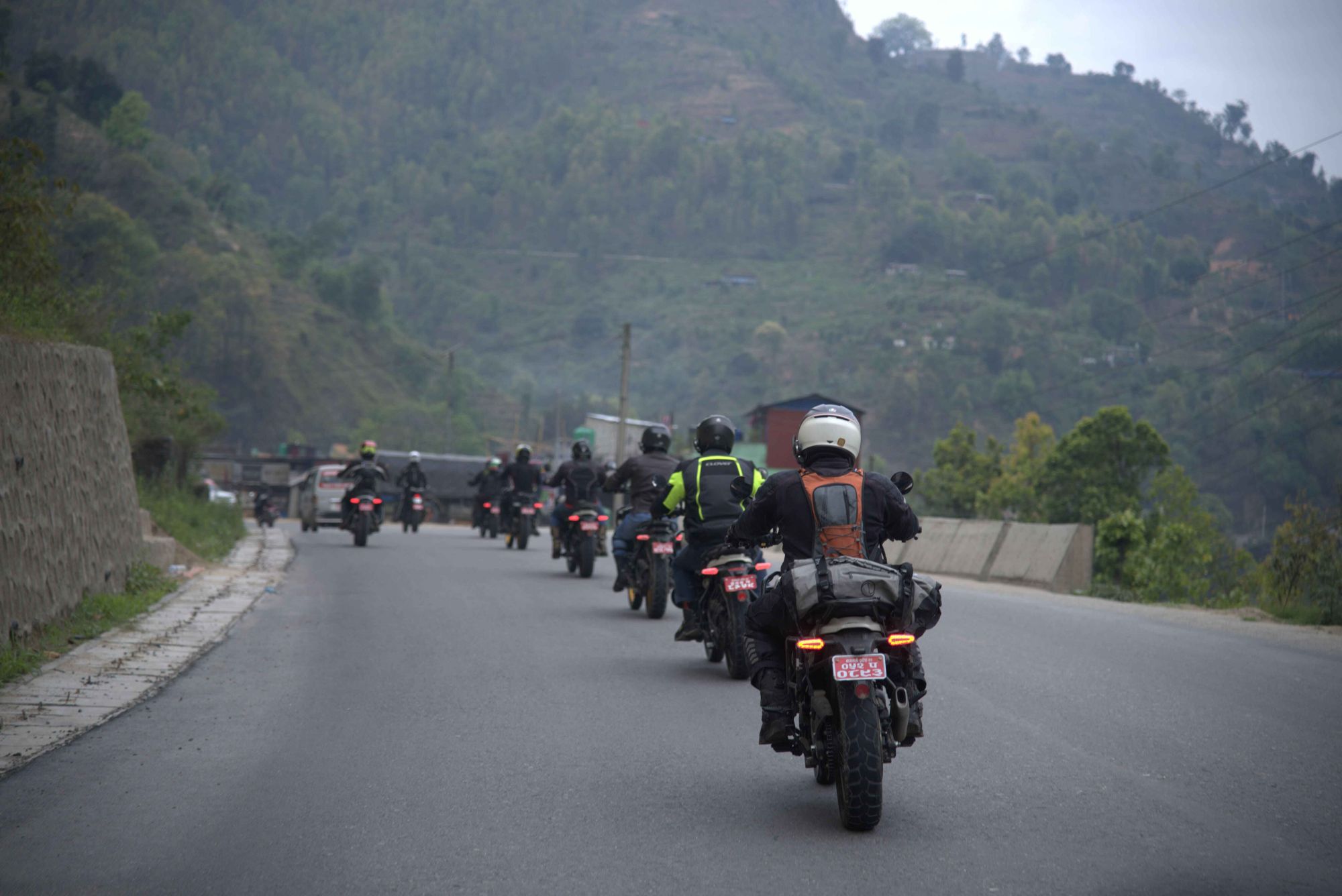
Muktinath is accessible by motorcycle from Jomsom via Kagbeni on a road that has improved significantly in the past decade. The surface from Jomsom to Kagbeni is sealed for most of its length. Above Kagbeni the road climbs steeply to Muktinath through a series of switchbacks that gain around 900 metres in altitude over approximately 18 kilometres.
The road to Muktinath above Kagbeni is not inside the Upper Mustang restricted area. The Upper Mustang permit checkpoint is at Kagbeni, and the road to Muktinath branches before it, climbing east rather than continuing north into the restricted zone. A rider without an Upper Mustang permit can reach Muktinath without restriction.
The switchback road to Muktinath is steep in sections and the surface is a combination of sealed road and gravel on the upper approaches. A Royal Enfield Himalayan handles it without difficulty in dry conditions. The descent is where most riders take more care than the ascent required, because the loose surface on the gravel sections and the gradient combine to demand more braking discipline than the uphill allowed.
Muktinath village is a small settlement of guesthouses and tea houses that exists primarily to serve the pilgrimage and trekking traffic. The temple complex is at the upper end of the village, and parking for motorcycles is available near the main entrance area. Arriving early in the morning, before the jeep convoys from Jomsom bring the day's pilgrimage traffic, gives the complex a different quality from the midday visit.
The History of Muktinath
The site's documented religious history begins with its mention in the Bhagavata Purana, one of Hinduism's major Puranic texts, which identifies Muktinath as Muktikshetra, the field of liberation. The date of this reference is debated but places the site's religious significance in the formal Hindu textual tradition at over a thousand years ago and almost certainly much earlier in practice.
The name Muktinath combines mukti, meaning liberation or salvation in Sanskrit, with nath, meaning lord or master. The full meaning is Lord of Liberation, which in the Vaishnava tradition refers to Vishnu in his capacity as the deity who grants moksha, the liberation from the cycle of birth and death that is the ultimate goal of Hindu spiritual practice.
The site's significance in the Vaishnava tradition comes specifically from its listing as one of 108 Divya Desams. The 108 Divya Desams are the sacred Vishnu temples identified in the Nalayira Divya Prabandham, the collected devotional hymns of the twelve Alvars, the Vaishnava poet-saints of South India who lived between roughly the 7th and 9th centuries CE. Of these 108 Divya Desams, Muktinath is the only one located outside the Indian subcontinent, which gives it a specific importance in the tradition as the northern boundary of the sacred geography the Alvars mapped.
For Tibetan Buddhists, the site's significance is associated with Guru Rinpoche, the 8th-century Indian master also known as Padmasambhava, who is credited with bringing Vajrayana Buddhism to Tibet and Nepal. The site is identified in Tibetan Buddhist tradition as one of the places where Guru Rinpoche meditated, and the name Chumig Gyatsa, meaning Hundred Waters, reflects the 108 water spouts that are the site's most distinctive physical feature.
The number 108 is sacred in both Hinduism and Buddhism and appears across both traditions in contexts from prayer bead counts to the number of sacred sites. Its presence in the physical form of Muktinath's water spouts is one of the concrete expressions of the site's dual religious nature.
The Temple Complex
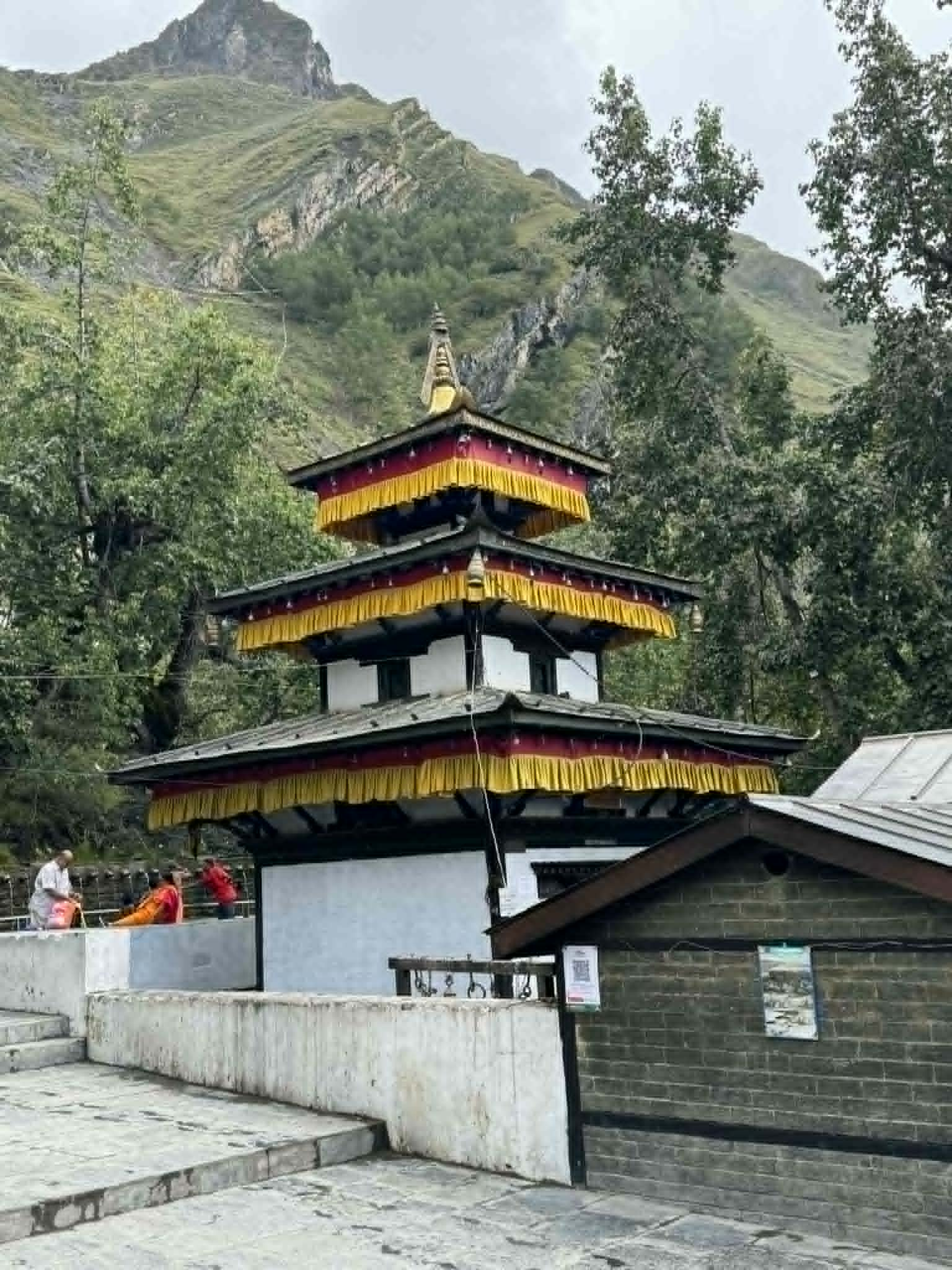
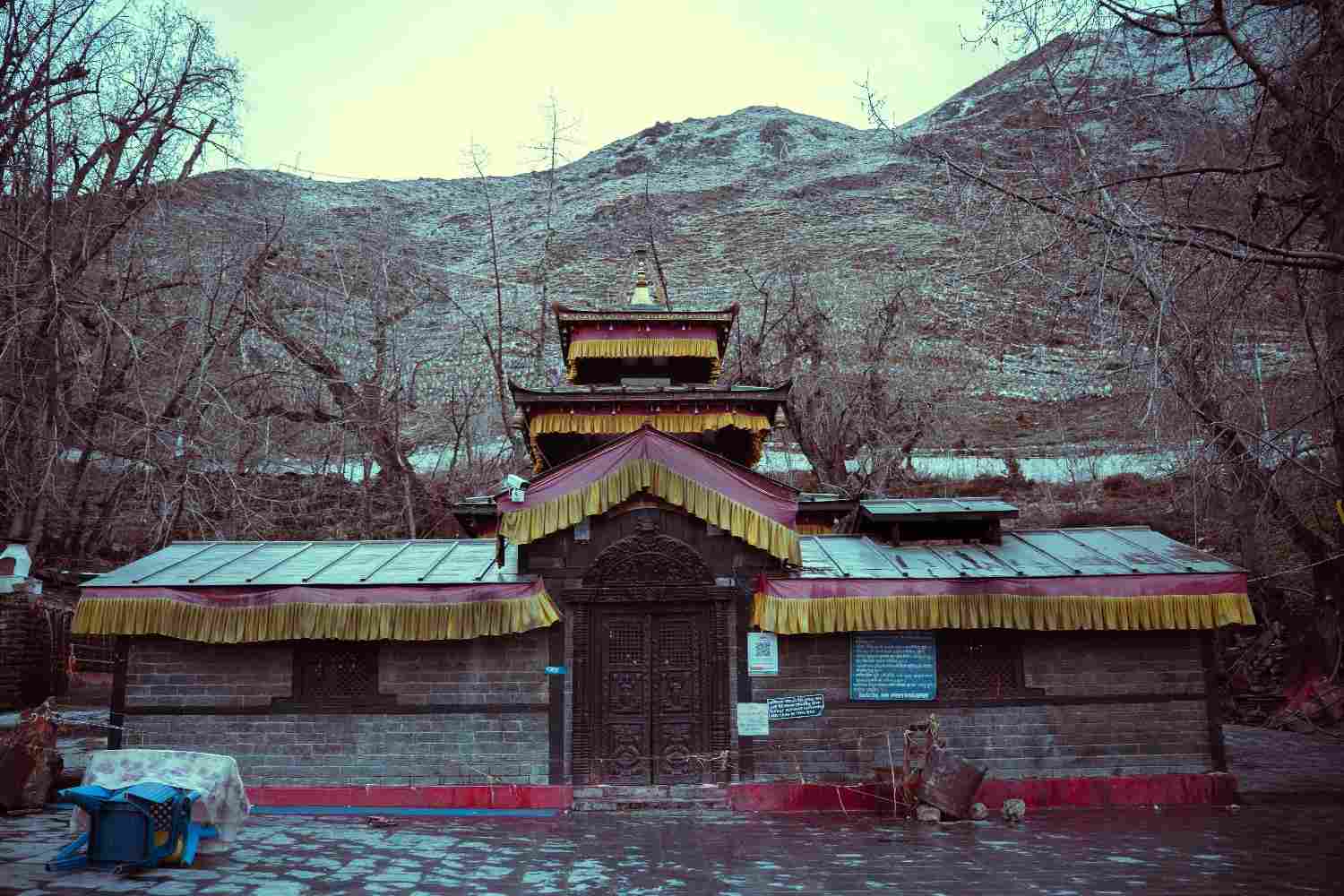
The Muktinath temple complex is a walled compound at the upper end of Muktinath village containing the main Vishnu temple, the Jwala Mai fire temple, the 108 water spouts, and several smaller shrines and structures.
The approach to the compound through the village involves a climb on stone steps from the main road level to the temple entrance. The steps are lined with smaller shrines and prayer wheels, and the sounds of the complex, bells from pilgrims announcing their arrival, the continuous flow of water from the spouts audible before the compound comes into view, begin before the entrance is reached.
The compound walls define the sacred precinct and the transition between the village's secular character and the religious space inside is immediate. The light and the quiet inside the compound are different from the exposed plateau character of the surrounding landscape.
The 108 Water Spouts
_1793222912.jpeg)
The 108 water spouts are the features that most pilgrims come to Muktinath to experience directly. The spouts are arranged in a curved row along the northern section of the compound, each one a bronze spout in the shape of a cow's head through which water flows continuously from the streams and springs of the mountainside above.
The religious act performed at the spouts is ritual bathing. Pilgrims walk the row of spouts and allow the water from each one to flow over them. The temperature of the water is cold at 3,710 metres regardless of season, approaching freezing in the early morning and only marginally warmer by midday. The cold is not incidental. It is part of the practice.
For Hindu pilgrims the bathing at the 108 spouts is an act of purification and a means of accumulating merit. The specific merit associated with Muktinath in the Vaishnava tradition is mukti, liberation, and the bathing practice is understood as a physical enactment of the spiritual cleansing that the site's location at a place of liberation makes possible.
For Tibetan Buddhist pilgrims the water of the Chumig Gyatsa is understood as blessed by Guru Rinpoche's presence and the circumambulation of the compound, including contact with the water spouts, is the form the pilgrimage practice takes.
The sight of pilgrims completing the 108 spouts in the early morning, many of them having walked for days or weeks from the Indian plains to reach this specific act, gives the water spout experience a weight that the physical details alone do not carry. The people bathing in cold water at high altitude in the morning are doing something that matters to them in ways that a brief visit cannot fully convey but that a period of observation begins to.
There is a smaller pool below the spouts where some pilgrims immerse fully. The pool water is fed by the overflow from the spouts and is cold in the way that standing water at high altitude is cold: absolute rather than merely cool.
The Jwala Mai Fire Temple
_1793222965.jpeg)
The Jwala Mai is a smaller temple within the Muktinath compound that contains the feature that makes this site theologically distinctive in a way that most pilgrimage sites are not: a natural flame burning from rock, alongside natural water, in the same enclosed space.
The flame at Jwala Mai is natural gas seeping through the rock and igniting at the surface, producing a blue flame that burns continuously without any fuel source that the surrounding rock suggests. The water flowing beside it comes from underground springs in the same area. Fire and water coexisting at the same point, both arising naturally rather than by human arrangement, is the specific sacred combination that Muktinath's dual religious significance rests on.
In the Hindu tradition, Jwala Mai, which means Flaming Mother, is understood as Agni, the sacred fire, manifesting alongside the water of Vishnu's sacred site. The combination of Vishnu's water and the sacred fire in one location is understood as uniquely auspicious.
In the Tibetan Buddhist tradition, the eternal flame is understood as one of the miraculous manifestations associated with Guru Rinpoche's meditative presence at the site. The flame's naturalness, the fact that it burns from rock without any supplied fuel, is what gives it its miraculous character in the Buddhist framework.
The Jwala Mai shrine housing the flame and the adjacent water source is a small, dark space inside a building in the compound. The flame itself is modest in size, a blue natural gas flame burning from a fissure in the rock floor. The contrast between the flame's modest physical scale and the significance it carries in two major religious traditions is part of what makes the visit to this specific shrine produce a particular stillness that the larger and more architecturally impressive main temple does not always generate.
The Main Vishnu Temple
The main temple at Muktinath is a relatively small structure in the Nepali pagoda style, with a distinctive golden roof that marks it as a Vishnu shrine in the visual vocabulary of Hindu temple architecture in the Nepal and north India tradition.
The principal deity is Vishnu in his form as Muktinath, housed in the inner sanctum of the temple. The image receives daily puja performed by the temple priests, and the puja timings, typically early morning and evening, are when the main temple is at its most active as a devotional space.
The atmosphere inside the main temple during a morning puja is the encounter with live religious practice that the site's age and its listing as a Divya Desam give a specific intensity. The priests performing the puja are doing what priests have done at this temple for centuries. The pilgrims attending are doing what pilgrims have done at this site for at least as long as the textual record reaches back.
Access to the inner sanctum is limited and the principal image is visible from the outer hall rather than from immediate proximity. The standard pilgrimage practice includes circumambulation of the temple after the main puja, which is the same clockwise circumambulation that most sacred structures in both Hindu and Buddhist tradition prescribe.
The Buddhist Monastery Adjacent to the Complex
A small Tibetan Buddhist monastery stands adjacent to the main temple compound, reflecting Muktinath's dual religious identity in architectural form. The monastery is an active institution housing Buddhist monks, and the coexistence of the Hindu temple compound and the Buddhist monastery in the same precinct, each conducting their own distinct practice, is the physical expression of the site's cross-religious character.
The monastery maintains its own circumambulation path and its own prayer wheel installations. Buddhist pilgrims who arrive at Muktinath perform their own circumambulation of the main compound and may also visit the monastery and perform circumambulation there. Hindu pilgrims coming for the Vishnu temple and the water spouts and Buddhist pilgrims coming for the Chumig Gyatsa occupy the same precinct without conflict, which is the practical expression of what the site's cross-religious significance means in daily practice rather than theological description.
The Saligram Connection
One of the specific reasons Muktinath holds such significance for Vaishnava pilgrims is the presence of ammonite fossils, called Shaligrams or Saligrams, in the Gandaki River below Muktinath.
Shaligrams are ammonite fossils found specifically in the black limestone of the Gandaki River's upper reaches, a region that encompasses the Muktinath area and the Kali Gandaki gorge below. In Vaishnava Hinduism, Shaligrams are understood as natural, aniconic representations of Vishnu, sacred objects that can be used in worship without the construction of a formal image. Their association with Vishnu comes from the river's association with Vishnu's chakra, the discus weapon that is one of Vishnu's primary attributes.
The fossil ammonites of this specific river region, the Gandaki, are the only Shaligrams accepted as genuine in the Vaishnava tradition. This specificity of location, the combination of Muktinath as a Divya Desam and the Gandaki as the source of the most sacred natural Vishnu objects, makes the Muktinath pilgrimage a journey to the geographic source of some of the tradition's most significant sacred objects.
Shaligrams are visible in the riverbed of the Kali Gandaki at points accessible from the road between Kagbeni and Jomsom. Pilgrims collecting them for personal worship carry them in small cloth bundles tied at the waist. The fossils range from the size of a marble to the size of a human head. Their abundance in this specific section of the Gandaki and their complete absence from other rivers is the geological fact that the theological tradition explains by means of the river's sacred character.
Practical Information for Visitors
Getting there from Jomsom: 18 kilometres on a steep road that climbs 900 metres. The road is sealed on the lower sections and gravel on the upper approach. A Royal Enfield Himalayan manages it in dry conditions without difficulty. Allow 45 minutes from Jomsom to Muktinath village.
Altitude: 3,710 metres. Riders coming directly from Pokhara without an acclimatisation night in Jomsom may feel the altitude. A night in Jomsom before the Muktinath visit is the standard recommendation.
Entry: The temple compound charges a modest entry fee for foreign visitors. Confirm the current fee at the compound entrance.
Dress: Shoulders and knees should be covered inside the temple compound. Remove footwear before entering the main temple and the Jwala Mai shrine.
Timing: Early morning, between 6 and 9 a.m., is when the puja timings and the lower pilgrimage volume combine to produce the best version of the visit. The midday hours bring the jeep convoys from Jomsom that increase the compound's visitor density significantly.
Photography: Photography is generally permitted in the outer areas of the compound. Confirm restrictions before photographing inside the main temple or the Jwala Mai shrine, where photography rules vary and are enforced at the discretion of the temple priests.
The return to Kagbeni and Jomsom: The descent on the switchback road is faster than the ascent but requires more active braking management on the gravel sections. The Kali Gandaki gorge wind builds through the morning and the descent in the late morning, when the wind is already moving, is more demanding than an early departure would have been. Leave Muktinath for the return before 11 a.m. if possible.
What Muktinath Adds to the Mustang Circuit
Riders on the Upper Mustang motorbike tour pass through Kagbeni on the way to and from Lo Manthang, and the Muktinath detour adds half a day to the itinerary. It adds it in a specific way: not more riding of the kind the circuit already provides, but a destination that gives the route a different register from pure landscape and technical road experience.
Upper Mustang is extraordinary as a high desert plateau with medieval cultural context. Muktinath is extraordinary as an active centre of cross-religious pilgrimage at altitude, a place that is continuously being used for the purpose it was built for by people for whom it matters deeply.
The two things do not compete. They complete each other in the way that any journey through a landscape is deepened by encountering the human significance that landscape has carried for the people who have lived in it longest. Each of these are prominent destinations for a nepal motorcycle trip.
Muktinath is accessible on the Nepal Moto Tours' standard Lower Mustang circuit tour as a detour from the main Kagbeni to Jomsom return. Get in touch to include it in your route planning.