
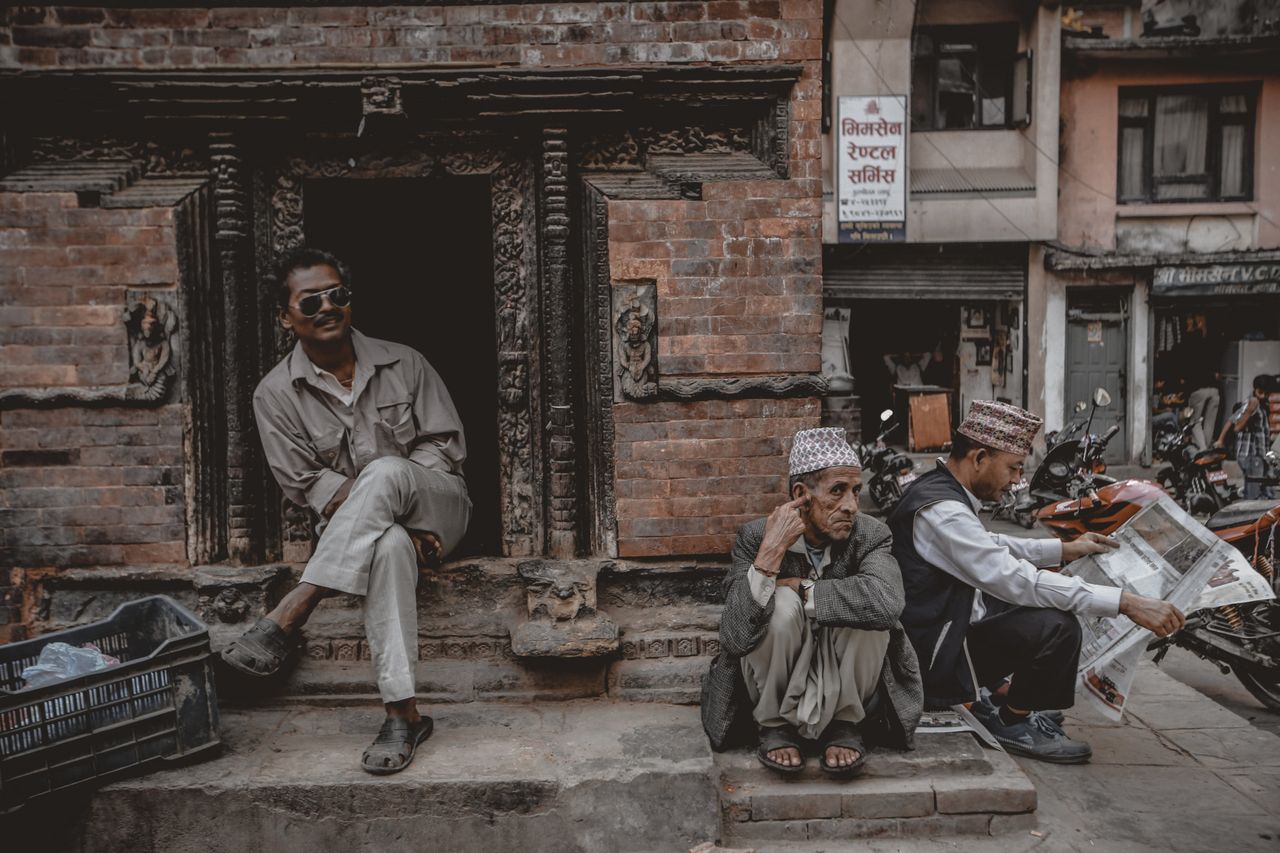
You do not need to speak Nepali to ride in Nepal. English works in Pokhara, Kathmandu, and most tourist-facing guesthouses along the established routes. But the moment the route goes somewhere that tourists do not routinely go, which is the point of most serious Nepal motorcycle adventure, the English disappears and what you have left is gesture, expression, and whatever Nepali you thought you were learning before you came.
This list covers the words and phrases that come up on a motorcycle trip specifically, not a general Nepali phrasebook. Road conditions, mechanical problems, fuel, food, accommodation, directions, altitude, and the handful of social phrases that open doors in remote villages rather than closing them. Learn these fifty and you will handle most of what Nepal's roads produce.
A note on pronunciation. Nepali is written in Devanagari script. The romanisations below are approximate guides to pronunciation rather than formal transliterations. The letter combination 'dh' is an aspirated 'd', not the English 'th'. 'Bh' is an aspirated 'b'. The stress in most Nepali words falls roughly on the first syllable.
The Road
1. Bato (बाटो)
Road or path. The most useful single word for navigation conversations. "Mustang ko bato" means the road to Mustang. "Bato ramro chha?" means is the road good?
2. Sajilo (सजिलो)
Easy or good. Used for road conditions. A local telling you the bato is sajilo means you are probably fine. A hesitation before saying sajilo means you should ask again.
3. Garo (गाह्रो)
Difficult or hard. The opposite of sajilo. If someone describes the road ahead as garo, find out how garo before you continue.
4. Mato (माटो)
Mud or clay. Relevant after rain on mountain tracks. "Bato ma mato chha" means there is mud on the road, which on a steep concrete pitch after rainfall means something specific and important.
5. Dhulo (धुलो)
Dust. The Kali Gandaki gorge in dry season produces dhulo in quantities that require goggles rather than a visor. Knowing the word helps when buying eye protection or explaining what happened to your jacket.
6. Pathhar (पत्थर)
Stone or rock. Road surfaces in Upper Mustang are frequently described as pathhar, distinguishing them from mato or dhulo sections.
7. Pul (पुल)
Bridge. Essential. "Pul chha?" means is there a bridge? On the Mustang circuit and the Manaslu approach, the answer is sometimes yes, sometimes no, and sometimes a version of yes that means a temporary structure you should inspect before trusting.
8. Khola (खोला)
River or stream. The crossings that define Nepal's technical riding routes. "Khola tarna sakinchha?" means can the river be crossed? The person answering has usually crossed it recently or knows someone who has.
9. Ukaalo (उकालो)
Uphill. Useful for asking about the road ahead. Significant ukaalo on a loaded bike at altitude is worth knowing about in advance.
10. Oraalo (ओरालो)
Downhill. The return direction. Also relevant when asking about road character, since a downhill on loose gravel has different implications from a downhill on sealed road.
11. Curve / Mod (मोड)
Bend or corner. Mod is the Nepali word for a road bend. A section described as धेरै मोड (dherai mod) means many corners, which is either good news or concerning depending on the surface.
12. Dherai (धेरै)
Many or a lot. Combines with almost everything else on this list. Dherai garo means very difficult. Dherai dhulo means a lot of dust. Dherai dherai is an emphatic very, very.
13. Alikati (अलिकति)
A little or a bit. The word that moderates everything. A local who says the road is alikati garo is telling you it is manageable. A local who drops alikati and goes straight to garo is telling you something different.
14. Agadi (अगाडि)
Ahead or forward. Direction instruction. "Agadi bato sajilo chha?" means is the road ahead good?
15. Pachhadi (पछाडि)
Behind or back. The direction you came from. Useful when asking about conditions on sections you have not yet ridden.
Fuel and Mechanics
16. Petrol (पेट्रोल)
Petrol. The word is borrowed from English and immediately understood. "Petrol chahinchha" means I need petrol. "Petrol kahaa painchha?" means where can I find petrol?
17. Pump (पम्प)
Fuel station. In Nepal's mountain areas, fuel is often sold from drums rather than formal stations. The pump or petrol pump refers to both.
18. Tyre (टायर)
Tyre. Again borrowed from English. "Tyre phutyo" means the tyre has punctured.
19. Hawaa (हावा)
Air. As in tyre pressure. "Tyre ma hawaa kam chha" means the tyre has low air. "Hawaa bharna parchha" means the tyre needs air.
20. Puncture (पंक्चर)
Puncture. Used as both noun and verb. Understood immediately anywhere motorcycles are used. "Puncture lagyo" means I have a puncture.
21. Mechanic (मेकानिक)
Mechanic. The English word is standard in Nepal. "Mechanic kahaa chha?" means where is a mechanic?
22. Chain (चेन)
Chain. "Chain dherai loose bhayo" means the chain has become too loose.
23. Tel (तेल)
Oil. Engine oil. "Tel change garnu parchha?" means does the oil need changing?
24. Brake (ब्रेक)
Brake. "Brake ramro chha?" is worth asking when you pick up a rental.
25. Battery (ब्याट्री)
Battery. Cold starts at altitude produce battery issues that the valley never reveals. "Battery discharge bhayo" means the battery has discharged.
26. Thik chha (ठीक छ)
It is fine / okay. The most versatile phrase in the mechanical conversation. A mechanic who looks at the problem and says thik chha is telling you it is manageable. Whether manageable means fixed or manageable-for-now requires a follow-up question.
27. Bigreko (बिग्रेको)
Broken or damaged. "Motor bigreko chha" means the bike is broken. The starting point of most roadside mechanical conversations.
Accommodation and Food
28. Khana (खाना)
Food or meal. "Khana painchha?" means can I get food here? The single most useful phrase for arriving anywhere at any hour.
29. Dal bhat (दाल भात)
Lentil soup and rice. Nepal's foundational meal and the most available food on every motorcycle route in the country. Ordering dal bhat in any guesthouse or roadside tea house produces the meal that will sustain more riding days than anything else.
30. Bhat (भात)
Cooked rice. The staple. Bhat appears in dal bhat, in tarkari bhat (rice with vegetables), and on its own as the accompaniment to whatever else is available.
31. Paani (पानी)
Water. "Paani dinus" means please give me water. "Tato paani" means hot water. "Chiso paani" means cold water.
32. Chiya (चिया)
Tea. The rhythm of Nepal motorcycle days is structured around chiya stops. Milky, sweet, and served in small glasses or mugs, chiya at a roadside tea house is the rest stop that every experienced Nepal rider builds into their day.
33. Kotha (कोठा)
Room. "Kotha painchha?" means is a room available? In remote guesthouses where no English is spoken, this question combined with a gesture toward the building usually produces either a yes or a no with minimal additional language required.
34. Sasto (सस्तो)
Cheap or inexpensive. Relevant in guesthouse price conversations. "Sasto kotha chha?" means do you have a cheap room?
35. Mahango (महंगो)
Expensive. The counterpart to sasto. Knowing both allows a basic price conversation even without other vocabulary.
36. Mito (मिठो)
Delicious. Saying mito after eating in a remote guesthouse where the cook has made the meal from whatever was available costs nothing and produces a response that makes the next conversation easier.
Health and Altitude
37. Birami (बिरामी)
Sick or unwell. "Ma birami chhu" means I am sick. The starting point for any conversation about altitude sickness or illness on the route.
38. Tauko dukeko (टाउको दुखेको)
Headache. The first symptom of altitude sickness. "Tauko dukyo" means my head hurts. A critical phrase above 3,000 metres.
39. Chakkar (चक्कर)
Dizziness. "Chakkar lagyo" means I feel dizzy. Another altitude warning sign that the person you are talking to will immediately understand in the context of a mountain road.
40. Doctor (डाक्टर)
Doctor. "Doctor kahaa chha?" means where is a doctor? In serious situations, this question combined with the direction to the nearest health post is the conversation you need to be able to start.
41. Hospital (अस्पताल)
Hospital. "Aspataal kahaa chha?" In remote areas the nearest hospital is typically in the district headquarters and knowing both the word and the location beforehand is better than needing it unexpectedly.
42. Aago (आगो)
Fire. Cold nights at altitude in teahouses where the heating is a wood stove. "Aago balne ho?" means will there be a fire? Relevant at Ghami and Chuksang in October evenings.
Directions and Navigation
43. Daaya (दायाँ)
Right. Turn right at the junction.
44. Baaya (बायाँ)
Left. The two direction words combined with the junction words are the core of navigation in places where road signs do not exist.
45. Sidha (सिधा)
Straight ahead. "Sidha jaanus" means go straight ahead.
46. Tala (तल)
Below or down. "Gau tala chha" means the village is below. In Nepal's vertical geography, above and below are more useful directional references than cardinal points.
47. Maathi (माथि)
Above or up. "Bato maathi chha" means the road is above, meaning you need to go higher.
48. Kati door (कति दूर)
How far. "Kagbeni kati door chha?" means how far is Kagbeni? The answer will be in kilometres or in time, and either is useful for planning the remaining riding day.
Social Phrases
49. Dhanyabad (धन्यवाद)
Thank you. The formal version. Said after directions, after meals, after mechanical help, after any assistance. Used more than any other phrase on the list.
50. Namaskar / Namaste (नमस्कार / नमस्ते)
Hello or greeting. Namaskar is the slightly more formal version. Both are accompanied by the hands pressed together at the chest. In remote villages on Nepal's motorcycle routes, arriving with a namaskar rather than a wave or a nod opens conversations that the wave does not, and those conversations are frequently where the most useful information about the road ahead comes from.
A Note on Using These Words
Learning words is one thing. Using them in a conversation where the other person responds in full Nepali and expects a reply is different. The most reliable use of this vocabulary is in short, simple questions that produce one-word or gesture answers rather than extended explanations.
"Bato sajilo chha?" said with an inquiring expression produces a yes or a no or a head wobble that means approximately, which is the information you need. A longer question in broken Nepali produces a longer answer in fluent Nepali that you cannot follow, which helps no one.
Short questions. One or two words if possible. A questioning expression to make clear you are asking rather than stating. The answers will be simple enough to understand even without the full vocabulary for the response.
The other thing that works is having the name of your destination written down and pointing to it. A piece of paper with "Lo Manthang" or "Kagbeni" written on it, shown to a person at a junction, produces a pointed arm that does the work of the full navigation conversation in under two seconds.
The combination of basic Nepali, a destination written in Roman script, and a genuine attempt to communicate something rather than expecting to be understood in English produces goodwill in remote Nepal that improves every subsequent interaction. The fifty words above are enough to start that process on any route the country offers.
Riding with Nepal Moto Tours, the guides handle the language on the route. But knowing these words yourself means the conversations that happen when the guide is not there produce useful information rather than a mutual shrug.