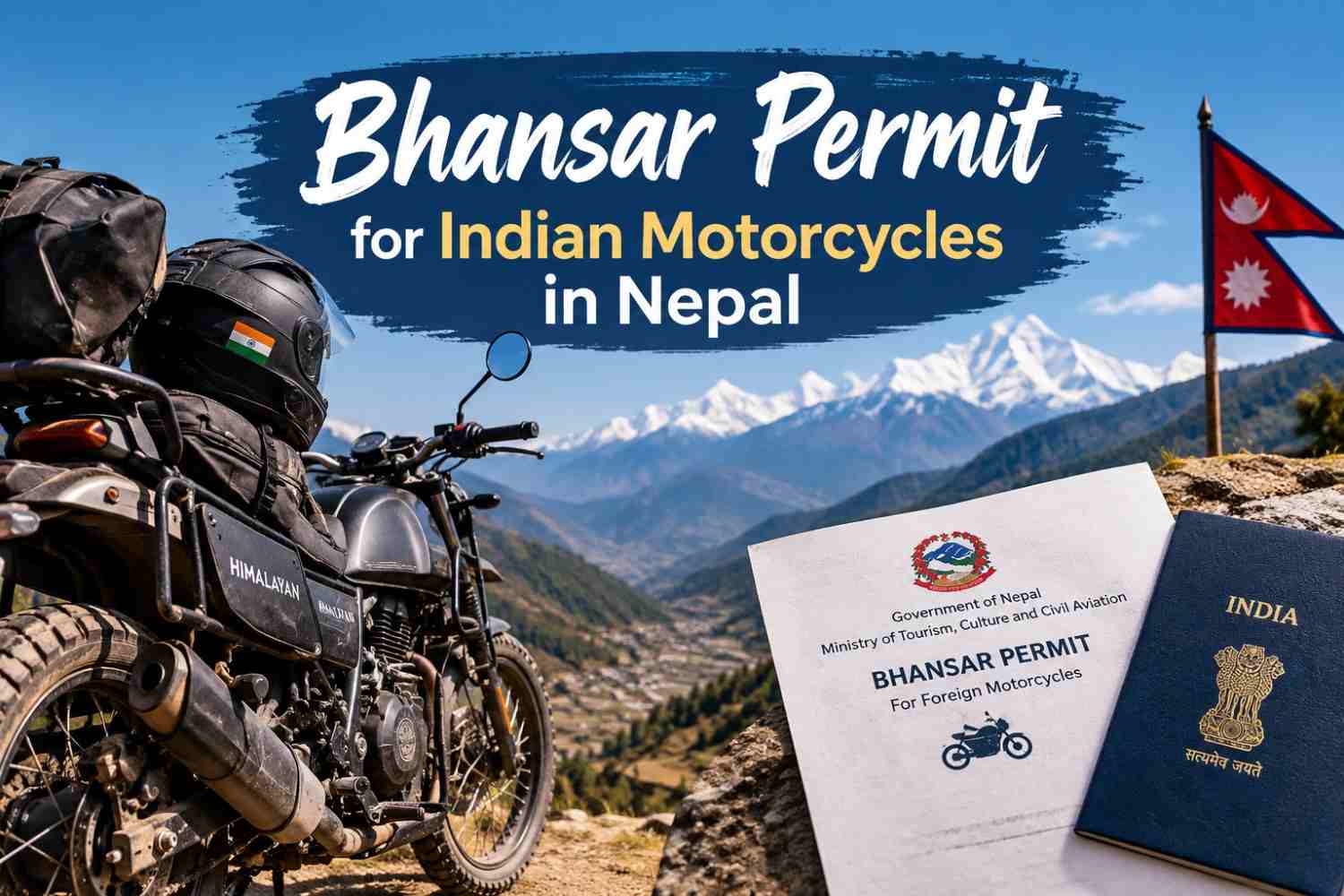
If you are riding an Indian-registered motorcycle into Nepal, the Bhansar permit is the document that makes it legal. Without it, the bike is treated as an unauthorised import under Nepali customs law and is liable to seizure. With it, you ride through with a daily customs fee that costs less than a roadside meal.
This guide covers exactly what the Bhansar is, what it costs in 2026, how the new online system works, what documents you need at the border, how long it lasts, how to extend it, and what happens if you overstay.
What the Bhansar Permit Actually Is
Bhansar is the Nepali word for customs. The Bhansar permit, formally the Bhansar Pass, is a customs document issued by Nepal's Department of Customs at the border that authorises a foreign-registered vehicle to operate on Nepali roads for a temporary period.
It is not a road permit in the sense of a driving licence or a registration transfer. It is a customs clearance document that declares the motorcycle as temporarily imported for tourism rather than permanently imported for commercial use or residence. This distinction matters because Nepal imposes very high customs duties on permanently imported vehicles, and the Bhansar system exists to allow temporary tourism use without triggering those duties.
The permit is specific to the vehicle, not the rider. If the motorcycle changes hands or a different person rides it into Nepal, the permit must reflect the current ownership. In practice, for a rider bringing their own registered Indian motorcycle, this is not a complication. The permit is issued in the name of the registered owner as per the RC book.
The 2026 Update: Online Registration Now Available
From May 2026, Nepal's Department of Customs launched an online vehicle registration and Bhansar payment system for foreign vehicles entering by road. This is a meaningful change from the previous system where all processing happened at the physical border customs office with its associated queues.
Under the new system, Indian motorcycle riders can pre-register their vehicle details and pay the Bhansar fee online before reaching the border. The Department of Customs website accepts the registration, processes payment, and issues a digital permit document that can be carried on a smartphone and presented at checkpoints within Nepal.
The online option does not eliminate the border customs office stop entirely. A physical endorsement at the border Bhansar Karyalaya is still required for the permit to be valid. What the online pre-registration eliminates is the time spent filling forms and processing payment at the border. Riders who have completed the online registration arrive at the border with their paperwork already done and move through the customs process significantly faster than under the previous system.
For riders who prefer to process the Bhansar at the border in the traditional manner, the physical office process remains available. The online system is an option rather than a mandate.
What It Costs
The Bhansar fee for motorcycles in 2026 is NPR 150 per day.
At current exchange rates this is approximately INR 93 per day or USD 1.10 per day. For a ten-day Nepal motorcycle circuit it totals NPR 1,500, approximately INR 930 or USD 11. For a thirty-day stay, the maximum single-permit period, it totals NPR 4,500, approximately INR 2,790 or USD 33.
The fee is paid in Nepali Rupees. The border customs offices accept only NPR for the Bhansar payment. If you arrive at the border with only Indian Rupees, the customs office may have an informal currency exchange available as some riders report, but this is not guaranteed. Carry NPR for the Bhansar payment specifically. Withdraw it before reaching the border or carry INR and exchange in the border town before approaching the customs office.
The daily rate is calculated per calendar day of presence in Nepal rather than per 24-hour period. A bike that enters Nepal on the afternoon of day one and exits on the morning of day three has been in Nepal for parts of three calendar days. Confirm with the issuing office whether the calculation covers calendar days or a fixed duration from entry time, as the application of this can vary.
Day Pass: The Zero-Cost Same-Day Option
Indian vehicles including motorcycles can enter Nepal for same-day visits to the nearest market or municipal area without paying any Bhansar fee. This is the day pass provision, which exists specifically for the cross-border commerce and community connections between India and Nepal's border towns.
The day pass requires that the vehicle returns to India before the border closes on the same day it entered. It does not require payment. The border customs office issues the day pass on the basis of the vehicle's registration documents.
For motorcycle riders this provision covers day rides into the Nepal border towns, which can be interesting in themselves, but does not extend to any Himalayan riding circuit. Any overnight stay in Nepal or any journey beyond the nearest market area requires the full Bhansar with the daily fee.
Documents Required at the Border
Carry all of these in accessible form before approaching the border customs office. Missing documents mean delays at the office.
Original RC Book. The Registration Certificate of the motorcycle in the original. Not a photocopy, not a phone photograph. The physical booklet or card. The customs officer records the vehicle details directly from the RC, and any mismatch between the RC and the vehicle, a modification that changed a recorded specification, a sticker over a chassis number, creates complications. Keep the RC accessible.
Indian driving licence. The original physical licence covering motorcycles. Indian driving licences are accepted in Nepal without requiring an International Driving Permit. Carry the original.
Proof of Indian citizenship. Passport or Voter ID in the original. For the Bhansar process itself, proof of the vehicle owner's identity is required. For entry into Nepal as an individual, Indian nationals need a passport or Voter ID as their travel document.
Insurance document. Indian motor insurance policies do not cover Nepal. This is the document most Indian riders are caught without adequate preparation on. A Nepali third-party insurance policy is required for operating the motorcycle on Nepali roads and is available from insurance providers near the major border crossings. The Bhansar customs office processes vehicle entry. The insurance requirement is separate and is enforced at internal checkpoints within Nepal rather than necessarily at the border itself, but a rider without Nepal-valid insurance is operating illegally on Nepali roads from the moment of entry.
Purchase a Nepal third-party insurance policy at or near the border before riding into the country. It is available, it is inexpensive, and the alternative is riding without it and hoping the checkpoints on the route to Pokhara or Kathmandu do not ask for it, which some do and some do not with no reliable predictability.
Border Crossings for the Mustang Circuit
The choice of border crossing affects the first day's riding and the overall route to the main Nepal motorcycle touring destinations.
Sunauli-Bhairahawa, Uttar Pradesh. The most practical crossing for riders heading to Pokhara and Upper Mustang. From Sunauli, the Siddhartha Highway runs 200 kilometres to Pokhara on a predominantly paved road. The border crossing is well-established, the customs office processes vehicles in quantity, and the town has facilities for preparing documents and exchanging currency before the customs office.
Raxaul-Birgunj, Bihar. It connects to the Prithvi Highway toward Kathmandu and then Pokhara. Used by riders coming from eastern and central India who find the Birgunj crossing a shorter home-to-border distance than Sunauli.
Kakarbhitta-Mechi, West Bengal. The easternmost practical crossing, used by riders from West Bengal, the Northeast, and Sikkim. It connects to the Terai highway and then the main road network toward Kathmandu.
All three crossings have Bhansar customs offices. Processing at Sunauli and Raxaul-Birgunj is the most experienced in handling touring motorcycles given the volume of riders using both crossings for Himalayan circuits.
Maximum Stay and the 30-Day Rule
A single Bhansar permit covers a maximum of 30 days in Nepal. Indian vehicles cannot be retained in Nepal for more than one month even with continued payment beyond the initial permit period.
For most Nepal motorcycle tours, the 30-day limit is not a constraint. The Upper Mustang circuit from Pokhara runs 10 to 12 days. A comprehensive Nepal circuit combining Kathmandu, Pokhara, Mustang, and Chitwan takes 20 to 25 days. Both fit comfortably within the 30-day limit.
Riders planning an extended Nepal stay, a month of digital nomad riding from Kathmandu combined with circuits into the mountains, need to plan the exit date from the outset rather than treating it as flexible. A motorcycle found in Nepal after the Bhansar period has expired is treated by customs as an illegally retained foreign vehicle. The consequences are vehicle seizure and customs proceedings, which are significantly more expensive and time-consuming than the original daily permit fee.
Extending the Bhansar from Within Nepal
As of the 2026 online system update, the Bhansar permit can be extended from within Nepal rather than requiring the rider to exit the country and re-enter to restart the permit period.
Extension applications go through the online customs portal or through the nearest Nepal Customs office in the region where the motorcycle is currently located. The extension is subject to the overall 30-day maximum, which means extension is available if the original permit was issued for fewer than 30 days and time remains within the monthly limit.
The extension process through the online system is designed to be manageable remotely, which is relevant for riders who are in the Mustang district or other areas distant from a major customs office when they realise an extension is needed.
In cases of genuine emergency, where a rider cannot exit Nepal by the Bhansar expiry due to medical situation, natural disaster, road closure, or documented equivalent circumstance, the nearest Nepal Customs office or Police office is the point of contact for emergency extension. These situations are handled case by case, and documentation of the emergency circumstances is required.
At Internal Checkpoints in Nepal
Nepal operates traffic police checkpoints on the main roads out of major cities and at entry points to national parks and restricted areas. What these checkpoints check from Indian motorcycle riders is consistent enough to be worth knowing in advance.
The Bhansar permits itself. The permit or its digital equivalent on your smartphone. The checkpoint officer looks at the dates, confirms they are current, and checks that the vehicle details match what is in front of them.
Driving licence. Original Indian driving licence. Some checkpoint officers ask for it, some do not.
Nepal insurance. The third-party Nepal insurance policy. Carry the physical document or a clear digital copy. Checkpoints on the main routes from Sunauli toward Pokhara and from Raxaul-Birgunj toward Kathmandu are the most consistent in checking insurance.
Helmet. Nepal requires helmet use for both rider and pillion. Checkpoints on the main corridors enforce this reliably.
The digital Bhansar on a smartphone is accepted at checkpoints under the 2026 system. Having the document accessible on your phone lock screen rather than buried in an app helps the checkpoint interaction move faster.
What Happens If You Overstay
The Consulate General of India in Birgunj, which covers the customs and vehicle permit matters for the Raxaul-Birgunj corridor, states the position clearly: Indian vehicles found in Nepal without a valid Bhansar pass are treated as illegally smuggled into Nepal. These vehicles are seized by police and subsequently auctioned by Nepal Customs.
This is not a theoretical enforcement scenario. The reason for strict enforcement is genuine: Nepal's very high customs import duty on vehicles creates an economic incentive for smuggling Indian vehicles into Nepal or using Indian vehicles commercially within Nepal without paying the appropriate duties. The Bhansar system exists to distinguish legitimate temporary tourist use from these scenarios, and a vehicle found in Nepal without current Bhansar documentation is indistinguishable from a smuggled vehicle until proven otherwise.
The practical protection is simple. Know your Bhansar expiry date. Build the exit from Nepal into the itinerary before the permit expires. Use the extension system if the timeline needs adjustment. Do not rely on the permit expiring quietly.
Surrendering the Bhansar on Exit
When leaving Nepal at any border crossing, the Bhansar permit is surrendered to the Nepal Customs office at the exit point. This surrender is recorded and closes the customs record for that vehicle entry.
Exit must happen at an official border crossing with a functioning customs office. Exiting Nepal at a crossing without a customs facility, or attempting to exit at a crossing different from the one where entry was processed without informing the destination crossing in advance, creates complications in the customs record.
The standard process is entry at one recognised crossing with Bhansar issuance, travel within Nepal for the permitted period, and exit at any recognised crossing with permit surrender. Multi-crossing routing within those parameters is standard and not unusual.
A Note on the Insurance Gap
The most common documentation gap for Indian motorcycle riders entering Nepal is third-party insurance, and it warrants specific emphasis because it is not addressed by the Bhansar process itself.
The Bhansar covers customs. It does not cover liability. An Indian motor insurance policy that is valid across India does not extend to Nepal. Riding in Nepal on an Indian insurance policy without a separate Nepal policy means riding uninsured for Nepali legal purposes.
Third-party Nepal motorcycle insurance is available at offices near the main border crossings, at insurance brokers in Bhairahawa and Birgunj, and in some cases through the online insurance providers that operate in the Terai towns. The cost is modest, the process is quick, and the absence of it at a checkpoint or in the event of an accident is the more significant problem.
Sort the Nepal insurance before leaving the border town rather than after, on the assumption that checkpoints on the route ahead will not ask for it.
Riding into Nepal from India for a Muktinath motorbike tour on your own motorcycle? Nepal Moto Tours can advise on the current border crossing logistics, the Bhansar process, and which route from the border to Pokhara suits your starting point in India. Get in touch before you plan your departure dates.