
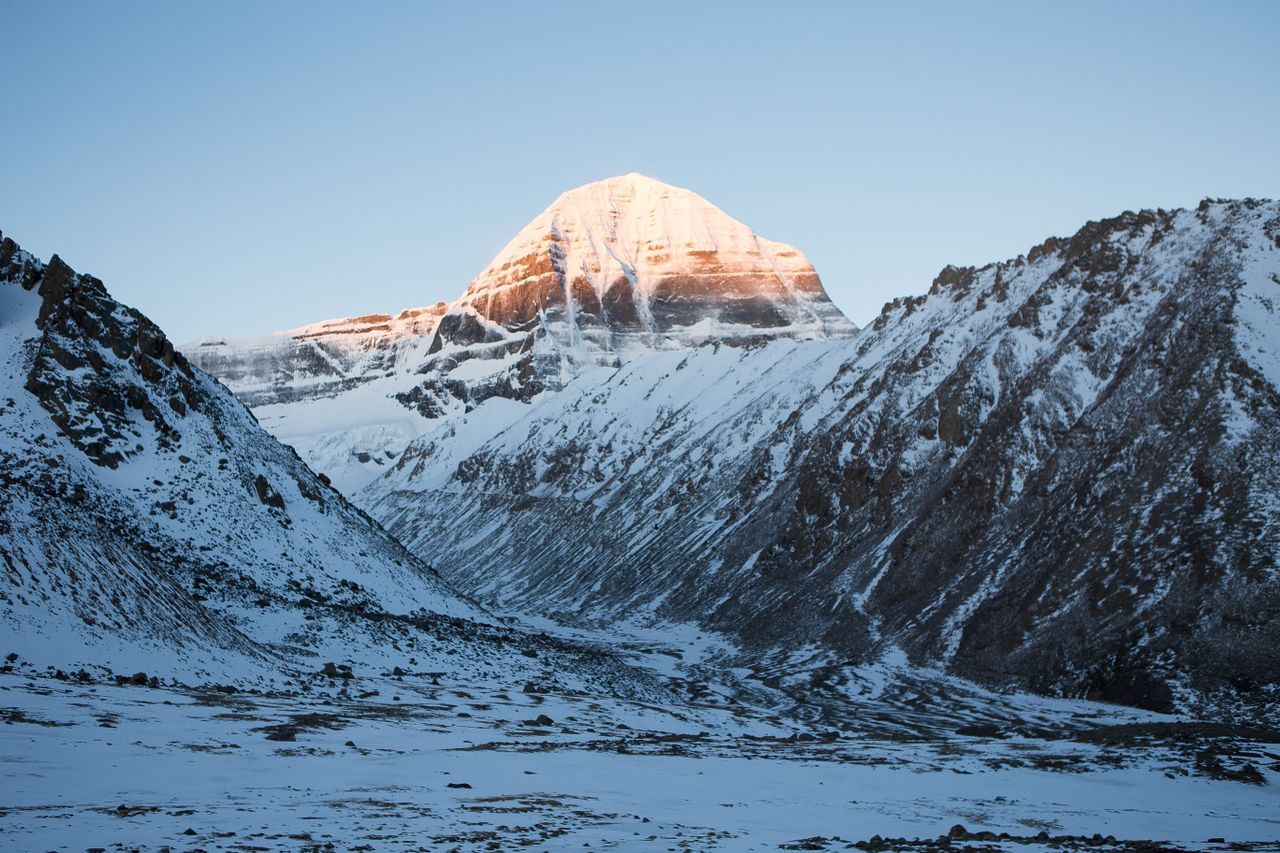
Mount Kailash stands at 6,638 metres in the far western corner of the Tibetan plateau. It is not the highest peak in the Himalayas. It is not the most technically demanding by the standards of serious mountaineering. Dozens of peaks of similar or greater elevation have been climbed multiple times. Kailash has never been summited by anyone.
The reason is not that no one has tried. The reason is more interesting than that.
The Mountain That Four Religions Call Sacred
Kailash is considered the most sacred mountain on earth across four distinct religious traditions. In Tibetan Buddhism it is the home of Demchog, a wrathful deity representing supreme bliss. In Hinduism it is the abode of Lord Shiva, and the mountain is the axis mundi around which the cosmos is organised. In the Jain tradition it is the site where Rishabhadeva, the first of the twenty-four Tirthankaras, attained liberation. In the indigenous Bon tradition of Tibet, which predates Buddhism's arrival, Kailash is the seat of all spiritual power.
These are not marginal or historical beliefs held by small communities. Hinduism alone accounts for over a billion adherents worldwide, for whom Kailash is one of the most significant sacred sites in the entire tradition. The mountain's religious significance is active and contemporary, not archaeological.
The combination of four living religious traditions holding the same specific peak as uniquely sacred, with no other mountain commanding comparable cross-religious reverence, makes Kailash's situation genuinely unusual rather than simply a cultural preference to be noted and set aside.
The Prohibition Comes from the Chinese Government
This is the part of the story that media coverage of Kailash most frequently obscures by leading with the religious angle and leaving the legal situation implicit.
Kailash sits in the Tibet Autonomous Region, administered by the People's Republic of China. The Chinese government has not issued mountaineering permits for Kailash since Tibet came under Chinese administration. The prohibition is a government policy rather than a physical impossibility, and it exists because the Chinese government has determined, with input from the religious communities for whom the mountain is sacred, that summit attempts would cause serious damage to the mountain's significance and to the religious sensitivities of the populations for whom it matters.
In 2000, a Spanish mountaineering expedition received provisional approval from Chinese authorities for a Kailash summit attempt. The announcement generated immediate international protest from Hindu and Buddhist communities across South Asia and beyond. The Chinese government subsequently withdrew the permit and has issued no mountaineering permits for Kailash since. The precedent from 2000 is the clearest statement of the policy that currently applies: the Chinese government views the religious and cultural significance of the mountain as a reason to maintain the prohibition rather than a preference to be balanced against mountaineering access.
The Tibetan Buddhist authorities, the Hindu religious organisations, and the Jain community have all at various points expressed support for the summit prohibition. The prohibition does not require religious enforcement because the government prohibition is sufficient, but the religious support for it means that the political cost of reversing the prohibition exceeds any benefit the Chinese government might gain from doing so.
What the Religious Prohibition Actually Means
Beyond the legal position, the religious prohibition deserves its own treatment because it is substantively different from the cultural sensitivity that protects other sacred sites around the world.
In the Hindu tradition, Kailash is not a mountain that happens to have religious associations. It is understood as the literal residence of Shiva in his physical form, and the mountain's inviolability is not a metaphor or a symbolic position. It is a doctrinal one. The idea of a human climbing to the summit of Shiva's residence and standing at its top is, within the doctrinal framework of this tradition, an act of profound disrespect that goes beyond insensitivity into something closer to desecration.
For Tibetan Buddhists, the understanding is comparable. The mountain is not simply a peak that was associated with Demchog by historical tradition. It is an active sacred site where the presence of the deity is understood as real rather than representational, and the circumambulation of the mountain, the kora that pilgrims have performed for centuries, is a religious practice whose power depends on the mountain's spiritual integrity being maintained.
The Bon tradition adds an additional layer. Bon's pre-Buddhist relationship with Kailash is the oldest of the four traditions' connections to the mountain and positions the peak as the source of spiritual power that the entire world's sacred mountains reflect. Summit access in this framework would not merely violate a sacred site. It would damage something that the Bon tradition understands as foundational to the spiritual order of the world.
These are beliefs held by hundreds of millions of people. Framing the summit prohibition as simply a restriction on mountaineers' recreational choices misunderstands the weight of what the prohibition protects in the eyes of those for whom the mountain is not primarily a geological feature.
Has Anyone Actually Attempted to Climb It?
The historical record of summit attempts on Kailash is thin, which itself reflects how seriously the prohibition has been treated.
Reinhold Messner, who has climbed all fourteen eight-thousanders and is among the most accomplished mountaineers of the twentieth century, was offered permission to attempt Kailash and declined. He described the mountain as belonging to the religious traditions that hold it sacred and stated that he would not climb it even with permission. His position was not uncertainty about the technical challenge. It was a conscious choice to respect the religious significance of the prohibition.
No successful summit attempt is recorded in the mountaineering literature. No base camp is established. No route is documented. The mountain stands at 6,638 metres without the infrastructure that most peaks of its altitude have accumulated across decades of expedition activity.
The absence of a documented summit attempt does not mean no one has ever set foot above the circumambulation trail. The kora itself, the 52-kilometre circumambulation route that pilgrims walk clockwise around the mountain, reaches elevations of approximately 5,700 metres at the Dolma La pass. But the circumambulation is a circumnavigation of the mountain, not an ascent of it, and the distinction matters both to the pilgrims who perform it and to the religious framework that gives it meaning.
The Technical Considerations
The summit prohibition exists independently of any technical analysis, but the technical characteristics of Kailash are worth understanding for completeness.
At 6,638 metres, Kailash is a significant altitude but not extreme by Himalayan standards. The peak is below the eight-thousander threshold that defines the highest tier of Himalayan mountaineering, and mountains of comparable or greater altitude, including peaks on the Tibetan plateau within visible distance of Kailash, have been climbed successfully.
The specific technical challenge of Kailash is its ice and rock faces. The mountain has four sheer faces corresponding to the four cardinal directions, each face composed of different geological material and presenting different technical problems. The southern face is the most photographed and the one most familiar from images of the mountain, a near-vertical ice face rising from the plateau to the summit pyramid. The technical standard required for this face would not defeat any serious Himalayan climber, but it is not a straightforward walk-up.
The altitude acclimatisation required for a Kailash summit would be managed in the same way as for comparable peaks, with acclimatisation rotations at lower altitude before the summit push. The logistics are not exceptional.
In other words, the mountain is not climbed because it is prohibited and because the prohibition commands broad respect, not because the summit is beyond technical reach.
The Kora: What Pilgrims Do Instead
While the summit is prohibited, the mountain is one of the most visited sacred sites in Asia precisely because the circumambulation route provides a form of engagement with Kailash that is both deeply meaningful within the religious traditions and physically accessible.
The kora is a 52-kilometre circuit of the mountain at base level, typically completed in three days by pilgrims on foot. Some devout pilgrims complete it in a single day. Tibetan Buddhist pilgrims who perform the kora as a full prostration, measuring their body length against the ground repeatedly for the entire circuit, may take two to three weeks.
The kora crosses the Dolma La pass at 5,700 metres, which is a serious altitude for pilgrims coming from the lower elevations of India, Nepal, and China. The combination of the physical demand of the three-day circuit, the altitude, and the spiritual significance of the practice makes the kora one of the most demanding pilgrimage circuits in the world.
It is also, by motorcycle to the starting point and then on foot, one of the most accessible extraordinary experiences in the Himalayan world. The road from the Nepal border through Tibet to the Kailash area is the same western Tibet corridor that the mountain's pilgrimage tradition has used for centuries, now paved rather than tracked and covered in days rather than weeks.
Nepal Moto Tours runs a Mount Kailash motorcycle tour that covers the route from Nepal to the Kailash region, including the approach roads across the western Tibetan plateau and the logistics of the kora itself. The motorcycle approach to Kailash, arriving at the mountain by road through the high plateau landscape rather than by bus or jeep, is the version of the journey that gives the arrival its proper weight.
Lake Manasarovar: The Sacred Lake Below
The context of Kailash is not only the mountain. Lake Manasarovar, which sits at the mountain's southern base at 4,590 metres, is in its own right one of the most sacred bodies of water in the Hindu, Buddhist, and Jain traditions.
The lake is the highest freshwater lake of its size in the world. In the Hindu tradition it is the lake that Brahma created in his mind, and its name, Manas Sarovar, translates roughly as lake of the mind. The practice of bathing in or drinking the water of Manasarovar is understood in the Hindu tradition as washing away the karma of lifetimes.
The combination of the mountain and the lake in the same landscape, the pyramid of Kailash rising above the turquoise of Manasarovar, is the visual and spiritual centre of western Tibet's sacred geography. Photographs of this combination are the ones that pilgrims who have made the journey describe as the closest a two-dimensional image comes to capturing what the place actually feels like.
Will Kailash Ever Be Climbed?
The short answer is that no credible path to summit permits currently exists. The Chinese government has not reversed the prohibition and has no evident incentive to do so. The religious communities for whom the prohibition matters have not moderated their position. The mountaineering community's respect for the prohibition is such that Kailash is not on any serious expedition target list.
The longer answer is that political situations change, religious community positions evolve, and the specific combination of Chinese government policy and religious community advocacy that currently maintains the prohibition could in principle shift. But there is no current evidence that it is shifting, and the 2000 precedent, where even provisional permit approval generated sufficient international protest to cause withdrawal, suggests that the political cost of reopening the question is not one any Chinese government is likely to absorb for the benefit of a mountaineering expedition.
The mountain that has never been climbed will most likely continue to have never been climbed for reasons that have nothing to do with technical difficulty and everything to do with what the mountain means to the people for whom it is the centre of the world.
Getting There
Kailash is in the far western corner of the Tibetan plateau, approximately 1,200 kilometres from Lhasa by road and about 1,000 kilometres from the Gyirong border crossing from Nepal. It is not close to anything by the standards of most travel.
The road corridor from the Nepal border through Saga and across the western plateau to Darchen, the small settlement at Kailash's southern base that serves as the kora's starting point, is the standard approach for both pilgrims coming from Nepal and India and for motorcycle riders connecting Nepal to the Kailash circuit.
The permit requirements for western Tibet are an extension of the standard Tibet permit stack. The TTP covers Tibet generally. The Aliens' Travel Permit is required for the western plateau corridor. An additional permit specifically for the Kailash area may be required depending on current regulations.
The full Mount Kailash motorcycle tour from Nepal Moto Tours handles the complete permit stack for the western Tibet approach and includes the acclimatisation schedule that the combination of Kailash's distance and the plateau's altitude demands. The journey across western Tibet to reach Kailash is itself one of the more extraordinary overland rides available anywhere, crossing a plateau landscape that the mountain at its end rewards rather than defines.
The mountain that cannot be climbed draws more pilgrims than most peaks that can be. What people come for is not the summit. It is the mountain itself, in its full presence, approached on foot for the kora or by road for the arrival. Both are enough.