
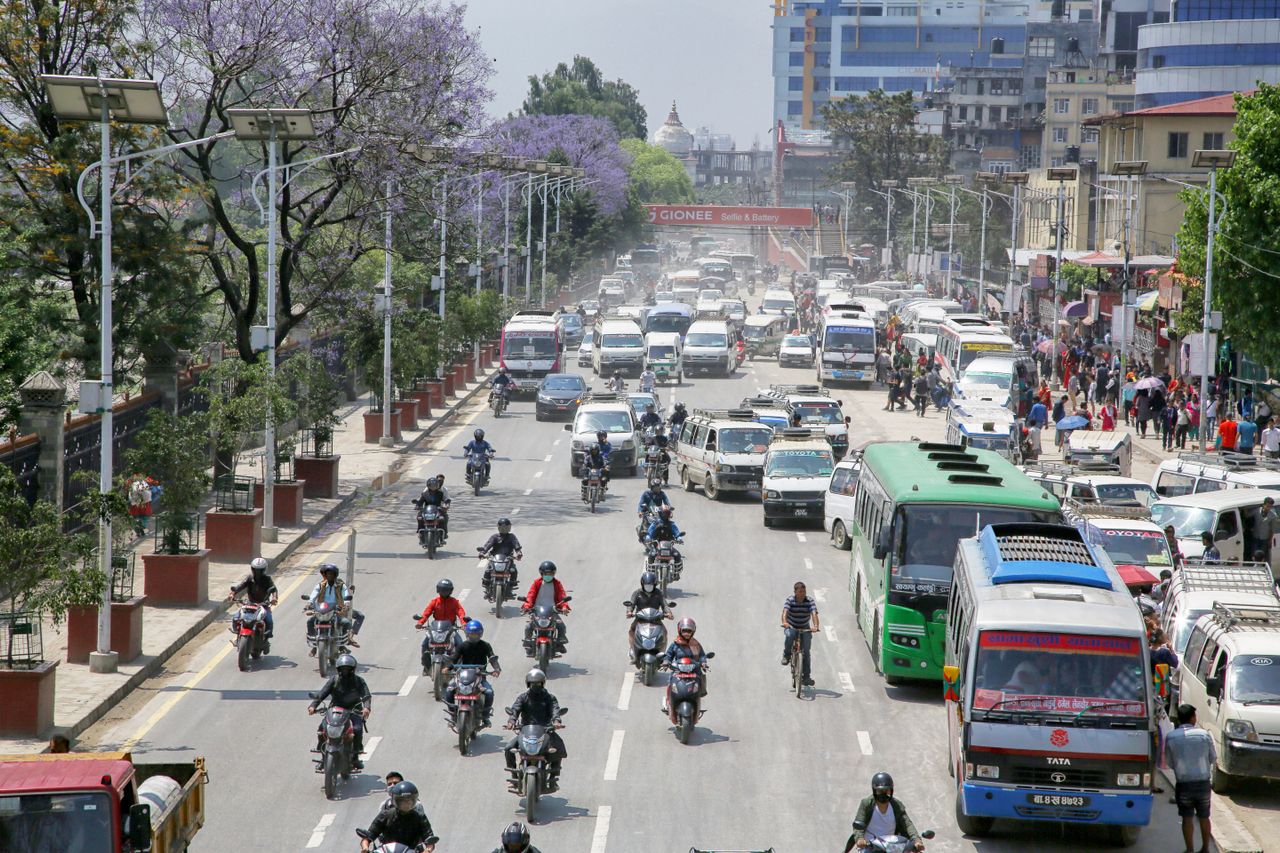
Kathmandu traffic does not ease you in. You come from the airport or the hotel, you get on the bike, and within thirty seconds you are in the middle of something that bears almost no resemblance to any riding you have done before. Buses pulling into your lane without signalling. Motorcycles appearing from directions that were not in your peripheral vision. A cow standing in the road at a junction that everyone else navigates around with the relaxed competence of people who have been doing this for years.
The first hour in Kathmandu traffic is the hour most first-time riders describe as their most stressful riding experience in Nepal, including the high passes and the river crossings. This is not because Kathmandu traffic is more dangerous than those things. It is because the skill set it requires is different from what most foreign riders have developed, and the gap between what you know and what the road demands becomes apparent very quickly.
This guide covers how Kathmandu traffic actually works, what the rules are and which ones are enforced, how to read the road in a way that makes sense rather than feeling like controlled chaos, and the specific habits that turn the first hour's stress into something manageable by the end of the first day.
How Kathmandu Traffic Actually Works
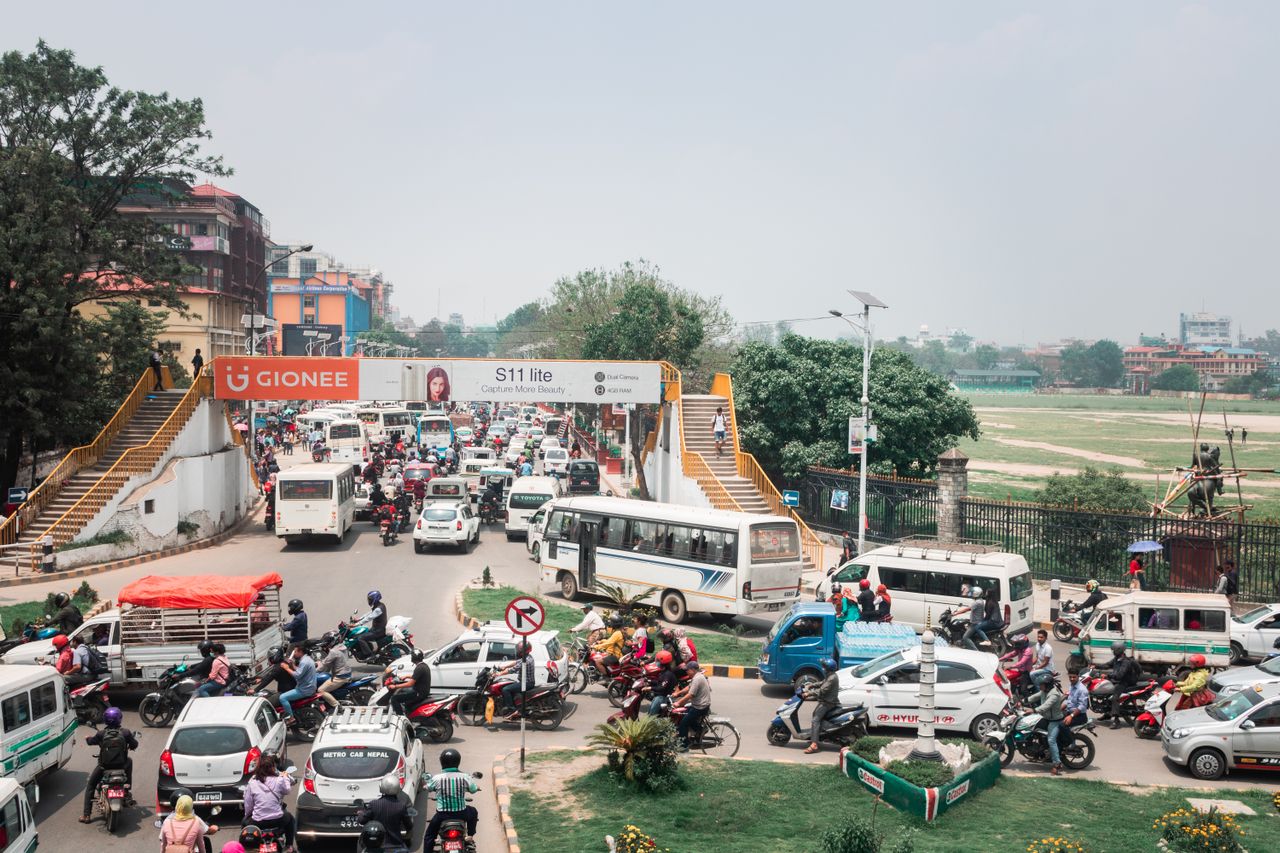
The first and most useful thing to understand about Kathmandu traffic is that it works. Not the way a German autobahn or a Tokyo ring road works, but it works. Millions of trips happen every day in Kathmandu and the overwhelming majority of them complete without incident. The system that produces this outcome is different from the system most foreign riders are used to, but it is a system, and once you understand it the road starts making sense.
The governing principle is negotiation rather than rule enforcement. In most Western road environments, traffic works because everyone follows the same rules and the rules are enforced strongly enough that deviation is rare. In Kathmandu, traffic works because road users are constantly communicating, reading each other, and making small adjustments that collectively keep things moving. The horn is part of this communication, not a sign of aggression. The absence of strict lane discipline is not chaos, it is flexibility that the road density requires. The vehicles that seem to be ignoring the rules are usually following a different set of rules that experience teaches.
The hierarchy operates by size and momentum. Larger vehicles have implicit right of way not because the law says so but because the physics of a collision favour them and everyone understands this. Buses do not yield to motorcycles not because the bus driver is aggressive but because the bus driver knows that a motorcycle can stop or redirect far more easily than a loaded bus, and the motorcycle rider knows this too and acts accordingly.
Pedestrians in Kathmandu cross roads continuously and from any point, and they do so by reading the traffic and moving in gaps rather than waiting for formal crossing opportunities. Their behaviour is not random. It is calibrated to the actual traffic, and a rider who understands this reads the pedestrian's movement as a signal rather than a surprise.
The Ring Road and the Inner Streets
Kathmandu's road network for a motorcycle rider breaks into two distinct environments with different riding demands.
The Ring Road that encircles the valley is the fastest and most predictable route between areas of the city, but it carries the heaviest vehicle mix. Trucks, buses, tempos, and private vehicles share a road that was not originally designed for the volume it now carries. Lane discipline is minimal. The right lane is nominally faster but is also where merging vehicles appear from entry roads. The safest position on the Ring Road for a foreign rider is the left lane at a pace that keeps you ahead of the buses but does not require you to overtake aggressively.
The inner streets of Thamel, Patan, and Bhaktapur operate at lower speeds and with a different character. Narrower roads, more pedestrian activity, more parked vehicles reducing the effective road width, and more frequent stops for junctions that lack any form of traffic management. These streets feel more chaotic than the Ring Road but are actually easier to manage because the speeds involved are lower and the margin for error in any collision is smaller. Slow down significantly on inner Thamel streets. A walking pace is not an exaggeration for the narrowest sections with pedestrian traffic.
The roads leading out of the valley, the Prithvi Highway toward Pokhara, the Araniko Highway toward the Tibet border, the road to Nuwakot, start in the density of the city and thin out progressively as the valley edge approaches. The transition from city density to open road is not immediate. The stretch between central Kathmandu and the valley rim carries a mix of urban and highway traffic for a distance that takes longer to clear than most riders expect.
The Horn: What It Means and How to Use It
A foreign rider's instinct about the horn in Kathmandu is usually wrong in one of two directions. Either they use it the way they would at home, meaning almost never and only when genuinely provoked, or they become so conditioned by the noise around them that they start using it reflexively without understanding what signal they are sending.
The horn in Kathmandu is a locational signal. It says I am here, I am moving, I am approaching this junction or this narrow section. It is used at blind corners to announce approach before the other vehicle can see you. It is used when overtaking to let the vehicle being passed know you are there. It is used when exiting a side street into a main road to announce entry before you are visible to traffic already on the road.
Use it the same way. At blind corners on narrow inner streets, a brief tap before committing to the corner gives anyone coming the other direction a moment of warning. When you are alongside a bus or a truck in traffic and the vehicle starts moving toward your lane, a horn tap is more effective than hoping the driver checks their mirror.
Do not use it at pedestrians who are crossing. In Kathmandu this achieves nothing except adding to the noise and occasionally startling someone into a less predictable movement.
Junctions: The Part That Confuses Foreign Riders Most
Kathmandu's junctions are the specific element of the traffic system that most first-time foreign riders find hardest to read. Many of them lack signals. Many of those that have signals have signals that are ignored with a consistency that suggests the signals are advisory rather than mandatory.
The operational logic at a signalless junction is size and momentum, reinforced by eye contact and the horn. The vehicle that is already moving and committed to the junction has implicit right of way over the vehicle that is entering it. The vehicle that is larger has implicit right of way over the vehicle that is smaller. When two vehicles of similar size arrive simultaneously, the one on the main road has priority over the one entering from a side road.
At junctions with traffic police, the officer's signals are followed and the system works more clearly. Kathmandu deploys traffic police at the major junctions during peak hours, roughly 8 to 10 in the morning and 5 to 7 in the evening. If a junction has an officer directing traffic, stop when indicated and go when waved through. The officer's signal overrides any light that might also be present.
The mistake foreign riders make most at Kathmandu junctions is stopping when they should be moving and moving when they should be reading. Stopping abruptly in traffic that expects you to keep moving creates the situation behind you that you were trying to avoid in front of you. Reading the junction for a moment before committing to it, even a second of observation, tells you whether there is a gap or whether you need to wait.
Overtaking Buses and Trucks
Buses in Kathmandu stop frequently, without always signalling, and sometimes in positions that block the lane completely rather than pulling fully to the side. This is particularly common on the main arterial roads and on the Ring Road, where bus stops are informal points rather than dedicated bays.
Overtaking a stopped bus requires checking for two things that are not always visible from behind it. First, traffic coming the other direction. A bus blocks your view of the oncoming lane and the lane is often narrower than it looks. Second, pedestrians who have just alighted and are crossing the road in front of or alongside the bus. Both appear from behind the bus at the same moment you commit to the overtake.
The overtake on a Kathmandu arterial road works by positioning slightly to the right while still behind the bus, checking the oncoming lane is clear, and moving past at a pace that allows you to stop if something appears from the front of the bus. A fast overtake removes the time you need to respond. A controlled one keeps it available.
Trucks on the Ring Road and the exit roads from the valley follow the same logic but with more consequence in a miscalculation. A truck's blind spots are larger, its response to your presence alongside it is slower, and its trajectory if it moves into your lane without seeing you leaves less room for correction. Pass trucks when you have a clear view of the oncoming lane and when the truck is moving in a predictable straight line. Do not sit alongside a truck in slow-moving traffic where its natural drift and the road's lateral variation can bring it toward you without the driver being aware.
What Gets You Stopped at Traffic Checkpoints
Kathmandu's traffic police run enforcement stops on the main roads, most consistently in the morning, and the items they check for foreign riders on rental bikes in Nepal are predictable.
Helmet. Both rider and pillion must wear one. This is enforced consistently on the main roads out of the city and on the Ring Road. A foreign rider on a rental bike without a helmet on the Prithvi Highway heading out of Kathmandu will be stopped.
Driving licence. Your home country licence is required. An IDP is strongly recommended for reasons covered separately in the licence guide. If you are stopped without a licence, the fine is modest but the stop itself takes time you did not budget.
Bike registration. This document should be in the bike's holder from the rental shop. Check it is there before you leave. A bike on the road without registration documentation can be detained at the checkpoint until the rental shop produces it.
Phone in hand. Traffic police in Kathmandu enforce the no-phone-while-riding rule on the main corridors. Mounting your phone on the handlebar for navigation is acceptable. Holding it in your hand while riding is not.
Riding the wrong way on a one-way street. Kathmandu has a significant number of one-way streets in the central areas, particularly around New Road, Durbar Marg, and the Thamel streets. They are not always clearly signed. Local riders know them by familiarity. Foreign riders learn them by being stopped. Check a map before navigating through central Kathmandu rather than following the general direction of traffic, which sometimes goes the wrong way on one-way streets without consequence until it does not.
Specific Areas and Their Particular Challenges
Thamel: The tourist district has the highest pedestrian density of any area you will ride through in Kathmandu. Narrow lanes, parked bikes reducing effective width, delivery vehicles stopped across the flow of traffic, and pedestrians who are looking at their phones rather than the road. Ride slowly, use the horn at blind corners, and accept that Thamel will take longer to cross than the map suggests.
Chabahil and the road to Boudhanath: This corridor carries a mix of local commuter traffic and tourist vehicles heading to Boudhanath Stupa. The Chabahil junction is one of the more congested in the city during peak hours. The road narrows before Boudhanath and the pedestrian and religious traffic around the stupa itself requires particularly slow speeds.
Kalanki junction: The main exit point from Kathmandu onto the Prithvi Highway heading toward Pokhara. This junction is consistently among the busiest in the valley and the point at which the city traffic transitions to the highway. The junction itself has traffic police during peak hours. The merge onto the Prithvi Highway immediately after requires positioning in the right lane early if you are heading west.
Koteshwar and the Ring Road eastern section: The eastern Ring Road carries significant truck and bus traffic and has sections where road quality drops sharply. Potholes on the Ring Road eastern section are larger and less predictable than on the western section. Ride this section at a pace that leaves stopping distance for road surface surprises.
The First Day Adjustment
The first day in Kathmandu traffic is the hardest because everything is new simultaneously. The road behaviour, the junction logic, the horn culture, the pedestrian movement patterns, the vehicle hierarchy. Trying to process all of it at once while also navigating to a destination on an unfamiliar road network is more cognitive load than most riding produces.
The practical adjustment that experienced riders recommend is to ride a short route on the first day rather than the route you need to ride. An hour in local traffic around the accommodation area before committing to a cross-city transit or a valley exit road gives your brain time to start building the pattern recognition that makes Kathmandu traffic readable. The road that felt chaotic at the start of that hour feels noticeably more legible by the end of it, not because the road has changed but because you have started to see the system inside it.
The second thing that helps is finding a moment of low traffic to leave for anything important. Early morning, before 7 a.m., Kathmandu's roads carry a fraction of the daytime volume. If you need to get across the city to meet someone, collect a permit, or reach the valley exit road at the start of a riding day, early morning departure turns a 45-minute transit into a 20-minute one and removes the peak-hour variables from a day that will have enough variables later.
The third thing is accepting that the first few junctions will be slower and more hesitant than local riders expect. This is fine. The worst outcome of a hesitant approach to an unfamiliar junction is that the traffic behind you adjusts, which it does with the same fluid competence it applies to everything else. The worst outcome of a confident approach you have not yet earned is different.
What Kathmandu Traffic Teaches You for the Rest of the Trip
Riders who spend even two days navigating Kathmandu before heading to the mountain routes consistently describe the city riding as useful preparation in ways they did not expect. The continuous attention the city requires, the horn communication habit, the reading of other vehicles' intentions from their movement rather than their signals, and the understanding of a road hierarchy that operates on physics and negotiation rather than rules and enforcement all transfer directly to Nepal's mountain roads.
The river crossing that requires reading the current and the far bank before committing is the same skill as the junction that requires reading the traffic flow before entering. The mountain track where a bus coming the other direction requires one of you to find a wider section and yield is the same negotiation as the Ring Road lane merge. The patience that Kathmandu traffic builds, the understanding that the road runs on its own timeline and that frustration does not accelerate it, is the exact quality that the day four expedition wall and the afternoon wind in the Kali Gandaki gorge will call for.
Nobody tells you that when you are in your first Kathmandu junction wondering why nothing is following any rule you were taught. By the third day, most riders have started to see it.
Starting your Nepal motorcycle tour in Kathmandu? Nepal Moto Tours routes all guided circuits through the city with a guide who rides alongside you through the transition from city to mountain road.