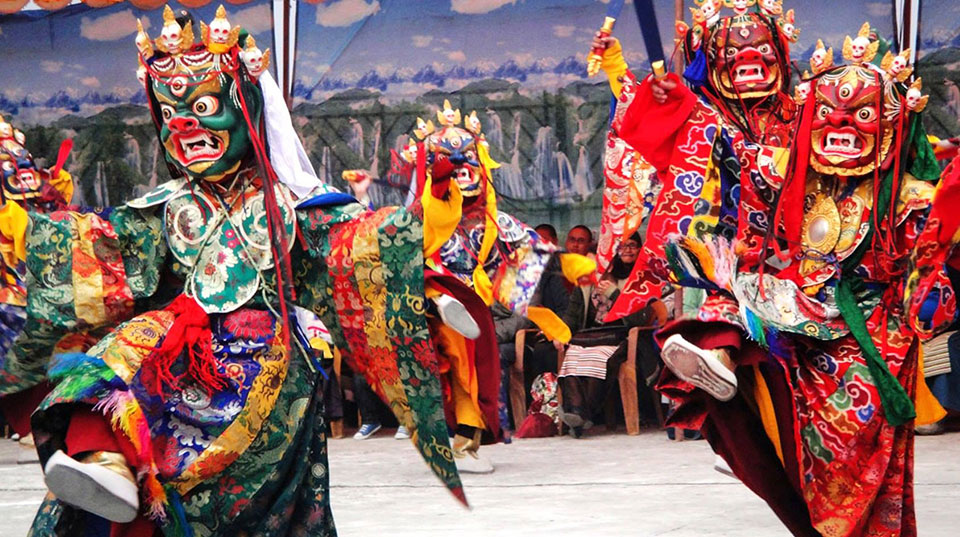
Once a year, the walled medieval city of Lo Manthang closes its narrow streets to daily life and opens its royal courtyard to something older than the Nepali state itself. Monks in fierce painted masks perform a centuries-old dance re-enacting a battle between a protector deity and a demon father who once brought drought and ruin to the kingdom. This is Tiji, the most important religious festival in Upper Mustang, and one of the few living Tibetan Buddhist rituals still performed exactly as it has been for hundreds of years.
This guide covers what Tiji actually is, the legend behind it, when it happens in 2026 and 2027, and everything you need to know to get there.
What Is the Tiji Festival
The Meaning Behind the Name
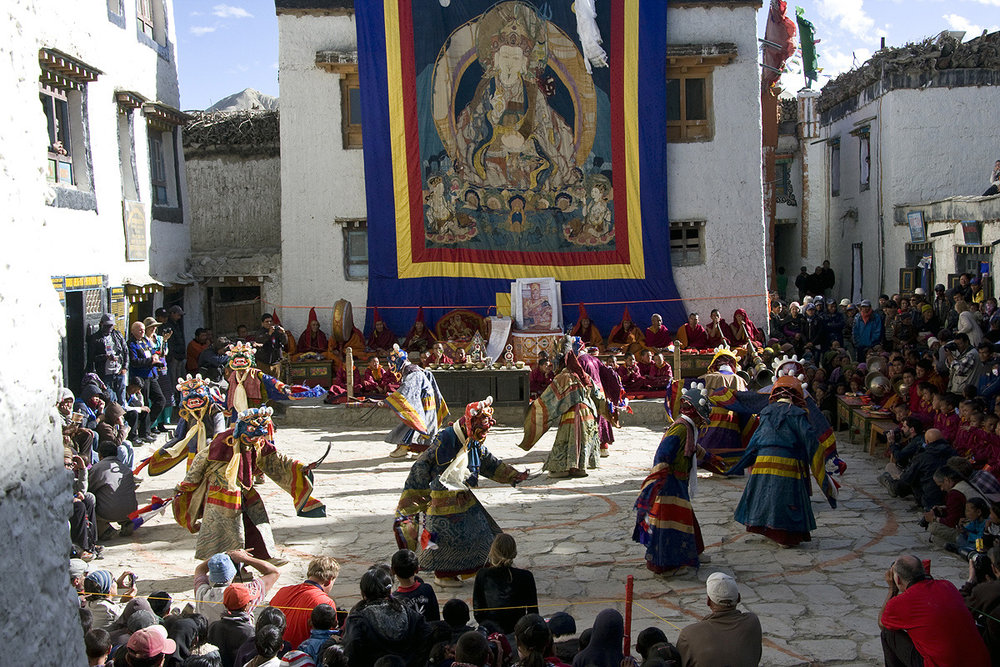
Tiji is a shortened form of Tenpa Chirim, sometimes written Tempa Chhirim or Tenchi, a phrase meaning "Prayer for World Peace" in the local Lo-pa dialect. It's a three-day Tibetan Buddhist ritual, not a folk festival in the tourist sense. The dances performed inside Lo Manthang's main square are considered active protective rituals by the monks who perform them, not historical re-enactments staged for an audience.
The Legend of Dorje Jono
At the center of Tiji is the story of Dorje Jono, an incarnation of the wrathful deity Vajrakila, who battled his own demon father, Ma Tam Ru Ta (also spelled Man Tam Ru). The demon had brought drought, disease, and chaos to the kingdom of Mustang, and Dorje Jono defeated him, driving him from the land and restoring peace. The three days of masked dances, known as Tsa Chham, Nga Chham, and Rha Chham, dramatize different stages of this battle, ending with the demon's symbolic expulsion from Lo Manthang.
History and Origins
The 17th-Century Vajrakila Ritual
The ritual tradition behind Tiji goes back much further than Mustang itself, to the 8th-century Vajrakila practices brought to Tibet by Padmasambhava. Its formal establishment in Lo Manthang is traced to the 17th century, when King Samdup Rabten invited the senior Sakya lama Ngawang Kunga to perform the Vajrakila ritual at Chode Monastery as protection for the kingdom. That ceremony, passed down through generations of monks at Chode Gompa, became the Tiji Festival practiced today.
How the Festival Nearly Disappeared
Tiji's history isn't unbroken. Political changes affecting Mustang in the 19th century led to the abolition of several old traditions, and the public ceremony in the city square was suspended, though monks at Choede Gompa quietly continued a scaled-down version within the monastery itself. According to local accounts, the full public festival was only revived after a spiritual warning: a local resident reportedly experienced a vision warning that abandoning Tiji would bring disease and hardship back to Lo. The late King Jigme Dorje Palbar Bista, working with monastery leaders, restored the full festival to Lo Manthang's main square, where it has continued since.
The Three Days: What Actually Happens
Day One: The Summoning
The first day begins with the lamas of Choede Monastery, Lo Manthang's principal monastery, preparing the sacred space and performing the initial rituals that open the festival. The morning is largely ceremonial and interiors-focused, elaborate thangka paintings are displayed on the monastery walls, ritual offerings are prepared, and the masked dancers begin their preparatory rites.
By mid-morning, the courtyard of the walled city fills with the community, families in traditional Loba dress, elders who have attended every Tiji they can remember, children for whom the festival is the year's most significant event, and an increasing number of visitors who have made the journey specifically for this. The monks of Choede perform the initial dances in elaborate masks representing the protective deities and demonic forces whose confrontation the festival narrates. The choreography is precise and long-established, each movement, each transition, each musical cue corresponds to a specific moment in the ritual narrative that the lamas understand in detail and that the community reads with the fluency of long familiarity.
The first day's atmosphere is one of contained anticipation. The full confrontation between Dorje Jono and the demon has not yet arrived. The ritual is building toward it, establishing the cosmological conditions under which the climax of the festival will occur.
Day Two: The Battle
The second day is the dramatic heart of Tiji and the day most visitors who have attended describe it as among the most arresting ritual spectacles they have encountered anywhere. The masked dance now depicts the direct confrontation between Dorje Jono and the demon threatening Lo, an extended, choreographed ritual combat performed in the courtyard and the streets of Lo Manthang with an intensity that the audience absorbs rather than merely observes.
The masks worn by the principal dancer-monks are extraordinary objects: large, elaborate, painted in brilliant colours, each representing a specific deity or protective force with its own iconographic tradition reaching back to the Tibetan Buddhist ceremonial culture from which the festival derives. The music, cymbals, long Tibetan horns called dungchen, drums, and oboe-like instruments, fills the walled courtyard with sound that has a physical presence at altitude, in the enclosed space, that recordings do not capture.
By the afternoon of the second day, the battle is reaching its peak. The demon figure, rendered in elaborate costuming, is pursued, confronted, and progressively weakened through the ritual dance. The community's participation is not passive, there is call and response, collective prayer, and a shared emotional engagement with the outcome that a visitor unfamiliar with the narrative can nonetheless feel in the atmosphere of the courtyard.
Day Three: The Expulsion
The third day brings resolution. The demon is formally expelled in a ritual that involves the burning of an effigy and the release of the community from the spiritual threat that has been the festival's dramatic subject. The mood shifts from intensity to relief and celebration, the expulsion complete, rain and fertility restored, the cycle renewed for another year.
For many visitors, the third day's atmosphere is the most moving, precisely because the resolution arrives not as a theatrical conclusion but as a genuine collective exhaling. The community of Lo has done what it needed to do. The lamas have completed the ritual. The demon is expelled. The atmosphere in Lo Manthang's courtyard after the third day's culmination is one of the more quietly extraordinary experiences that Himalayan travel produces.
When Tiji Happens: Dates and Timing
Tiji Festival is held annually in the Tibetan lunar calendar, which means the dates shift each year in the Gregorian calendar. The festival typically falls in May, occasionally late April, occasionally early June, with the specific dates determined by the Tibetan lunar calendar calculation.
For 2026 and beyond, exact dates should be confirmed through Nepal Tourism Board announcements or directly with Upper Mustang permit-issuing agencies in Kathmandu or Pokhara, typically three to six months before the festival. Planning a motorcycle trip to Upper Mustang specifically around Tiji requires building the permit, route, and accommodation logistics around confirmed dates, and doing this early, Lo Manthang's limited accommodation fills well before the festival in years of strong visitor numbers.
The timing of Tiji in May aligns almost perfectly with the pre-Monsoon riding window that represents one of Nepal's two best motorcycle touring seasons. The road from Kagbeni to Lo Manthang in May is typically dry and in its best post-winter condition. The passes approaching Mustang from Pokhara via Jomsom are clear. The Kali Gandaki corridor, while subject to the afternoon winds that define its riding character year-round, is not yet subject to the Monsoon conditions that can make it challenging in June and beyond. Riding to Lo Manthang for Tiji in May is, in terms of road conditions, genuinely the ideal convergence of cultural and motorcycling opportunity.
Where Tiji Takes Place: Lo Manthang, the Walled Capital
Lo Manthang sits at roughly 3,840 meters and was the capital of the independent Kingdom of Lo from the 14th century onward. Its whitewashed mud-brick homes, narrow alleys, and monasteries remain largely unchanged, which is part of what makes Tiji feel less like a performance and more like stepping into an earlier century. The festival takes place entirely within the town's walls, centered on the square outside the King's Palace.
How to Get to Lo Manthang for Tiji Festival
By Road or Jeep
The standard route runs Kathmandu to Pokhara, then Pokhara to Jomsom and Kagbeni along the Kali Gandaki gorge, followed by a rougher mountain road from Kagbeni north to Lo Manthang. Most operators cover this in two to three days each way by 4WD jeep. Flying Kathmandu to Pokhara to Jomsom cuts a significant chunk of driving time, weather permitting, since the short mountain flights are frequently delayed or cancelled.
By Trek
The classic Upper Mustang trek follows roughly the same corridor on foot, passing through Kagbeni, Chele, Syangboche, Ghami, and Tsarang before reaching Lo Manthang. Depending on pacing and acclimatization days, the full round trip typically runs 10 to 14 days.
Getting to Tiji Festival by Motorcycle
The Permit Requirements
Upper Mustang is a restricted area requiring a separate permit beyond standard Nepal entry documentation. The Restricted Area Permit for Upper Mustang costs USD 50 per day. This permit must be obtained through a registered Nepal Tourism Board approved agency, it cannot be self-arranged by a foreign tourist at the border or at the Kagbeni checkpoint.
Additionally, riders require a standard Nepal entry visa, an Annapurna Conservation Area permit, and a TIMS card. For riders planning to attend Tiji, all permits should be processed in Kathmandu or Pokhara at minimum one week before departure, and ideally longer during peak festival season when agency processing capacity is under pressure.
The checkpoint at Kagbeni is where Upper Mustang permits are verified. Riders without the correct documentation cannot proceed past this point. There is no permit arrangement available at the checkpoint itself.
The Route from Pokhara
The standard motorcycle route from Pokhara to Lo Manthang runs approximately 260 kilometres and is typically ridden over three days, though two days is possible for experienced riders accepting very long riding days.
Pokhara to Jomsom (approximately 140km): The road follows the Kali Gandaki River valley northward through Beni, climbing progressively through Tatopani, Ghasa, and Marpha before reaching Jomsom at 2,720 metres. This section of the route combines sealed roads on the lower approaches with gravel and packed dirt tracks as the valley narrows and the landscape transitions from green hillside to the rain shadow landscape that defines Mustang's character. The afternoon wind in the Kali Gandaki gorge, a reliable and powerful daily phenomenon is best managed by early departure from Pokhara or an overnight stop in Tatopani, which positions riders to reach Jomsom in the morning before the wind builds.
Jomsom to Kagbeni to Chusang (approximately 50km): The road from Jomsom to Kagbeni is short and substantially improved, a relatively smooth track that reaches the ancient village of Kagbeni, the gateway to Upper Mustang proper, within an hour. Permit verification happens at Kagbeni. Beyond the checkpoint, the road enters the high desert terrain that defines Upper Mustang, ochre cliffs, wind-eroded landscape of extraordinary visual drama, scattered settlements of stone houses with flat roofs and prayer flags. The track to Chuksang continues north along the river, crossing the Kali Gandaki several times depending on water level — the river crossings here are genuine fords, not bridges, and require appropriate confidence and technique.
Chusang to Lo Manthang (approximately 70km): This is the most demanding and most visually extraordinary section of the route. The track climbs through Ghami and Charang, passing ancient cave settlements carved into the cliff faces, chortens and mani walls that predate the permit system by centuries, and viewpoints that reveal the Himalayan range to the south in conditions that clear skies make overwhelming. Lo Manthang appears as a walled city rising from the plateau — unexpected in its scale and compactness, its whitewashed walls and the gold and red of its monastery rooflines vivid against the ochre landscape.
Road Conditions Specific to May
May conditions on the Pokhara–Lo Manthang route are generally the year's best for motorcycle travel. The winter snow that can block higher sections has cleared. The Monsoon conditions that affect river levels and road surfaces from June onward have not yet arrived. The Kali Gandaki crossings between Chuksang and Kagbeni are typically at their most manageable pre-Monsoon water level in May.
The specific consideration for Tiji timing is traffic volume. The days immediately before the festival see a significant increase in vehicle traffic on the Lo Manthang approach — other riders, jeep convoys carrying visitors, and supply vehicles serving Lo Manthang's festival period. Departure from Pokhara two to three days before the festival's first day is recommended, both to allow for the three-day riding schedule without time pressure and to arrive in Lo Manthang with time to acclimatise before the first day's events begin. Tiji festival is one of the best things that you can witness on your motorbike tour to upper mustang.
Accommodation in Lo Manthang During Tiji
Lo Manthang's accommodation capacity is limited by the constraints of a walled city at 3,840 metres that was not designed with tourism infrastructure in mind. The guesthouses inside and immediately outside the walled city number in the low dozens and accommodate visitor numbers that the festival now attracts with some difficulty during peak years.
Booking accommodation for Tiji in Lo Manthang requires advance planning of a kind that Nepal's more accessible destinations do not. Guesthouses with any online presence fill months before the festival in years of strong visitor numbers. The most reliable booking approach for riders planning a Tiji trip is through your Nepal motorcycle tour operator with established relationships in Lo Manthang, these operators maintain direct communication with guesthouse owners and can confirm availability and rates that are not accessible through standard booking platforms.
Accommodation inside Lo Manthang's walls carries a premium during Tiji, both because of proximity to the festival courtyard and because the limited supply faces concentrated demand. Accommodation in Ghami, one riding day south of Lo Manthang, is more available and serves as a reasonable base for riders who book late, accepting a daily round trip to the festival. Jomsom offers the widest accommodation range and the most reliable availability, but its distance from Lo Manthang makes it impractical as a Tiji base unless the ride to and from Lo Manthang is done as a single very long day, which is not recommended given the road conditions and the hour at which the festival days conclude.
Understanding What You Are Witnessing
Tiji Festival is a living Tibetan Buddhist religious ceremony, not a cultural performance staged for visitor benefit. Understanding this distinction changes not just how you engage with it but what you are actually able to see and experience.
The ritual narrative — Dorje Jono's defeat and expulsion of the demon — is encoded in every element of the performance: the specific masks worn by each dancer, the sequence of musical cues, the directional orientation of the dances, the offerings prepared and consumed over the three days. A visitor who arrives without any prior knowledge of the narrative watches a spectacular and emotionally engaging event. A visitor who has spent an hour reading about Dorje Jono, the Kingdom of Lo's relationship with Tibetan Buddhism, and the symbolic vocabulary of the specific masks and instruments used in the ceremony watches a rich, multi-layered ritual in which each element carries meaning they can follow in real time.
English-language resources on the Tiji Festival mythology and Tibetan Buddhist ritual vocabulary are available in Kathmandu and Pokhara bookshops, in the publications of the Mustang Eco-Cultural Tourism Society, and increasingly online. Reading them before arriving is one of the highest-return investments of preparation time available for this specific trip.
Photographic etiquette during Tiji requires specific consideration. The monks performing the ritual dances are not subjects for photography in the way that festival performers in commercialised cultural tourism contexts often are. They are conducting a religious ceremony. Photography is generally permitted in the main courtyard and the public areas of the festival, but direct flash photography directed at performing lamas and monks is considered disrespectful and will generate a response from the community accordingly. Longer lenses from a respectful distance produce better images and better relationships with the community simultaneously.
Dress respectfully for the festival days themselves — conservative coverage appropriate for a religious site, with particular attention to removing footwear when entering the monastery precincts where festival preparations and some ritual elements occur.
The Broader Mustang Context: What to Ride While You're There
A motorcycle trip to Lo Manthang for Tiji that treats the festival as the sole purpose and the riding as transport misses what the combination of festival and route genuinely offers. The Upper Mustang landscape and the broader Mustang district contain some of the most extraordinary riding available in Nepal, and the permit cost and logistical investment of reaching Lo Manthang are better justified by staying long enough to explore the region properly.
The road south from Lo Manthang toward Ghami, Charang, and the ancient caves of Chhoser — artificial caves carved into the cliff faces by a civilisation predating the Kingdom of Lo — constitutes one of the most archaeologically extraordinary day rides available anywhere. The landscape north of Lo Manthang, approaching the Tibetan border in the direction of the ancient salt trade routes, is accessible on certain tracks and offers a glimpse of the high plateau terrain that defined Mustang's historical character as a trading hub between Nepal and Tibet.
The return route from Lo Manthang to Pokhara can be varied from the ascent route by taking the alternative road through Muktinath and descending via Jomsom through the Kali Gandaki gorge, which produces a loop rather than an out-and-back and introduces the extraordinary Muktinath temple complex — sacred to both Hindu and Buddhist traditions and one of the most significant religious sites in the Himalayas — as an addition to the cultural dimension of the trip.
Practical Details
Best time to visit: May annually, with specific dates varying by Tibetan lunar calendar. Confirm exact dates six months in advance.
Permit cost: USD 50/day in Upper Mustang, plus standard Nepal visa, Annapurna Conservation Area permit, and TIMS card. All permits processed in Kathmandu or Pokhara.
Recommended riding days from Pokhara: Three days up, two to three days return, plus festival days in Lo Manthang. A minimum ten-day permit covers this comfortably for most itineraries.
Accommodation booking: Arrange through a Kathmandu or Pokhara motorcycle tour operator with Lo Manthang relationships. Direct booking for accommodation inside Lo Manthang's walls is difficult for first-time visitors without established contacts.
Altitude acclimatisation: Lo Manthang sits at 3,840 metres. Riders should not ride directly from Pokhara to Lo Manthang in one day. The three-day ascent schedule provides adequate acclimatisation for most riders if the stages are followed and rest days are taken seriously rather than compressed under schedule pressure.
Weather in May: Generally dry and clear, with afternoon wind through the Kali Gandaki gorge a consistent daily feature. Morning departures are strongly recommended for all stages of the route to avoid being on exposed sections during peak afternoon wind.
Photography: Permitted in public areas. Respectful distance and no direct flash toward performing monks.
Language: Loba (the local Tibetan-derived language) is the primary community language. Nepali is understood in most guesthouses. English varies but is available through guides and in the better-established guesthouses in and around Lo Manthang.
Why This Trip Specifically Rewards a Motorcycle
Every mode of transport that reaches Lo Manthang for Tiji arrives with something the others do not have. Trekkers arrive with the embodied knowledge of every metre of altitude gained on foot. Jeep passengers arrive with the ability to carry comfort and supplies. Helicopter passengers arrive quickly and with minimal physical investment.
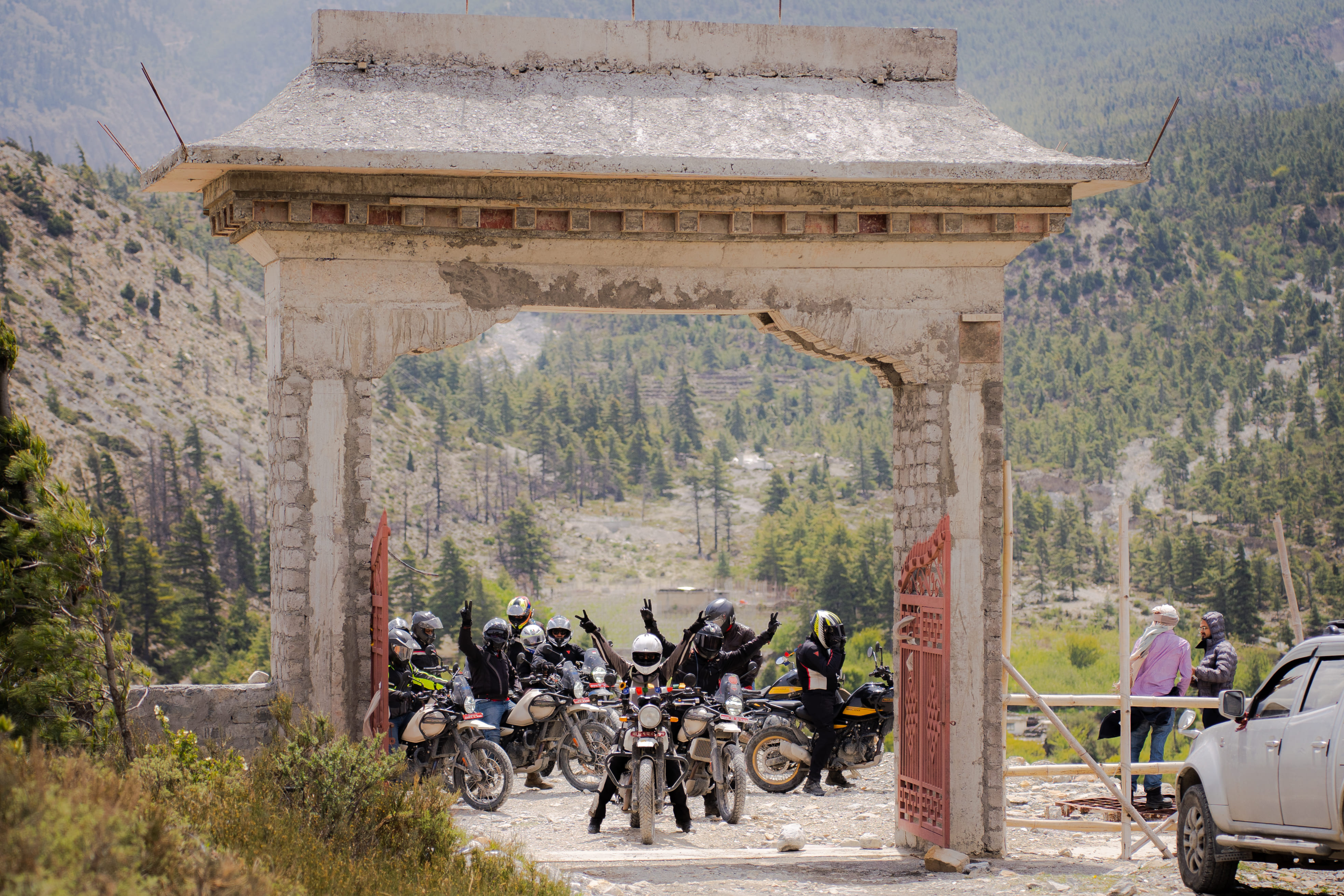
Motorcycle riders arrive with something different: the accumulated texture of the road itself, read through three days of riding through the Kali Gandaki gorge, the river crossings, the high plateau approach, and the moment of Lo Manthang's walled city appearing from the ochre landscape. The riding is not context for the festival. It is part of the same experience — demanding, visually extraordinary, and culturally specific to a landscape that the motorcycle engages with more directly than any enclosed vehicle, and at a pace more connected to the human scale of the place than any faster transit.
The Tiji Festival in Lo Manthang, reached by motorcycle through Upper Mustang's plateau, is among the most complete convergence of riding and place available in Himalayan travel. It requires planning, permits, preparation, and genuine commitment to the logistics of reaching a remote, high-altitude destination. It returns, in proportion to that commitment, an experience that is genuinely difficult to find a comparison for.