.jpg)
Two deserts. Two ancient kingdoms. Two routes that riders plan for years and talk about for decades afterward. Upper Mustang and Morocco's desert south are the destinations that come up most consistently when experienced adventure riders start comparing notes on where the genuinely great off-road touring happens and they come up together often enough that the comparison deserves a proper treatment rather than the vague "both are amazing, it depends on what you want" answer that fills most destination content.
This article makes the comparison directly, with the honest specificity that actually helps a rider decide. Not which is more photogenic. Not which has better Instagram potential. Which delivers a better off-road adventure, on what kind of terrain, for what kind of rider, in what season, at what cost and whether the question even has a single answer or whether the right choice is entirely a function of where you are in your riding life.
Setting the Stage: What Each Destination Actually Is
Before comparing them, it is worth being precise about what Upper Mustang and Morocco's desert south actually offer, because the popular shorthand — "Himalayan high-altitude desert" versus "Saharan desert" compresses distinctions that matter enormously to a rider making a decision.
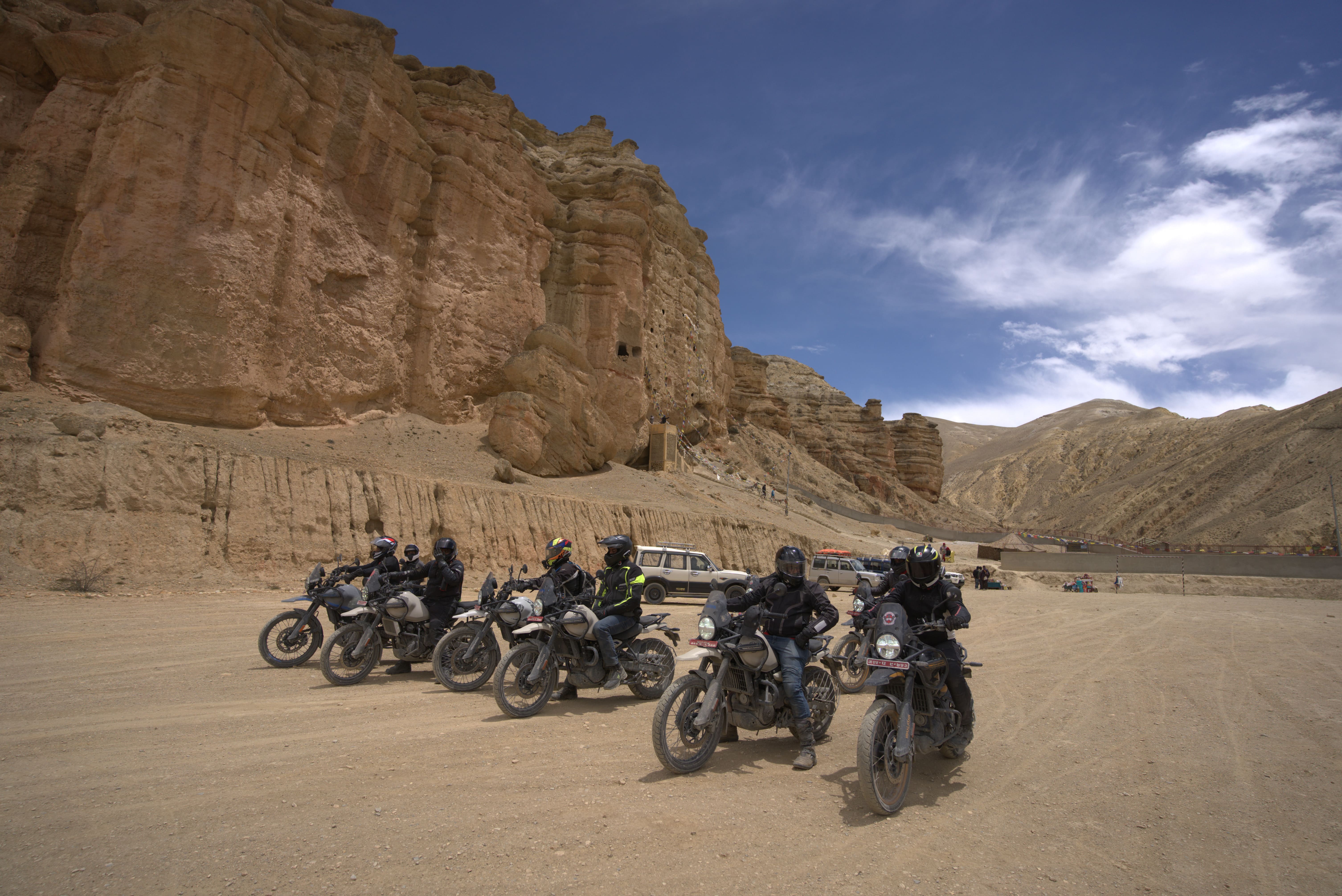
Upper Mustang is the northern section of Nepal's Mustang district, accessible only through a restricted area permit system, situated at elevations between 2,800 and 4,000 metres on the Tibetan plateau side of the Annapurna and Dhaulagiri ranges. It is a rain shadow desert, not a sand desert, but a high-altitude landscape of ochre cliffs, wind-eroded canyon systems, ancient cave settlements, and a Tibetan Buddhist cultural tradition that has been largely preserved by the same geographic isolation that makes the riding so demanding. The roads are unpaved tracks: river gravel, exposed limestone shelf, compacted dirt that becomes loose at altitude, and genuine river crossings that vary in difficulty seasonally. The altitude is constant and significant riders spend multiple consecutive nights above 3,500 metres.
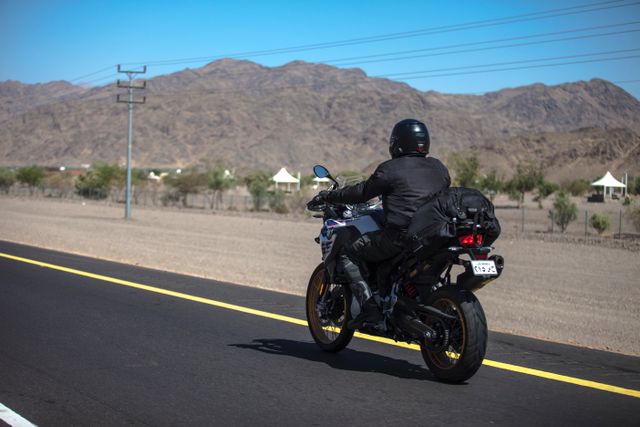
Morocco's desert motorcycle touring territory encompasses the region south and east of the Atlas Mountains, the Draa Valley, the Dades and Todra gorges, the Erg Chebbi dune systems near Merzouga, the Saharan piste routes toward Zagora, M'Hamid, and the Algerian border. This is genuinely varied terrain: sealed mountain road through the Atlas passes, gravel and piste through the pre-Saharan plateau, sand tracks between oasis settlements, and the soft sand of the erg dunes themselves. Elevation is low by Himalayan standards — the Atlas passes reach around 2,000 metres and drop rapidly to Saharan plain below 1,000 metres. The culture is Berber and Arab, the architecture is kasbahs and ksour, the colour palette is ochre and terracotta against sky blue.
Both are deserts in the broad sense. The experience of riding through them is almost entirely different.
The Terrain Comparison: Technical Difficulty and Character
This is where the comparison matters most to an off-road rider, and where the two destinations diverge most clearly.
Upper Mustang: Technical, Altitude-Complicated, Constantly Variable
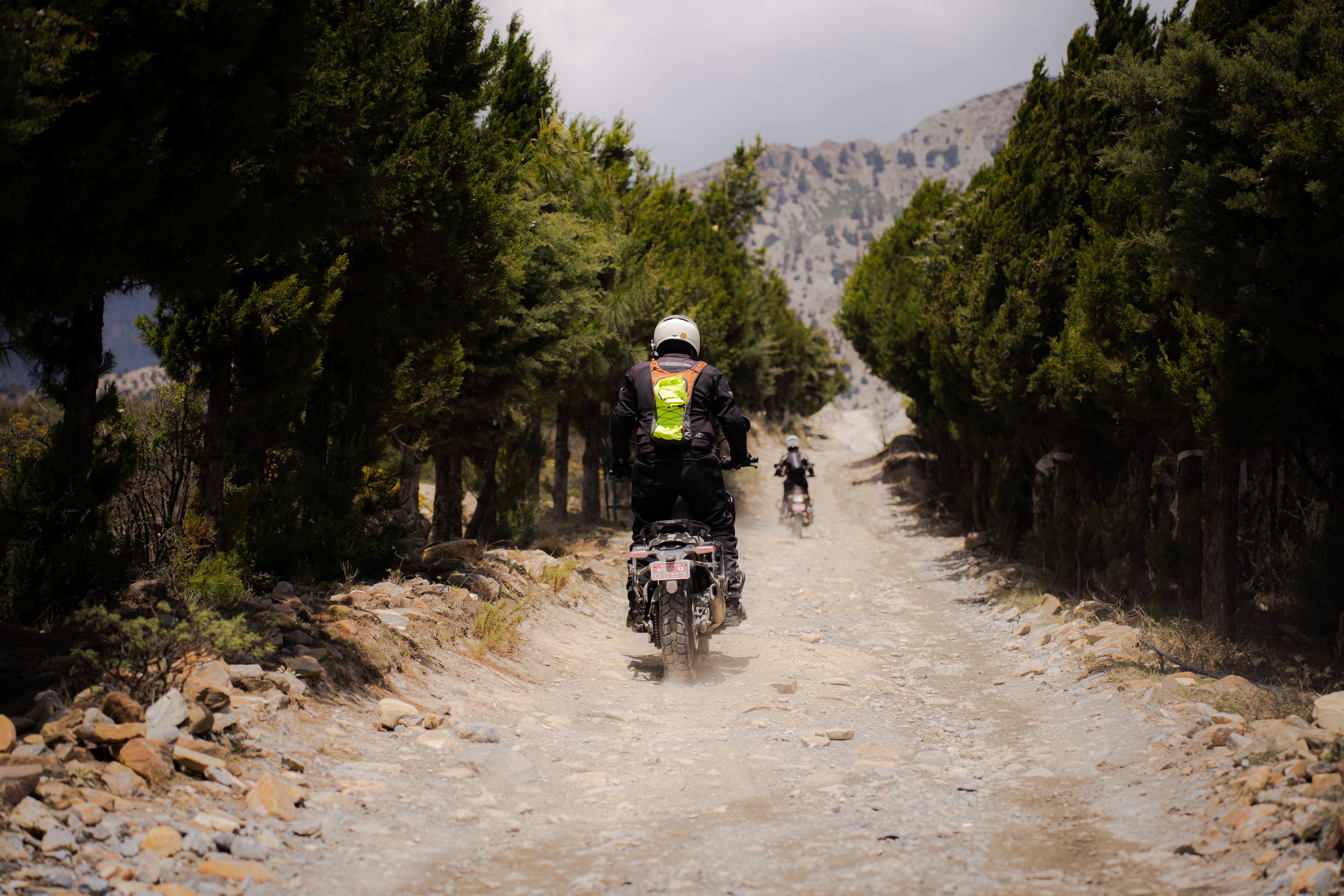
Upper Mustang's off-road terrain is technically demanding in a specific and relentless way. The difficulty is not concentrated in particularly challenging sections you can identify and prepare for, it is distributed continuously across the riding day, in the form of surface variability that requires sustained attention and constant micro-adjustment.
The river crossings between Kagbeni and Chuksang are the most talked-about obstacle, and they deserve their reputation: the Kali Gandaki and its tributaries require genuine water-crossing technique, particularly in late spring when snowmelt raises water levels above their pre-Monsoon baseline. But the crossings are not actually the most demanding element of Upper Mustang riding for most riders. The sustained gravel and rock sections at altitude — where surface looseness, lateral wind, and the cognitive load of continuous technical decision-making compound with altitude-reduced physical and mental performance — are harder over a full day than any single crossing.
The wind in the Kali Gandaki gorge, the world's deepest river valley, channelling air between the Annapurna and Dhaulagiri massifs with a reliability and force that local riders accept as a fixed feature of the landscape is a riding factor that visitors consistently underestimate until they are in it. Sustained lateral gusts on exposed sections of the gorge road are not uncomfortable interruptions to the riding. They are a continuous demand on balance, line choice, and throttle management that compounds significantly with fatigue over a long riding day.
The technical difficulty of Upper Mustang riding is high by any honest assessment, and it is paired with an altitude factor sustained nights above 3,500 metres, day riding above 4,000 metres on the Lo Manthang approaches that reduces physical and cognitive performance in ways that lower-altitude riding does not. A rider who is technically capable at sea level is a somewhat less capable version of themselves at 4,000 metres, and building in enough acclimatisation time to close that performance gap is a serious planning consideration rather than a precaution that experienced riders can skip.
Morocco: Variable, Learnable, Progressively Challenging
Morocco's desert off-road terrain is technically demanding at its hardest — the Saharan piste routes toward the Algerian border, the sand tracks through the Erg Chebbi approaches, and the more remote Atlas mountain tracks challenge experienced riders genuinely. But the difficulty profile is more graduated and more learnable than Upper Mustang's terrain, which matters significantly for riders who are building off-road skills rather than operating at the far end of them.
The Atlas mountain routes provide excellent gravel and dirt track riding at manageable altitude with consistent visual reward the approach to the Draa Valley from Ouarzazate through the Dades Gorge is among the most cinematically beautiful paved-and-gravel route combinations in North Africa, and the technical demands are well within the range of a rider with basic off-road experience. The Saharan piste routes beyond Zagora and M'Hamid introduce soft sand and navigation challenges that require genuine off-road competence and appropriate technique — standing on the pegs, reducing tyre pressure for soft-sand traction, reading the surface for the firmer lines through loose sections.
The sand itself the element that most specifically defines Morocco desert riding in the popular imagination — is technically demanding in a different way from Upper Mustang's gravel and rock. Sand rewards momentum and punishes hesitation; gravel at altitude rewards caution and punishes speed. A rider skilled in one environment is not automatically skilled in the other, and understanding which technical challenge suits your current ability is part of making the right destination choice.
What Morocco's terrain lacks, relative to Upper Mustang, is altitude consequence. A mistake or a mechanical issue on a Moroccan piste has a recovery environment that Upper Mustang's remote high-altitude plateau does not provide in the same way. Morocco has mobile signal in most areas the touring routes cover, a vehicle population that means passing help arrives within manageable time on most tracks, and an altitude that does not compound fatigue and reduce judgment. This makes Morocco more forgiving of the errors that genuine off-road riding produces and more appropriate for riders who are still developing the off-road technique and mechanical self-sufficiency that Upper Mustang's environment demands.
The Cultural Dimension: Ancient Kingdoms at Different Scales
Both destinations carry deep, ancient cultures, and both place those cultures in landscapes of extraordinary visual drama. The comparison between them is not a quality judgment but a character assessment.
Upper Mustang's Cultural Depth
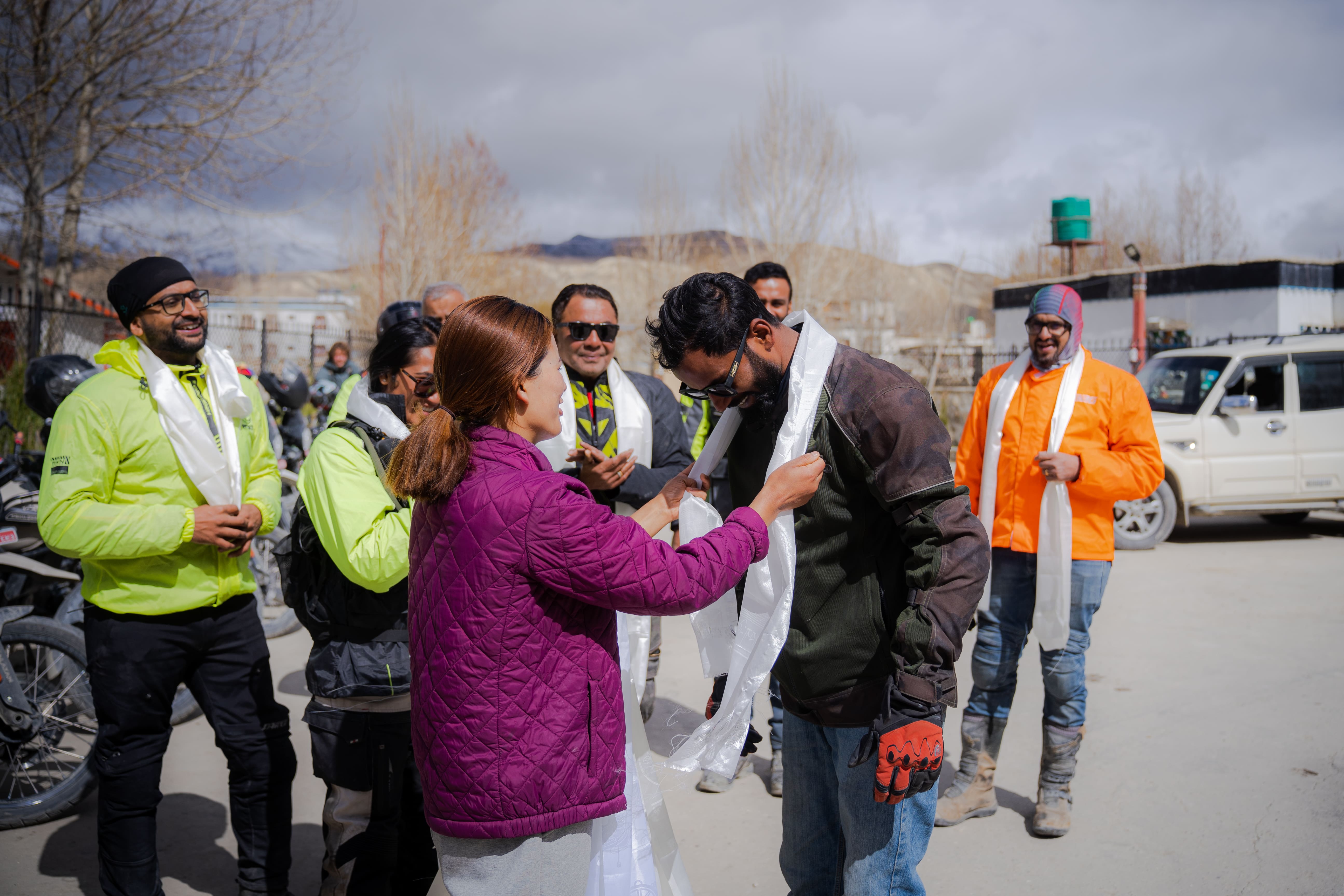
Upper Mustang preserves a form of Tibetan Buddhist culture that has been largely altered or destroyed within Tibet itself since 1959. Lo Manthang, the ancient walled capital of the Kingdom of Lo, contains monastery complexes Choede, Thubchen, Jampa that hold thangka paintings, sacred texts, and ritual objects of extraordinary antiquity and historical significance. The cave complexes carved into the cliff faces by pre-Lo civilisations, some containing ancient painted chambers, represent an archaeological layer that predates the Kingdom of Lo by centuries and that serious cultural travellers find extraordinary.
The Tiji Festival, held annually in Lo Manthang in May, is among the most significant and least-commercialised major religious festivals in the Himalayan world — a three-day masked dance ritual enacting the defeat and expulsion of a demon threatening the community, conducted with the full intensity of a living religious tradition rather than the attenuated version that heavy tourism produces elsewhere.
The cultural texture of Upper Mustang's villages is also specific and affecting in ways that brief description cannot fully capture: the Loba people, Tibetan-speaking, operating an agricultural and pastoral economy whose basic structure has not changed fundamentally in centuries, inhabiting stone houses and monasteries that their ancestors built, conducting rituals that their community has conducted for generations. A rider who spends time in Lo Manthang's guesthouses, eats with local families, and watches the community going about its life between the festival's ritual moments is encountering something that is genuinely rare in its combination of cultural survival and accessibility.
Morocco's Cultural Richness
Morocco's Saharan south carries a different but equally genuine cultural depth. The Berber and Arab communities of the Draa Valley and the pre-Saharan oases have their own ancient continuity the ksour and kasbahs of the Draa Valley are architectural achievements of considerable historical significance, the Berber cultural traditions of the Atlas mountain communities are living and specific, and the trans-Saharan trading history that built the oasis settlements of Zagora and M'Hamid is readable in the built environment in ways that reward curiosity.
The cultural experience of touring Morocco by motorcycle is generally more accessible than Upper Mustang English and French are more widely spoken, cultural explanation is more readily available through established tourism infrastructure, and the range of cultural experiences available across the route is wider if less concentrated. Morocco's medinas, souks, and riads are a recognised world-class cultural offer. The desert south adds a specific and less-touristed dimension to that broader offer.
What Morocco's desert south does not have is Upper Mustang's combination of extreme physical isolation, permit-controlled access limits, and the specific character of a culture that exists as it does partly because no road reached it for so long. The permit system and the altitude together create a selectivity of visitor that preserves something in Upper Mustang's cultural environment that Morocco's more accessible south cannot fully replicate.
Logistics, Permits, and Accessibility: The Practical Reality
This comparison is significant enough to deserve direct treatment, because the logistics of the two destinations are genuinely different in ways that affect who can reasonably attempt each.
Upper Mustang
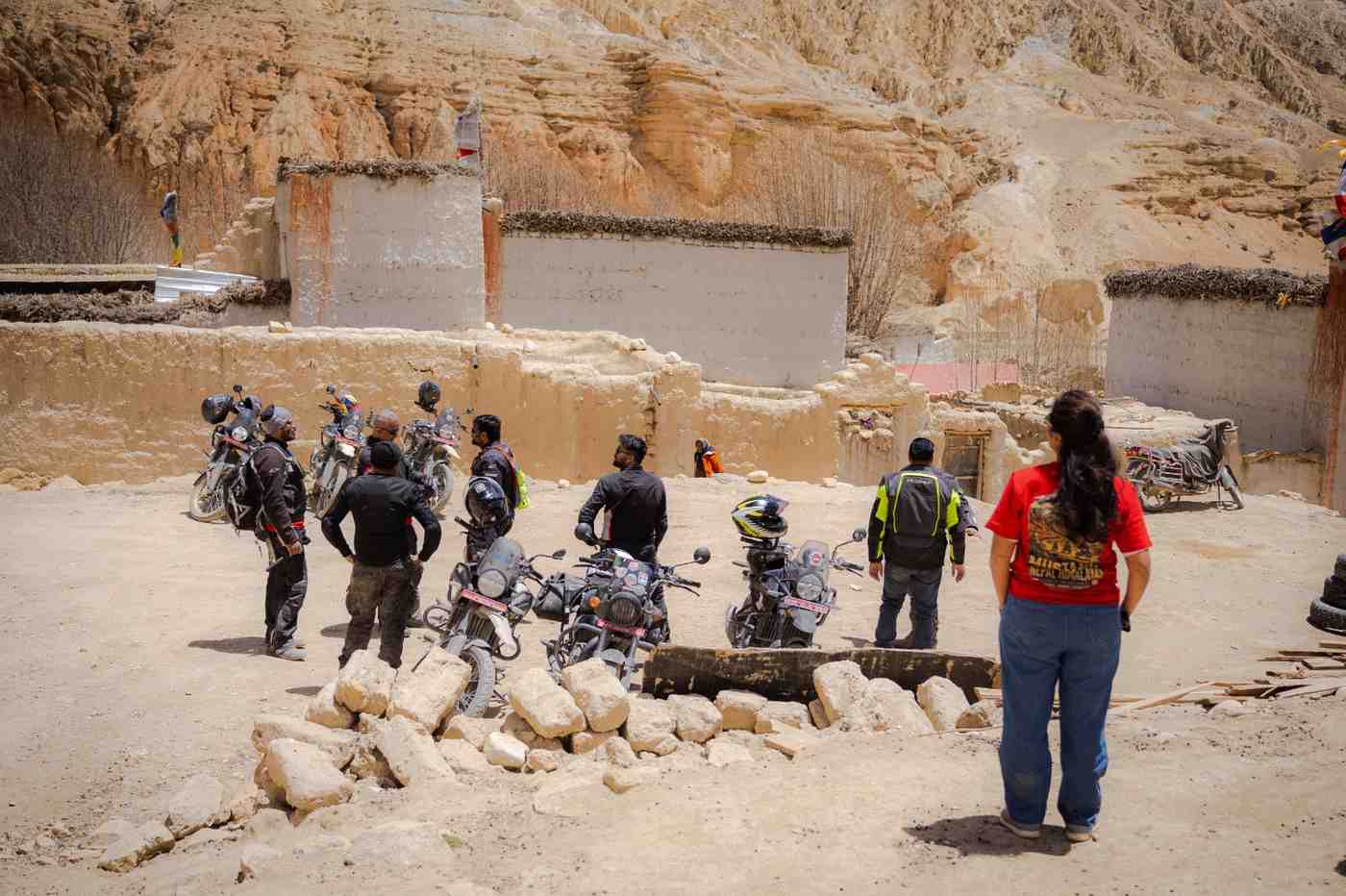
Upper Mustang requires: a Nepal entry visa for most nationalities, a TIMS card, an Annapurna Conservation Area permit, and the Restricted Area Permit costing USD 50/day. This permit must be processed through a registered Nepal Tourism Board agency, it cannot be self-arranged. The permit defines exactly where you can ride and for how long, and the checkpoint at Kagbeni enforces it without exception.
The motorcycle rental infrastructure for Upper Mustang is concentrated in Kathmandu and Pokhara, with established operators offering Royal Enfield Himalayans and other appropriate machines. Bringing your own motorcycle requires Carnet de Passage arrangements for Nepal and is navigable but adds a logistical layer. The riding infrastructure — fuel, accommodation, basic mechanical support is present along the main Mustang route but thins out above Kagbeni in ways that require advance planning of fuel range and accommodation booking.
International access is through Tribhuvan International Airport in Kathmandu, with ongoing service from major regional hubs and direct connections from some European cities. Flight prices vary significantly by season, and the May Tiji Festival period sees elevated demand on Kathmandu-bound routes.
Morocco
Morocco's desert south requires no special permits beyond a standard tourist visa for most nationalities, which is either not required or available on arrival for the majority of European, North American, and Antipodean passport holders. Bringing your own motorcycle is straightforward, Morocco accepts standard vehicle documents and is a well-established overland destination with a functional Carnet de Passage process for visitors who require it.
The motorcycle rental infrastructure in Morocco is less developed than Nepal's for adventure-specific machines, but Spanish and French rental companies operating cross-border tours are available, and Moroccan operators in Marrakech and Ouarzazate offer bikes appropriate for the Atlas and desert routes. The riding infrastructure, fuel availability, accommodation ranging from basic to luxury, mechanical support in most large towns — is generally more consistent and more predictable than Upper Mustang's equivalent, reflecting Morocco's longer history of managing adventure tourism at volume.
International access is through multiple Moroccan airports, with low-cost carrier connections from most European cities making Morocco significantly cheaper to reach from Europe than Nepal. For North American and Australian riders, Nepal's geographic position is the better starting point, with Morocco requiring an additional European routing.
Cost Comparison: What Each Actually Costs
The permit structure of Upper Mustang makes it significantly more expensive than Morocco for the restricted area days, but the comparison at total trip level is more nuanced.
A two-week Upper Mustang motorcycle tour including permits, motorcycle rental, accommodation, food, and guide support runs approximately USD 2,500–4,000 depending on the operator and accommodation standard chosen. The USD 50/day for Restricted Area Permit, making it proportionally more significant on shorter trips and less significant on longer ones.
A two-week Morocco desert motorcycle trip including flights from Europe, motorcycle rental, accommodation, food, and fuel runs approximately USD 2,000–3,500 depending on accommodation standard, rental specification, and whether a guide or organised tour is used. The absence of special permits reduces the fixed cost overhead, though Morocco's fuel costs and the logistics of the Saharan routes add variable costs that can approach Upper Mustang levels on ambitious itineraries.
The cost difference at the total level is smaller than the permit comparison alone suggests. Upper Mustang is more expensive, but not dramatically so for trips of two weeks or more when all costs are honestly compared.
Season: When Each Destination Is at Its Best
This comparison has a clearer winner than most others in this article.
Upper Mustang's riding window is effectively May through October, with May and October representing the quality peaks: pre-Monsoon stability and the Tiji Festival in May, post-Monsoon clarity and the best mountain visibility in October. The Monsoon months of June through August affect the Mustang approaches more than the rain shadow plateau itself, but flood risk on the lower route sections and unpredictable road conditions on the Kali Gandaki approaches make mid-Monsoon timing inadvisable for most riders.
Morocco's desert riding season is October through April, essentially the opposite of Upper Mustang's peak windows. Moroccan summer temperatures in the Saharan south exceed 45°C in July and August, making desert riding genuinely dangerous from heat exposure. The ideal Morocco riding conditions — cool clear days in the Saharan plain, manageable Atlas mountain temperatures, minimal rain risk — occur from October through March, with November through February representing the sweetest spot.
The practical implication for riders weighing the two destinations: they occupy almost entirely different calendar windows, which means the choice is often made by timing rather than preference. A rider with a May window should go to Upper Mustang. A rider with a November window should go to Morocco. Riders with genuine flexibility in both directions have the luxury of choosing on merit and on merit, this article argues that Upper Mustang edges Morocco for riders prioritising genuine off-road difficulty and cultural depth, while Morocco edges Upper Mustang for accessibility, forgiving terrain, and consistent riding conditions across the season.
The Honest Head-to-Head
|
Factor |
Upper Mustang |
Morocco Desert |
|
Off-road technical difficulty |
High — sustained, altitude-compounded |
Medium-High — graduated, learnable |
|
Cultural depth |
Extraordinary, permit-protected |
Rich and accessible |
|
Altitude factor |
Significant (3,500m–4,000m+) |
Minimal (Atlas 2,000m max) |
|
Permits and logistics |
Complex, USD 500+ restricted permit |
Simple, standard tourist entry |
|
Best riding season |
May, October |
October–March |
|
International access |
Moderate — Kathmandu hub |
Easy — multiple European low-cost routes |
|
Mechanical support |
Adequate on main route, thin above Kagbeni |
More consistent, better coverage |
|
Cost (2 weeks, all-in) |
USD 2,500–4,000 |
USD 2,000–3,500 |
|
Rider experience required |
Intermediate–Advanced |
Beginner–Advanced (route dependent) |
|
Accommodation range |
Basic–Comfortable |
Basic–Luxury |
|
Unique experience factor |
Exceptional |
High |
Which One Should You Do?
Do Upper Mustang if: you have genuine off-road riding experience on variable surfaces, you are comfortable managing altitude and its effects on performance and judgment, you have the permit budget and the patience for the logistics, and you are specifically drawn to the combination of extreme landscape and living cultural depth that its isolation has preserved. When it comes to motorcycle tour in Nepal, Upper Mustang is the harder trip, the more expensive trip, the more demanding trip logistically and it is also, for the right rider at the right moment, the more extraordinary one.
Do Morocco if: you are building off-road skills and want terrain that challenges you without punishing every error with altitude-compounded consequence, you are travelling from Europe and want a trip with lower logistical overhead and better seasonal flexibility, you want the Saharan landscape experience specifically — the dunes, the kasbahs, the ochre and terracotta of the Draa Valley, rather than the Himalayan plateau version of desert riding, or you want genuine off-road adventure with the option of escalating to the harder routes as your skills develop across the trip.
Do both, eventually, if you are serious about desert motorcycle adventure — because the two experiences are genuinely complementary rather than substitutable. A rider who has done Morocco's Saharan piste routes and then attempts Upper Mustang will find their Morocco training in sand and gravel technique useful, their experience of desert navigation relevant, and the altitude dimension of Upper Mustang genuinely new and specifically demanding. A rider who has done Upper Mustang and then attempts Morocco's desert south will find the relative accessibility and the lower altitude a relief, and the sand technique that Morocco specifically demands an entirely new challenge to develop.
They are both the best version of desert motorcycle adventure — in different registers, for different riders, at different moments in a riding life. The question is not which is objectively better. The question is which is better for you, right now, with the skills and time and budget you currently have. Answer that honestly, and the comparison resolves itself.