The question comes up on every serious Nepal motorcycle tour planning thread. Someone asks whether a support vehicle is necessary, and the answers split immediately between riders who say it is essential and riders who say it is dead weight that kills the freedom the trip is supposed to deliver. Both groups have a point, and neither gives you the full picture.
This article covers the honest answer, which is that it depends on your route, your group, your mechanical confidence, and what you are actually trying to get out of the trip. It also covers what a support vehicle actually does on a Nepal motorcycle tour, what it costs, what you lose by having one, and where the line sits between a sensible precaution and an unnecessary expense.
What a Support Vehicle Actually Does
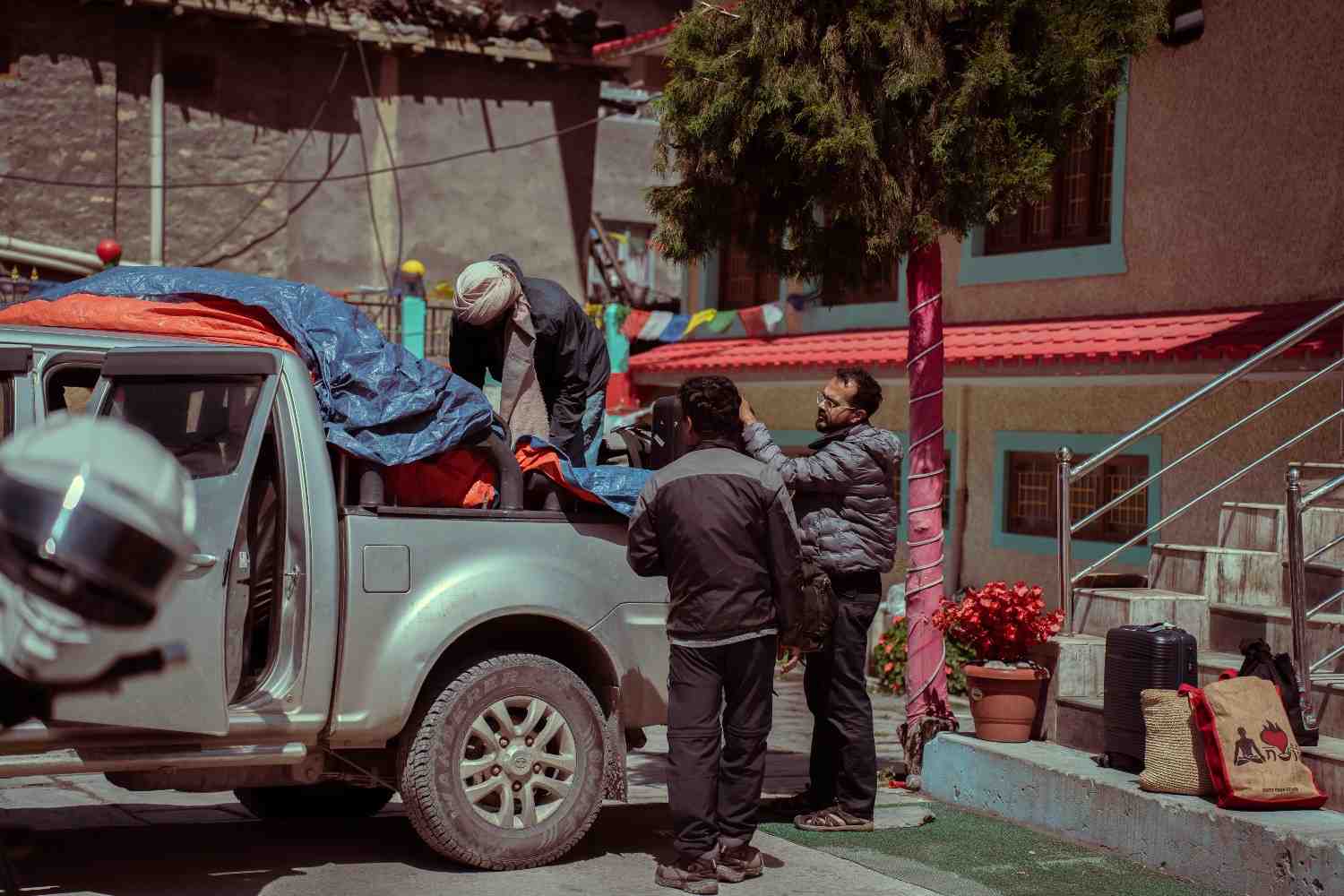
Before the decision, the basics. A support vehicle on a Nepal motorcycle tour is typically a 4WD jeep, a Mahindra Bolero, Toyota Hilux or a similar high-clearance vehicle that travels the same route as the riding group, carrying spare parts, luggage, a mechanic or guide, emergency supplies, and in some cases a rider who cannot continue on the bike due to injury or illness.
On paper that sounds like a safety net. In practice it is several different things depending on the route and the situation.
On a straightforward circuit like the Kathmandu to Pokhara corridor or the Annapurna foothills approaches, a support vehicle is largely redundant. The road infrastructure is functional, mechanical support exists in towns along the route, accommodation is bookable without someone running ahead to hold rooms, and a breakdown is an inconvenience rather than a crisis.
On a route like Upper Mustang, the Manaslu Circuit, or the Karnali zone roads of far western Nepal, the same vehicle becomes a different proposition entirely. The distance between any form of reliable help extends considerably. A mechanical failure above Kagbeni on the way to Lo Manthang is not the kind of problem you solve by calling a roadside assistance number. A rider who takes a fall and cannot continue needs transport that the next passing jeep may not be able to provide on any predictable schedule. Luggage that does not need to be strapped to a loaded bike in river crossings arrives in better condition and with less risk to the rider's balance on technical sections.
The support vehicle question is really several different questions bundled into one, and it is worth separating them.
The Mechanical Case: When Distance Changes the Calculation
Nepal's motorcycle touring infrastructure is better than most riders expect before their first trip and thinner than they remember when something actually goes wrong in a remote location.
On the main routes, the Royal Enfield mechanic network that threads through Nepal's mountain towns is genuinely useful. Jomsom has mechanics. Beni has mechanics. Tatopani has mechanics. The towns along the Prithvi Highway and the Siddhartha Highway have mechanics at intervals that make a breakdown manageable rather than catastrophic.
Above Kagbeni the calculation changes. The track toward Lo Manthang runs through Chuksang, Ghami, Charang, and then the plateau to Lo Manthang itself. These are villages with guesthouses and basic supplies. They are not towns with motorcycle workshops. A snapped clutch cable, a punctured tyre, a broken brake lever, a seized chain, any one of these turns into a logistics problem whose solution depends entirely on whether you are carrying the parts and the knowledge to fix it yourself, or whether there is a vehicle on the same route that carries a more comprehensive kit.
A rider who is mechanically confident and carries a proper toolkit with the specific spare parts their machine is most likely to need, clutch and brake levers, a full tyre repair kit, spare cables, a multimeter for electrical faults, chain links and masterlinks, can manage most common failures independently. A rider who is not at that level, or whose kit is light because the luggage was already pushing the limit, finds the same failure a significantly more serious situation.
The support vehicle is, from the mechanical perspective, a mobile workshop and parts store. It carries what the bikes cannot. On remote routes where that gap between problem and solution is measured in days rather than hours, the question of whether it is worth paying for answers itself.
The Logistics Case: What a Support Vehicle Changes About the Riding
Beyond mechanical emergencies, a support vehicle changes the daily logistics of a Nepal motorcycle tour in ways that are easy to undervalue before the trip and very clear during it.
Luggage is the most immediate difference. A loaded motorcycle on Nepal's technical terrain is a different machine from an unloaded one. The weight distribution changes, the handling on loose gravel changes, the confidence at river crossings changes, and the physical effort required over a full day's riding changes substantially. Riders who have ridden loaded across the Kali Gandaki gorge tracks and then ridden the same section unloaded describe the difference in handling confidence as significant enough to change what sections they were willing to attempt.
A support vehicle carries the bags. The riders carry a day pack, their documents, and their riding kit. The bike handles as close to its standard weight as the fuel load allows. On a route that includes river crossings, loose gravel sections, and the kind of technical terrain that punishes a misjudged line, this matters.
Accommodation logistics are the second difference. On popular Nepal routes during October and May, guesthouses along the circuit fill quickly. A support vehicle with a guide who drives ahead in the afternoon can confirm rooms at the next stop before the riding group arrives. This is not a luxury on routes where the alternative accommodation is the next village another hour of riding away. It is a practical solution to a real problem that independent riders encounter regularly during peak season.
The third logistics difference is medical. A rider who develops significant altitude symptoms above 3,000 metres needs to descend. On a motorcycle, descending means riding, which is not always possible when the symptoms are severe enough to matter. In a support vehicle, the same rider descends in a seat while someone else manages the bike. This does not come up on every tour. When it does come up, it comes up without warning, and the absence of an alternative can end a trip or create a situation that is genuinely dangerous.
The Freedom Case: What You Give Up With a Support Vehicle
The honest comparison requires giving the other side its proper weight, because riders who dislike support vehicles are not simply being stubborn.
A support vehicle changes the character of a Nepal motorcycle tour in ways that matter to a specific kind of rider. The self-sufficiency of a well-prepared independent motorcycle tour, the knowledge that everything you need is either on the bike or in your toolkit, the decision-making freedom that comes from not needing to coordinate with a vehicle that can only go where the road goes, and the quality of encounter with the landscape and its people that comes from moving at the motorcycle's pace rather than the logistical pace of a group with a support vehicle, these are real parts of what adventure motorcycle travel delivers, and a support vehicle reduces all of them to some degree.
For experienced riders on their second or third Nepal tour, who have done the standard circuits and are attempting something more remote and more technical, the self-sufficiency model with a comprehensive toolkit and genuine mechanical confidence is not reckless. It is the appropriate expression of earned capability in a demanding environment.
For a first-time Nepal rider, a group with mixed skill levels, anyone attempting Upper Mustang or other restricted area routes for the first time, or a group whose motorcycle mechanical knowledge collectively amounts to being able to check the oil level, the freedom argument for going without a support vehicle is less persuasive than it sounds.
The Cost Question
A support vehicle on a Nepal motorcycle tour adds cost in two ways. The direct cost of the vehicle itself, typically a daily hire rate for a 4WD jeep plus driver plus fuel, runs approximately NPR 8,000 to NPR 15,000 per day depending on the vehicle, the route, and the operator. Across a ten-day Upper Mustang motorbike tour that adds NPR 80,000 to NPR 150,000 to the trip cost, which spreads across a group of four riders works out to NPR 20,000 to NPR 37,500 per person, roughly USD 150 to USD 280 each.
The indirect cost is the accommodation and food for the driver and guide travelling with the vehicle, which an established operator typically included in the vehicle hire rate rather than charging separately.
Against that cost, consider what the support vehicle replaces. A rider who breaks down on the Mustang track without a support vehicle and needs to arrange transport for the bike to Jomsom for repair faces a cost that can approach or exceed the cost of the support vehicle for the entire trip, plus the lost riding days. A rider who develops altitude symptoms above 3,500 metres and needs to descend faces the same calculation.
The support vehicle does not prevent these situations. It prevents them from becoming the kind of situation that ends a trip or, in the worst cases, becomes significantly more serious than a trip interruption.
Routes Where a Support Vehicle Makes Clear Sense
Upper Mustang: The distance between reliable mechanical support, the altitude, the river crossings, and the remoteness of the plateau above Kagbeni make a support vehicle the sensible choice for all but the most mechanically experienced and self-sufficient riders.
Manaslu Circuit and Tsum Valley: The technical single-track sections, the distance from any town with motorcycle support, and the restricted area logistics make this the Nepal route where the case for a support vehicle is strongest of all.
Dolpo and far western Nepal: The Karnali zone roads and the approaches to Rara Lake and the Dolpo circuit are the routes where support infrastructure is thinnest relative to the distances involved. A support vehicle here is not optional for most touring groups.
First-time Nepal riders on any route: The unfamiliarity with the road culture, the altitude effects on judgment, and the distance from home infrastructure make a first Nepal tour the moment where mechanical and logistical backup earns its cost most clearly.
Routes Where You Can Reasonably Go Without
Kathmandu to Pokhara corridor: Mechanical support is available at regular intervals. The road is paved for the majority of the distance. Accommodation is plentiful. A well-prepared rider with a solid toolkit can manage this route independently without meaningful risk increase.
Pokhara and Annapurna foothills: The lower Annapurna approaches, the roads around Pokhara, and the mid-hill circuits within a day's riding of the city are well-served enough by the existing infrastructure that a support vehicle adds cost without a proportional increase in safety or convenience.
Experienced riders on familiar routes: A rider who has done Upper Mustang twice, who carries a comprehensive toolkit, who has managed roadside repairs on previous Nepal tours, and who is riding with others of similar experience is in a different position from a first-time visitor. The support vehicle adds less for this rider because they have already developed what the support vehicle would otherwise provide.
What Nepal Moto Tours Does and Why
Nepal Moto Tours includes a support vehicle on all Upper Mustang circuits and on any route that goes into restricted area or remote terrain for a specific reason: the combination of altitude, technical road conditions, and the genuine distance from mechanical and medical support on these routes makes it the responsible default rather than an optional add-on.
On more accessible circuits, the support vehicle option is discussed with each group based on the route, the group's mechanical confidence, and the time of year. A group of experienced riders doing the Kathmandu-Pokhara corridor in October does not need the same support as a mixed-experience group attempting the Manaslu Circuit in May.
The decision is always honest. Where the route and the group's profile make a support vehicle necessary for safe, enjoyable riding, that is stated directly. Where it is genuinely optional, that is stated equally directly. The goal is a trip that delivers the riding the group came for, not a trip that sells them equipment they do not need or sends them into terrain without the backup the terrain requires.
The Honest Answer
A support vehicle on a Nepal motorcycle tour is not a universal answer to a universal question. It is the right answer for some routes, some rider profiles, and some group compositions, and the wrong answer, or at least an unnecessary expense, for others.
The routes where it makes clear sense are the remote and restricted ones. Upper Mustang, Manaslu, Dolpo, far western Nepal. The first Nepal tour regardless of route. Any group whose mechanical confidence is limited relative to the terrain they are attempting.
The routes where it is genuinely optional are the main corridors, the Annapurna foothills, and any circuit well-served by the existing infrastructure along the route.
The middle ground, which covers most Nepal motorcycle tours by volume, is where honest assessment of your group's mechanical capability, your route's support infrastructure, and your tolerance for the kind of situation a breakdown or a medical issue creates in a remote location gives you the answer that maps to your actual trip rather than a general rule.
If you are unsure which category your planned route and group fall into, the question to ask your operator is not whether a support vehicle is available, but what specifically happens if one of the bikes has a significant mechanical failure at the furthest point from any town on your route, and how long the resolution takes with and without the vehicle. The answer to that question usually settles the decision.